Can One Giant Project Change the Narrative Around Downtown Los Angeles?
The city is about to find out with the 7.6-acre Fourth & Central, which is likely to broadly expand the area’s residential base
By Patrick Sisson July 14, 2026 4:15 pm
reprints

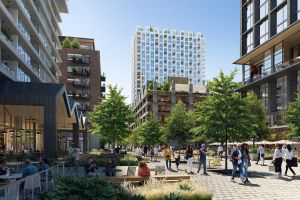
Unveiled in 2021, the Rauch family’s $2 billion Fourth & Central megadevelopment in Los Angeles’ downtown finally earned City Council approval on June 30.
It would be easy to cite the five-year delay, including environmental reviews and numerous redesigns, as another sign of the city’s sclerotic development process. But, in important ways, the approval of the 7.6-acre multi-use mix of 1,589 residences, offices and retail came at just the right time.
With institutional sentiment around Los Angeles waning and a former candidate for mayor, reality TV personality Spencer Pratt, making the “downtown is a hellscape” argument core to his pitch to voters, getting a green light for such a significant project injects much-needed optimism into the development market, especially downtown.
“It really signals that Downtown L.A. is not going anywhere,” said Jessica Lall, Downtown L.A. managing director for CBRE. “We still have big projects that are moving forward despite the challenges we currently face. I see it as a critical anchor in an important part of Los Angeles.”
Lall added that the project has become a key part of the pitch deck for any downtown concepts. Had it not been approved, it would have affirmed fears that the city isn’t open for business and not open to transformative visions. But, perhaps with a bottom reached in terms of pricing and property valuations, Fourth & Central further opens the door to creative development and redevelopment.
“The value of this approval is informational, not transactional,” said Marco Chung, a senior market intelligence analyst at Avison Young. “The market already knew downtown land was cheap.”
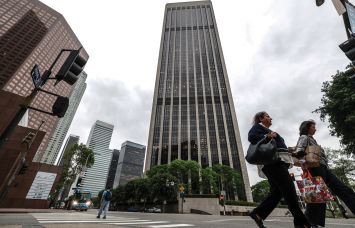
Sale comps have said so for years, Chung added. Bank of America Plaza traded at near $150 per square foot earlier this year, while the Aon Center transacted at roughly $130 per square foot — steep cuts from the pre-pandemic neighborhood average of $450 per square foot.
Entitlement risk was holding back development, argues Chung, and the City Council’s unanimous approval of Fourth & Central retired that variable.
“It is a live demonstration that the city will let density move at scale in the district where sponsors most doubted it,” he said. “That repositions the entitlement assumption under every eastern-edge site at once.”
Chung was careful to note this momentum applied to housing, and not necessarily office, which has its own issues and capital pool. But, with Downtown L.A.’s growing residential population — currently just above 90,000 — and a desire for more foot traffic to help retail and office properties, the new investment of Fourth & Central sends a positive message to nearby owners, especially on the cusp of mega-events like the World Cup and Olympics.
The new collection of 10 buildings — the Rauch family will relocate their decades-old cold-storage buildings elsewhere in the region — will bridge the gap between neighborhoods, with nearly one in seven units planned as affordable.
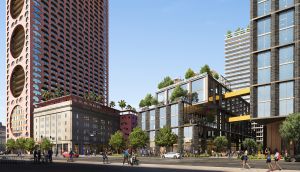
“We have literally spent years working on our plan to transform this industrial property into a mixed-use community,” Larry Rauch, president of Los Angeles Cold Storage, said in a statement after the Fourth & Central was approved. “To hear our city’s decision-makers agree with our vision for what Downtown Los Angeles can and should be makes today’s major milestone all the more rewarding.
“We are big believers in the potential of our city, and that’s why we have chosen to make this substantive investment in its future.”
The approval of Fourth & Central is also indicative of better downtown development policy. The city’s Downtown 2040 Plan has helped increase the portion of downtown that allows by-right development from about 30 percent to 60 percent, helping speed up long entitlement processes. Add that to SB 79, the recently approved state law that increases density bonuses for transit-oriented development and which covers a decent portion of downtown, and developers now have opportunities to do bigger, quicker projects.
Kelly Farrell, managing director of Gensler’s Los Angeles office, said that while by-right development alone won’t help potential developments clear every hurdle when it comes to approvals, it’s a “really compelling move” that will help projects move forward. Factor in the city’s updated Adaptive Reuse Ordinance, which offers incentives to projects built as recently as 2011, and there’s suddenly a lot more potential in redeveloping downtown’s aged stock of buildings.
It’s not the only sign of new life downtown. Developers Jamison and Kennedy Wilson, as part of a new 15-project, 4,000-unit office-to-residential push in Los Angeles, plan to spend $200 million transforming the L.A. World Trade Center on Figueroa Street into 512 units, with affordable apartments starting at roughly $1,000 a month. Multifamily developer Jamison Services also announced plans in January to convert the 33-story Health Plan Tower on Seventh Street into nearly 700 residential units.
These developments only further downtown’s long-in-the-works tilt towards housing. Nella McOsker, president and CEO of the Central City Association of Los Angeles, which supported the project, said that it’s another example of downtown becoming a center for residential activity. Downtown contributed 25 percent of Los Angeles county’s main housing stock between 2010 to 2025.
“The population downtown is now pushing 90,000, which is about the population of Santa Monica,” said McOsker. “This project is so important to downtown’s future because it’s another reminder we can get back to residential growth here.”
Along with the $2.7 billion convention center commitment unveiled by the city, the Fourth & Central project sends a great signal to hotels and businesses downtown that there will be more residents, events, and development that they will benefit from, added Farrell. Adding more homes, businesses and cultural institutions, as well as developments and placemaking that start connecting neighborhoods and making them more walkable, and you begin to see “the roadmap for how downtown knits itself together,” said Farrell.
Fourth & Central will break ground in roughly two years with extensive public space such as paseos, plazas and parks to help with the discontinuity issue that has always plagued Downtown Los Angeles, an area made up of numerous neighborhoods that remain poorly stitched together.
Developers also scaled back some elements, including shrinking the residential tower from 44 to 30 stories and eliminating a proposed hotel, in part to calm gentrification fear from local residents. By replacing nearly 8 acres of cold storage, warehouses and parking lots with thousands of homes and new businesses, the development better knits together Little Tokyo, the Arts District and Skid Row.
Chung calls it “a missing tooth in the middle of the mouth.”
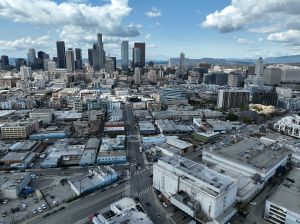
He expects land trades, entitlement filings, and activity should pick up fairly soon due to the approval. The eastern edge of the development has created an ideal situation for making residential development pencil, including cheap land, proof that you can entitle at scale. And there will be places to go nearby, including the forthcoming park under the Sixth Street Viaduct, the Bjarke Ingels-designed tower complex near the Leonard Hill Arts Plaza, a proposed Los Angeles River bike path extension, and a future Metro stop at Sixth Street.
This project and the residential shift downtown alter the market calculus, with office becoming more of a byproduct. While office sales and leasing have been improving recently, especially from private investors, downtown still has space to recover after being one of the markets to be hit the hardest during the pandemic..
But investors have seen that residential and mixed-use underwriting in DTLA gets validation, said Chung, while speculative ground-up office development moves from marginal to essentially unfinanceable.
“I think there’s some wrongly placed kind of doom and gloom about Downtown L.A. and maybe downtowns everywhere,” said McOsker. “But Downtown L.A. is really unique in the massive growth that’s experienced in the residential market.”
Downtown still faces significant challenges, including hemorrhaging property values and a relatively soft commercial real estate market, with more than 30 percent office availability and below-average rental rates, per Savills research. Whether it’s a fair symbol or not, the empty, graffiti-covered Oceanwide Plaza tower remains after more than six years a sign of inaction and stagnation. Office workers have not fully returned, and the nexus of the office market has long since moved west to areas like Century City. Decades of failed policies around the unhoused and homelessness continue to vex local leaders and advocates, challenging efforts to create a more vibrant, walkable downtown.
But this Rauch family development constitutes a significant sign that there remains more potential here than many give it credit.
“For a generation, downtown meant the office tower, and everything else was ancillary,” said Chung. “Fourth & Central and the office-to-residential conversion wave are the same trade run from opposite ends: one subtracts obsolete office, the other adds housing, and both point at a downtown organized around a resident base for the first time in its modern history.”