

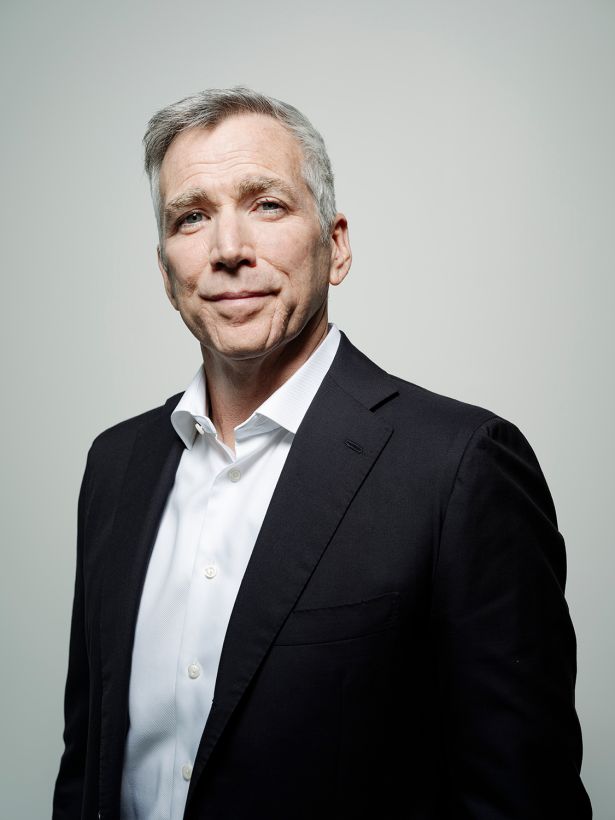
Realterm CEO Bob Fordi Is Transforming the IOS Business
Over the past 20 years, Fordi has forged Realterm into a $14 billion industrial logistics behemoth
By Brian Pascus June 8, 2026 6:30 am
reprints
For most companies, the period of COVID-19 — roughly 2020 to 2022 — was considered nothing short of catastrophic, as the global pandemic presented an existential threat to business plans, underwriting assumptions and, of course, tens of millions of lives.
But for Bob Fordi, CEO of Realterm, the multinational transportation and logistics real estate investment firm headquartered in Annapolis, Md., the early 2020s, and subsequent years, have been a period of unprecedented growth and resounding success.
Since being promoted to CEO of Realterm in 2019 — and precisely 20 years after he joined the firm as one of its first 12 employees — Fordi, 58, has overseen an aggressive acquisitions, recapitalization and investment strategy that has helped Realterm triple its assets from $4.5 billion to $14 billion, and has seen the firm establish footprints in Amsterdam, Singapore, Australia and, in the coming months, Japan.
Not bad for a firm that began in the early 1990s under the auspices of co-founders Kenneth Code and John Cammett, a pair of real estate hands who saw their office development ambitions thwarted by the savings and loan crisis, but found new life, and lucrative private equity partnerships, in what was the nascent, pre-internet transportation industrial space.
“Before Bob, Realterm was once a small little firm in Annapolis,” said Michael Caprile, former vice chairman of CBRE. “Two senior partners founded it, one came from Canada, and they had ideas to grow the company, but Bob has taken it to another universe.”
Since 1991, Realterm’s bread and butter has been transportation logistics, primarily air cargo facilities across the U.S., and truck terminals, where the firm essentially inaugurated development of the industrial outdoor storage (IOS) space before it became a recognized asset class in the 2020s. Today Realterm is seen as the market leader in supportive logistics for terminals, warehouses, fuel stations and truck parking.
“We have been investing in what the markets call IOS for 35 years,” said Peter Lesburg, managing director and global head of capital markets at Realterm.
“We didn’t create that acronym,” he continued, “but we have always referred to what we build and buy as ‘HFT real estate,’ buildings with ‘high flow-through’ characteristics and IOS functionality — our buildings are purpose-built to move, not store, freight.”
Fun fact: The firm is North America’s largest IOS owner by volume, with a $7.5 billion portfolio.
Then there’s Realterm’s $2.5 billion air cargo business, with 150 assets and footholds in 38 airports across North America, including all the major gateway cities, as the firm controls lucrative ground leases for numerous air cargo terminals and also invests in new construction of those same assets.
Last year, in partnership with the Port Authority of New York and New Jersey, Realterm developed a 350,000-square-foot cargo-handling terminal at JFK International Airport. The $270 million development was the airport’s first new air cargo facility in 25 years.
To Fordi, these assets give his firm a foundational grip on transportation logistics, or what he calls “the global backbone of the modern economy,” vis-a-vis their connectivity to mission-critical elements of commerce, industrial development, travel and numerous supply chains.
“We view ourselves as experts in transportation,” Fordi told Commercial Observer. “When you think about the growth of our business and our business plan, it’s really to service this voracious need that the transportation companies have. And transportation is 8 percent of global GDP, $9 trillion per year of spending, so it’s a massive use of real assets.”
Realterm’s total portfolio includes more than 500 real assets and in excess of 1,000 leases, with numerous team members devoted to organizing and overseeing the day-to-day function of the air cargo and truck terminals.
“Property management’s a big part of our business,” said Fordi. “We view that as a competitive advantage because we’re able to really see what’s going on in all of our facilities. … We are having regular conversations with all of our operators every day.”
As CEO and chief investment officer, Fordi oversees 272 employees in 15 offices, mostly in the United States and Canada, but the firm has 40 professionals in Amsterdam and other offices sprinkled around the Pacific and Indian oceans. Under his leadership, the firm has also transitioned into private credit, launching its inaugural U.S. Logistics Credit Fund (RLCF) in September 2025 with $350 million in fresh capital commitments.
“Debt was the natural next step for us, because we also had counterparties, or customers, who weren’t interested in the purchase of an asset or development of an asset — they were interested in financing that asset,” said Fordi.
The firm’s fundraising prowess stretches across the Atlantic. Last year Realterm closed an approximately $547 million pan-European logistics fund (RELF II), giving the firm a $1.16 billion-plus portfolio in Europe despite entering the continental market only five years ago.
“People realize, not only do they understand the freight and IOS business better than anybody, but these guys were way ahead by a decade or so in understanding this business,” said Caprile. “They’re looked at in the financial markets as the premier dominant force in these different segments and it’s all under Bob’s leadership.”
Growth story
To hear it from one of their founding partners, Realterm wasn’t always an international juggernaut, and its leading place in the marketplace was by no means inevitable.
When Ken Code and Jon Cammett began working together in the early 1990s, they found themselves shut out of the few office developments that commercial banks were willing to finance, but they came to understand that outdoor industrial real estate, which seemed to be the only door open to them, had its own unique benefits.
For one, the asset class had little to no speculative development, so supply and demand remained in balance, and the mission-critical qualities of the assets performed well, even through a devastating early-decade real estate recession that began in the late 1980s and stretched into 1993.
“We fell backward into industrial deals, and over the course of a couple of years, we came to understand they performed when nothing else was performing,” said Code. “They were industrial assets that moved goods, rather than stored goods, and it was an insight lost on the larger real estate industry at the time.”
After starting small with first-mortgage and second-mortgage seller financings, Code and Cammett began leveraging their transportation real estate expertise into joint venture partnerships with private equity firms, namely AEW Capital Management. They worked as operators and property managers during the 1990s and early 2000s, and invested equity to help build out these large portfolios of air cargo and truck terminals assets before seeing them recapitalized at increased values under the private equity know-how.
Around this time, circa 1999, Fordi was hired.

After securing a master’s in real estate from John Hopkins University, the New Jersey native had spent several years at Arthur Andersen in Washington, D.C., focusing on consulting and determining the accurate valuation of real estate assets. A headhunter viewed Fordi’s numbers skills as a good fit for Realterm, which needed an investment expert to help manage the firm’s multiple joint-venture portfolios, and quickly arranged a marriage.
“They had done a small acquisition of an air cargo portfolio, and needed someone to come in to effectively build a back office —- not the operational back office, but the underwriting function, help the investments side, and put a property management group together,” recalled Fordi. “I was targeted to do that as a mid-level employee.”
In these years, Realterm’s business was bifurcated: North American Truck Terminals (NAT) handled the IOS side of things, while Aeroterm specialized in air cargo. Moreover, the firm’s private equity partners had pooled their shared portfolio of transportation assets into several closed-end funds that were sold to CalPERs Global Logistics in 2005, which retained Realterm to manage numerous complex transportation assets.
“We came into the U.S. as joint-venture sharpshooters, so we were the operators and the capital behind us were these two private equity firms,” explained Lesburg. “But we were kept on by CalPERS as the property manager because we know what we’re doing.”
By now, Realterm had moved from being the younger brother in joint ventures with private equity firms to serving as the main investment partner with CalPERs and Lasalle Investment Management.
But, following the 2008 Global Financial Crisis, Realterm’s C-suite realized that as lucrative as the multiple recapitalizations of the private equity portfolios had been, the firm itself still didn’t control its own destiny, as all its real estate exclusivity was locked up behind CalPERS. To protect the firm, and eventually expand, Realterm’s management knew they needed to manage and finance their own transportation real estate portfolios through discretionary capital obtained by internal fundraising. In short, they needed to become a private equity firm themselves.
“We decided in 2010 that we were being intermediated for no good reason,” said Fordi. “So we started to raise our own funds, where we were the sponsor, and really turned ourselves into an asset management platform, as opposed to really just a joint venture deal shop, and that’s continued since 2010.”
Luck helped, too. CalPERs’ investment manager, GI Partners, made a strategic error by siding with the rail-focused assets in the overall portfolio. It put an $850 million tranche of the air and truck assets up for auction, one that was a roll-up of Realterm’s previous air and cargo acquisitions from the 1990s that had been recapitalized multiple times since and grown in value.
“We formed an open-ended fund to participate in that auction, which we subsequently won,” said Lesburg. “Fast forward to today, and this is by far the largest third party-owned portfolio of airport infrastructure assets in North America.”
Unlike GI Partners, Realterm’s executives believed in a core investment thesis that proved overwhelmingly true: airports are important, and air cargo is essential to the movement of goods and services. Safe to say, during the pandemic, when most passenger flights were canceled but planes retained the loads of bulk cargo, Realterm’s bottom line flourished.
Today, Realterm’s private fund and portfolio strategy is the heart of its business. The firm manages more than $10 billion of portfolio assets through multiple logistics-oriented private equity funds, either open-ended or closed-ended, targeting the asset classes it has specialized in for three decades.
“I give Bob a ton of credit for taking a business that was highly entrepreneurial and looking at the repetitive opportunities, or the core activity in it, and focusing with incredible dedication on those elements,” said Code. “A lot of Bob’s efforts went into taking the business plan forward, but while being very, very disciplined about not looking at extraneous opportunities.”
A $50 billion firm?
Now that Fordi has established Realterm as the market leader in transportation logistics real estate, he must lean into the foundations he’s created to prepare Realterm for its next 35 years.
Fordi knows that air cargo will remain the cornerstone of Realterm’s operations. For these commercial real estate sites, the assets that Realterm owns store and haul everything from iPads and personal computers to pharmaceuticals and imported flowers, and are locked in place under long-term ground leases whose tenants include UPS, FedEx, and DHL Global Forwarding. Most importantly, across America, many of the airports where Realterm has a footprint are in desperate need of capital improvements.
“There’s been an under-investment in air cargo facilities,” said Fordi. “And, so, when there are opportunities to put in more modernized facilities, we’ve been able to be involved in those projects.”
His next order of business will be to ensure Realterm retains its iron grip on the IOS sector, which has attracted a boatload of competitors in recent years, notably Zenith Industrial Outdoor Storage and J.P. Morgan Asset Management, as well as Alterra IOS.
“A lot of groups that are doing it now are in the $3 million to $10 million range on deal sizes,” said Fordi. “We’re more like in the $15 million to $30 million range, we have $200 million in assets, so … it’s a bit of a different mismatch.”
Then there’s the most novel aspect of Fordi’s tenure as CEO: the growth of the firm’s credit vehicles. Realterm began lending only in January 2025 with a $70.8 million loan to Greenpoint to acquire eight industrial outdoor storage properties on more than 163 acres across five states. A year later, in February 2026, the firm originated a $300 million credit facility to Greenpoint so it could acquire a six-property infrastructure portfolio.
“Our customer’s job is to move stuff around, not to really be thinking about their real estate portfolio,” said Fordi. “And, so, what we try to do is build the relationship and understand their business well enough, in the context of the larger market, to be a true value-add for them.”
With offices on five continents (Realterm opened an India office in 2007), those who have helped build its business with Fordi expect nothing but further growth, both in terms of physical footprints and the number listed in assets under management. It’s an optimism founded largely on the track record he’s generated over the last seven years.
“Pre-COVID, we were probably $4.5 billion in assets, and coming out of COVID, we’re $10 billion,” said Lesburg. “Bob drove us there. He just took what was a difficult time and used it as an opportunity to gain market share and grow and optimize the business.”
Co-founder Code said Realterm has “a tremendous opportunity” to move up a level.
“All the cylinders we mentioned earlier [credit vehicles, international expansion, IOS] are poised for continuous growth or new initiatives, so we feel we have a tremendous opportunity for the team to succeed,” he said. “Bob is a tremendous leader. He’s a communicator of the highest order.”
As for Fordi, he is not one to disagree with these optimistic assumptions, especially when he’s the one driving the charge.
“We see ourselves continuing to fill out and go from being a $14 billion asset manager to being a $30 billion, a $50 billion, and even a $100 billion asset manager based on the market opportunity that we find centered only on real assets in the transportation space,” he said. “No one else really focuses on it in the way that we do.”
Brian Pascus can be reached at bpascus@commercialobserver.com.


