Post Brothers President Matthew Pestronk On D.C.’s $750M Office Conversion
It’s the largest such project in the U.S. outside of New York City
By Greg Cornfield June 18, 2026 4:05 pm
reprints
One of the markets that has struggled the most with office real estate’s long post-pandemic correction happens to be home to one of the nation’s biggest conversion projects.
Construction is underway on the Geneva, a $750 million project to turn a Class C office building in Washington, D.C., into a 532-unit multifamily complex with 61 affordable apartments and 57,000 square feet of retail. It’s the largest office-to-residential conversion ever in D.C., and bigger than any current project of its kind outside of New York.
Post Brothers, the Philadelphia-based development firm running the show, recently secured a $575 million financing package, led by a record $465 million Commercial Property Assessed Clean Energy (C-PACE) loan from Nuveen Green Capital, and a $110 million senior loan from Mavik Capital.
Residents will start moving in next year.
Commercial Observer spoke with Matthew Pestronk, co-founder and president of Post Brothers, about how the Geneva penciled, how the financing came together, and what cities get right and wrong about conversions.
This conversation has been edited for length and clarity.
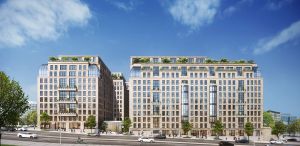
Commercial Observer: Can you tell me about the Geneva, which is being described as the biggest office-to-resi project in D.C. history?
Matthew Pestronk: It’s a lot more than that. It’s going to be the single most valuable piece of real estate in Washington, D.C., probably. It’s the best location anyone’s been able to build a rental apartment building anywhere in the United States, maybe in my career.
It was previously encumbered by a Class C office building with a lot of long-term leases, and the neighborhood surrounding it was $5 million to $20 million houses, and there’s very rarely any residential properties available for large-scale development in a neighborhood like that.
Can you talk about what made this particular building of this size work when so many office conversions don’t work?
I think all office conversions start with just the legal ability to put a residential property where there’s a commercial property. Not all cities have that. A lot do. Some are easier, some are harder.
Then the other big obstacle is, the encumbrances of a building’s long-term leases — if those exist, it doesn’t really matter how well located the building is, or the floor, or the zoning, or the shape of the floor plate. If there are tenants that want to stay, it’s very, very hard to convert an office building where there’s a mix of office and residential uses on the upper floors.
What was the occupancy rate at the Geneva at the time you were embarking on the conversion?
When we were evaluating buying the building, the building had WeWork, it was not particularly well occupied, the market rents were probably in the mid-$40s per square foot per year, which is average, and remains average for Class C buildings in Washington.
Washington does have pretty high rents for all office. However, it was basically, for all intents and purposes, an upgraded version of what had been delivered in the early `60s. The building was about 60 years old when we bought it in 2022.
You’ve got this landmark financing package now. What’s the status of the Geneva? Where do things sit, and how’s everything going?
We’re under construction. We have three tower cranes that sit high above downtown that we’re using to transport things, adding floors to the building, and taking things off the existing building.
Can you talk about how the capital stack came together, and what it says about conversion financing?
I think financing these projects is no different than financing any other residential project. I think C-PACE is particularly relevant because it’s meant to provide incentives for new construction energy retrofits, and all different kinds of things, so it’s well designed.
The lenders who provide C-PACE financing are by definition construction lenders, so that’s what they’re open for business for. We had a variety of options that worked to develop the building from a financing perspective. The C-PACE financing was very attractive because it has a long-term, fixed-rate component that takes some interest rate risk away after you deliver the building.
I would say that the financing came together in a very advantageous way after Washington, as a whole, had kind of been out of favor with lenders because of the perception of DOGE sort of destroying the local economy. Washington’s economy is definitely in a little bit of a recession right now.
I think for a lot of 2025, lenders and all investors were a little scared of the market. I think you’re starting to see a fair amount of new construction starts, and investor interest in buying office buildings that are staying office. There will be a fairly significant amount of office buildings that become something else, but they’re really the bottom of the stock.
If investors are not as wary anymore, and cities like D.C. are pushing incentives for office-to-resi conversions, are you seeing more widespread acceptance, and are you seeing the market change because of this?
Most major cities have put some kind of incentive around redeveloping office space that’s just had a massive decline in its assessed values. Office buildings that are now worth a quarter or less of what they were once worth are paying a lot less real estate taxes.
And, despite any sort of political backlash against market-rate development in any city, most politicians are acutely aware that there’s a shortage of residential housing in all of these places that have an element of the office market that’s very depressed.
So you could have an apartment building that’s worth $400 million or you can have an empty office building that’s worth $40 million, and, even if the tax rate is 2 percent on the office building and 1 percent on the apartment building, and the municipality gives a 10- or 20-year tax abatement over a 30- or 40-year sort of budget-balancing period — which is how municipalities tend to look at their own credit — they’re so much better off incentivizing new residential construction.
At the moment, in a lot of cities, new residential construction is going to come out of failed office buildings that are very well located.
Are there any big misconceptions about these types of conversions?
I think that when cities try to attach social policy goals like a burdensome amount of affordable housing to market-rate development without providing subsidies that offset the cost of that goal, that makes development impossible, and you’re seeing that in some places.
That being said, I think there are more cities getting it right than wrong now. Burdening existing rent-controlled housing with more regulation is a potentially disastrous policy compared to burdening new construction with rent regulation, because the new construction there can just be a clear outcome.
If there’s too much affordable housing required for construction, nothing will get built. The increased regulation, or permanent affordability covenants — it’s not even a double-edged sword, it’s like an infinite sword.
That scares people from building things in general, and it stops those units from ever coming to market, which makes the buildings worth less, which causes the owners to invest less, which makes an affordable housing crisis even worse.
Were D.C.’s tax abatements and support vital to the Geneva?
Yes. I think it’s an extremely challenging financing and interest rate environment, and the abatement was extremely critical.
Do you foresee any similar projects hitting your pipeline anytime soon, whether they’re in D.C. or another market nearby?
We think Washington presents a really good opportunity at the moment. The office recovery there is still a few years behind New York, so office buildings that are not working are attractively priced, and typically the ones we’re interested in happen to be in locations that would support very high-quality residential.
Gregory Cornfield can be reached at gcornfield@commercialobserver.com.