Karim Alibhai Started at Best Western. Now He Rents Rooms at $2,500 a Night.
Rates at some of his Gencom properties have doubled just since the pandemic
By Jeff Ostrowski July 30, 2026 2:15 pm
reprints
As room rates at the world’s poshest properties push past $2,000 a night, Karim Alibhai has been snapping up high-profile luxury hotels.
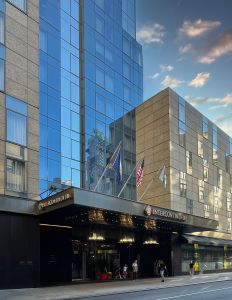
Alibhai has built an $8 billion portfolio that includes properties from Chicago to Bermuda to Costa Rica. His company, Gencom, this year paid $320 million for the Ritz-Carlton New York, Central Park. Since 2024, Miami-based Gencom also has acquired the Thompson Central Park and the InterContinental New York Times Square, along with the Ritz-Carlton Key Biscayne in South Florida.
Not bad for someone whose first job in the hospitality industry was managing a Best Western.
A native of Kenya, Alibhai attended Rice University in Houston and now lives in Coral Gables, Fla. Commercial Observer caught up with the CEO this week to ask about Gencom’s $1 billion in acquisitions in New York City the past two years, as well as rising room rates, the K-shaped economy and the evolution of his career.
The following conversation has been edited for length and clarity.

Commercial Observer: You’ve taken on $1 billion in acquisitions in the past couple of years. What’s driving your deals?
Karim Alibha: I think it’s a combination of a few things. One is market driven. So, for example, in New York City, that’s a market we identified with one of the lowest supplies in 25 years, and demand was looking to increase. So that was a big reason that we went over the past two years and acquired almost $1 billion of hotels in New York City. That was a driver for us.
Separately is the leisure resort segment. Since the pandemic, that segment has had the best recovery and has far surpassed other luxury segments. That’s another big driver for us. So it’s really market driven/opportunity driven.
I get the sense that the luxury hotel market is resistant to price increases. What are you seeing on the pricing front in terms of room rates?
It’s been very resilient, and obviously with the broader economy and the market performing well, that has permitted the luxury segment in both corporate business and individual guests to keep paying the right premium for the right product and experience.

What are typical room rates at the newly acquired Ritz-Carlton, for instance?
Rates are from $1,500 to almost $2,500 a night, both at the Ritz-Carlton we opened in Costa Rica and at the one we acquired in New York City.
You’re in the middle of it, so I’m sure that sounds normal to you. But to an outside observer, that sounds like a lot — maybe that market has crossed some kind of a threshold?
Some of our markets do closer to a $750 to $850 average rate, versus our two most recent ones. But even at $750 to $850, that’s a significant lift from pre-pandemic, when the rates were in the $400s for the same property.
Do you get the sense that rates will stay this high, or is there some retrenchment at some point?
I think the percentage growth in rates is going to taper down to normal inflationary numbers. Rates were growing above inflation from 2022 to now. I think they’re going to be more stable, and not the kind of growth we’ve experienced in the past four years.
Is this a bet on the K-shaped economy story that those at the upper ends of the income curve and wealth distribution are doing really well?
You’re generally right about that. More people are moving into the class that can afford these kinds of properties, so that’s also a big factor. People are moving up into a particular category, because now you have luxury and ultra-luxury. The luxury segment has now been carved up into two classes.
What’s the difference? What would I experience in an ultra-luxury hotel as opposed to a luxury hotel?
A few things. One, obviously, is the room size – they’re generally more like suite sizes. Two, the properties are generally smaller in size, more luxury boutique, from 40 to 100 keys. You would have amenities like each of the rooms having their own plunge pools in ultra-luxury, which you would not find for luxury.
The offerings are definitely a premium over what luxury is. In many cases, you have butler service in ultra-luxury, not in luxury. Product, service and amenities is what differentiates the two classes.
I find it fascinating that you started at a Best Western and now you own hotels with $2,000 room rates.
Only in America, as they say.
There was really a lot of blood and sweat and tears to it. I finished college when I was 18. My family had a motel that we called a negative two-star motel. That’s how bad it was.
I was given the assignment to run it, and take full charge of it. I call it my MBA. I didn’t get to go to any prime school for my MBA. I started by acquiring one motel at a time, and I kept working up the food chain, from Best Westerns to Comfort Inns to Holiday Inns to Days Inns, then to Hiltons, Sheratons, Marriotts.
I built a company that I was able to take public in the mid-1990s. I was still in Texas at the time. Then, when I came to Miami, I stumbled into luxury.
So you got your unofficial MBA at the Best Western. What were some of the business lessons that you learned from that experience?
Firstly, there’s nothing short of having to roll up your sleeves for anything and everything you do. There’s no easy formula where things just come to you. That’s one of the formulas for my company. Don’t be afraid to take on something where you really have to work.
What are the similarities and differences between running a Best Western and running a luxury or ultra luxury resort?
A lot, lot, lot, lot of differences, but ultimately, they’re both businesses. They both require satisfying guests at different levels, obviously. So, you have some element of service – obviously a much, much higher level of service on the luxury side.
You have to watch your costs, whether you’re at the Best Western or in the luxury segment, because no matter how well you do on the revenues, if your costs are not properly contained, you could lose your shirt.

What’s next? Are you going to continue to acquire and grow?
We will always selectively keep looking for the right opportunity that fits us well, and where we can do a value-add. Typically, we don’t buy anything that’s running so well that we’re just there to clip coupons. We like to find something where we can reposition, renovate, rebrand, change the food and beverage.
What would you say is your biggest challenge?
One is construction costs are still going up quite significantly. The booming economy leads to more demand for homes, buildings, other things. That’s really been a challenge trying to keep those costs in check, whether it’s a renovation or a ground-up new development.
The other is that, interestingly, even though things are doing well in the U.S., we’re getting really, really affected by foreign travel, which has gone down given some of the administration’s policies on visas and other things. In New York, we’ve seen a sharp drop in Canadians the last 12 months. They’re just not coming because it’s too painful.
Jeff Ostrowski can be reached at jostrowski@commercialobserver.com.