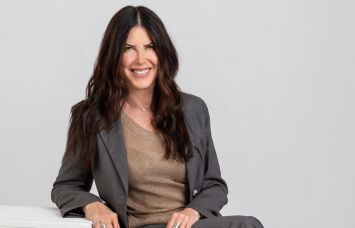
Frances Katzen of Douglas Elliman: 5 Questions
By Amanda Schiavo June 29, 2026 8:00 am
reprints
See that girl, watch that scene, diggin’ the dancing queen. Or, rather, the real estate queen.
Real estate wasn’t always meant to be the career that brought Frances Katzen her success. While she had family in the industry, the 52-year-old founder and leader of the Katzen Team at Douglas Elliman began as a professional dancer, a career she excelled at until an injury forced her to hang up her ballet shoes.
Now, the former dancer with the American Ballet Theatre leads one of Douglas Elliman’s top-producing real estate teams in the country. Over her career, Katzen has done more than $3.5 billion in sales, and today moves over $350 million annually.
Commercial Observer caught up with Katzen in late June to discuss her career pivot and how she found success as a broker.
This interview has been edited for length and clarity.
Commercial Observer: How did you first discover your passion for ballet?
Frances Katzen: I was the kid who couldn’t sit still. I had ants in my pants. I was a dreamer. I always wanted to be the best and the biggest.
Growing up in Australia, it’s not exactly an ideal setup for someone who dreams big, because of the culture. It’s called the tall poppy syndrome. Australia loves the underdog; they don’t love the winner. Whereas America embraces both. So, in America, there was a freedom to dream big, to push for things, and to break the glass ceiling.
How did you go from ballet to broker?
Injuries. The first injury that set me back, and actually got me fired from the American Ballet company, was a fractured spine. They told me I’d never dance again. I was in a Boston brace for six months, but I rehabbed and came back.
The real [ending] injury was when I was dancing with the Miami City Ballet. Everyone was in so much pain from taking [ballet dancer and choreographer] Edward Villella’s classes that I was on Vioxx, a COX-2 inhibitor, which prevented me from laying down calcium. So my bones were getting more and more injured, and I ended up fracturing the largest bone in my foot, and they said, “You’re out.”
They wanted to put a plate in my foot, and I did a little prolotherapy and was back on my feet walking around as a real estate broker.
What’s been the key to your success as a broker?
I think it’s because I am a good consumer and I walk into every experience with the perspective of how this would be received by the consumer. I’m very visually affected by things and how they can be changed and improved upon. And I think when you tap into the 30-second rule of getting someone to subscribe to what you are offering, you basically create a way for people to stay with you.
We really have an instant gratification culture, and you’re really trying to get them to zero in on yours. And in real estate, for me, I enjoy the idea of repositioning, creating something, rebuilding it, taking something that no one else wanted and making it desirable. Sometimes what I’ve ended up buying was a complete wreck that created the most inherent value.
I think that if you have the eye to see beyond the imperfection, you can uncover real gold of products for clients, for sellers, and people who have become so used to their own property they don’t see what you see.
I tell clients I’ll get it there if you let me go, and when they finally let you have a go at it, and they see the results, they’re in awe.
Is there a project that you’ve worked on that stands out in your mind?
In my third year in the business, I won 15 Renwick from another competitive, very established brokerage and broker. And for me, it was the fact that I knew we could turn it into something cooler.
I remember it was not a particularly sexy location, and we identified it as West SoHo. We got Peter Tunney to do an art gallery in the commercial space, we got Bang & Olufsen to do the in-store sound system, and it just was cool, and it was fresh, and it was not expected. It was these little dynamics that created a flurry of interest, and we were 36 percent sold in our first 10 weeks.
Of course, then the market crashed and the banks wanted my capital stack to put more money down, so they said, “We don’t have to do it, so come and collect.” The project stalled, and that was the end of it. But my point is, I knew I was in the right zone of positioning, and I think that sort of became my own trust-o-meter in doing this.
I remember working with Sorgente Group of America on 34 Greene Street and they gave me 60 White Street, which was a blank canvas for me to really create something beautiful and fresh. It was all renewable. We even recycled the 100-year-old nails when we could. It was really a labor of love, and we got ridiculous pricing at a time when you just weren’t getting that. It was closer to East Broadway, it wasn’t as gentrified, it was all emerging at that time, and I was really proud of what we created.
What has the chatter been like among brokers as it relates to New York City’s pied-a-terre tax?
It’s been interesting. There have been moments where people are hitting the pause button.
One thing that is becoming clear is that there are areas where you can navigate around it. For example, you can rent it out to a family member and own it in that structure. So there are ways to work around it, but obviously those are subject to changes as Phase 2 gets implemented after 2028.
I definitely find it to be one of the most counterintuitive things I have ever observed as a broker in my career. I have never seen a more anti-New York, anti-capitalistic, anti-support of keeping our nation pumping the way it was, and the trajectory with which it was on.
We had the highest bonus payout in three decades that got quelled shortly after April and May when these proposals were floated. I think it’s going to have repercussions here for sure.
Amanda Schiavo can be reached at aschiavo@commercialobserver.com.