

Warsh’s First Fed Meeting as Chair Produces a Result Many in CRE Expected
‘We've built our strategy around the assumption that meaningful rate relief is not coming in 2026.’
By Andrew Coen June 17, 2026 3:22 pm
reprints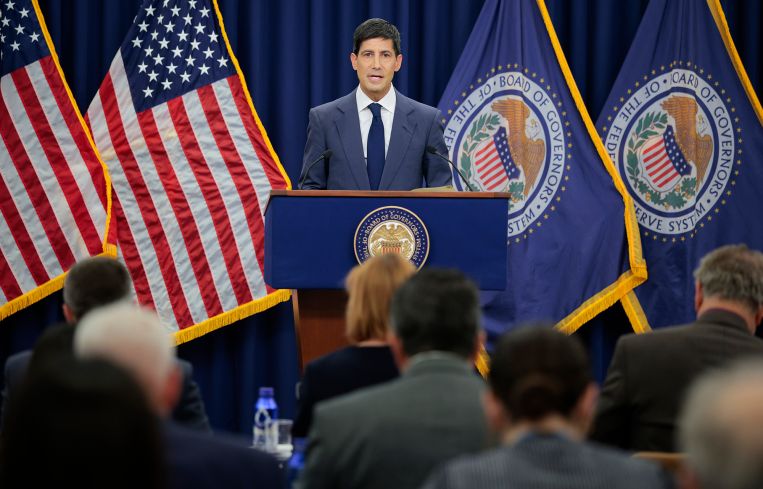
President Donald Trump nominated Kevin Warsh as Federal Reserve chairman in the hope of lowering interest rates, but the first Federal Open Market Committee (FOMC) meeting under his leadership signaled a continued higher-for-longer environment.
The central bank, in a unanimous 12-0 vote Wednesday, kept its benchmark interest rate at between 3.5 percent and 3.75 percent for the fourth straight meeting, citing inflation uncertainty tied to the war in Iran.
The Fed also released an updated quarterly “dot plot” matrix of individual committees that removed prior forecasts of one rate cut by the end of this year and signaled possible rate hikes. The updated, more hawkish FOMC projections, which Warsh opted to not participate in, is now showing a federal funds rate of 3.8 percent at the end of 2026, up from 3.4 percent estimated in March, with nine of the 18 members signaling a near-term hike.
“Economic activity is expanding at a solid pace despite elevated uncertainty that owes in part to conflict in the Middle East,” Warsh said in prepared remarks to open his post-meeting press conference. “Productivity growth and capital investment are both strong, job gains have kept pace with the workforce, and the unemployment rate has changed little.”
The unanimous Fed decision Wednesday marked a stark contrast to an 8-4 vote on April 29 to maintain interest rates, a vote that marked the highest level of dissent since October 1992. The FOMC board includes former Fed chair Jerome Powell, who opted to remain as a governor and is eligible to stay in the post through January 2028.
Warsh said he is forming five task forces that will determine the Fed’s use and reliance on existing data and the central bank’s inflation framework. He also announced a preference to remove “forward guidance” formerly used by the FOMC to shape future monetary policy decisions.
Jay Neveloff, partner and chair of U.S. real estate at HSF Kramer, said Warsh may alter some of the ways the Fed examines data such as its long-standing goal of keeping inflation growth at 2 percent or lower. He does not see the new Fed chair dropping rates in the near term, though, as uncertainty persists in the Middle East and the labor market is strong.
While the commercial real estate industry has been pushing for lower interest rates, Neveloff said a number of clients he works with don’t think a quarter-point reduction would make a material difference in pricing most deals, and many are ready to execute deals.
“Some of the people I deal with are saying if a 25 percent basis point change increase in interest rates is the difference between the deal making sense and not making sense, then the deal doesn’t make sense,” Neveloff said. “Some people are still a little reluctant and they don’t know if they’re going to get approval from the investment committee, and others are saying this is the moment and this is the window.”
Lisa Pendergast, CEO of the Commercial Real Estate Finance Council, noted there’s around $875 billion of outstanding CRE loans slated to mature this year, largely at 4 percent coupons, making refinancing a major challenge. She said lenders will likely continue to extend loans as long as they can to avoid taking back assets with the hope that rates will eventually head downward.
“At some point, that will come to an end and, hopefully, if that comes to an end, the Fed has changed its tune, although I don’t think anyone is thinking that is going to happen anytime soon,” Pendergast said.
Tyler Chesser, co-founder and managing partner of CF Capital, a multifamily investment firm, said the market has largely priced in higher-for-longer interest rate conditions. He noted that the “real friction point” is the spread between where maturing multifamily loans originated as low as 5.1 percent and the average 6.2 percent interest rate for average CRE debt deals.
“What we’re watching for is whether the 10-Year Treasury can stay in a tighter range because that’s the real lever for refinancing economics — not the Fed funds rate,” Chesser said.
“We’ve built our strategy around the assumption that meaningful rate relief is not coming in 2026. That means underwriting conservatively on debt assumptions and prioritizing deals where in-place cash flow can carry the asset at current financing costs without depending on a refinancing tailwind that may not materialize.”
Andrew Coen can be reached at acoen@commercialobserver.com.


