

Saks Global’s Fire Sale Might Help It Out of Bankruptcy — But Kill the Business
The story starts with what seemed like a sure-fire merger of two iconic retail brands two years ago
By Brian Pascus May 18, 2026 6:30 am
reprints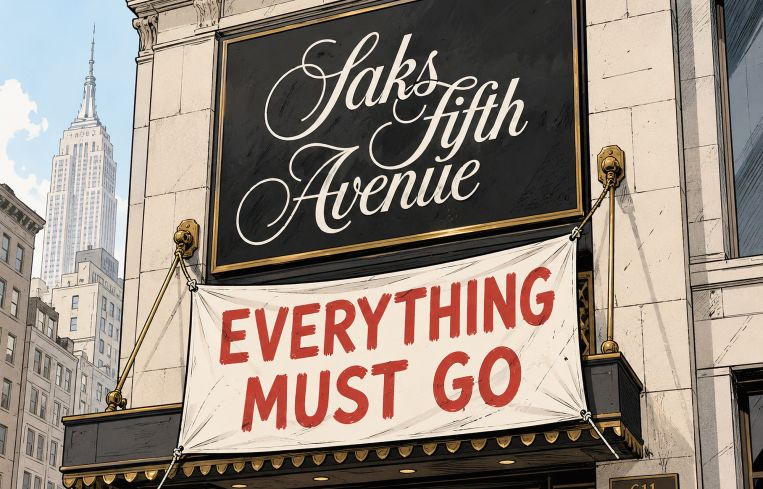
It wasn’t supposed to go like this.
When Saks Fifth Avenue agreed in July 2024 to buy Neiman Marcus for $2.65 billion to create Saks Global, a new $7 billion luxury retail behemoth, the conventional thinking was that senior executives at the two firms — once enemies, now family — would find a way to combine business lines to box out competitors Macy’s, Nordstrom and Bloomingdale’s.
After all, the new Saks Global now boasted 75 brand stores, two iconic Bergdorf Goodman locations, and an additional 100 Saks Off 5th discount outlets. The deal, while financed largely through $2.2 billion in loans, included the blessings of $1.5 billion from Apollo Global Management and a $475 million equity injection from Amazon (which hoped to sell Saks and Neiman Marcus goods on its website). The deal also had investment capital from software firm Salesforce, mall owner Simon Property Group, and Authentic Brands Group (whose stable includes Reebok, Brooks Brothers and Juicy Couture).
Yet, not even 18 months later, in late 2025, Saks Global missed a $100 million bond payment and announced in January 2026 that it would be filing for bankruptcy — a stunning turn that led to the resignations of two CEOs, the fire sale of dozens of retail real estate properties and hundreds of job losses. Brand-name vendors like Chanel, Zegna and Akris are owed at least $700 million, per The New York Times.
“Saks and Neiman are two concepts that were hard to put together and make work as one,” said Glen Kunofsky, founder and CEO of Surmount, a real estate investment firm. “They’re two different business plans, two different ways of attracting customers, and I think it was doomed from the start.”
There were reasons for optimism after the terms were announced nearly two years ago.
Hudson’s Bay Company CEO Richard Baker, chief of the parent entity that owned Saks Global, believed the combined retailers would generate $600 million in savings within five years through cost-cutting synergies, while then-Saks Global CEO Marc Metrick insisted after the merger that the new entity would invest in technology and AI while remaining committed to physical luxury stores and maintaining relationships with top global brands.
“With the dual corporate operations, you’re combining two offices into one and saving money that way, through cost reductions, rationalization of inventory management, and all that stuff goes into the bucket of synergies,” explained Mickey Chadha, vice president of corporate finance at Moody’s Ratings. “They just weren’t enough to improve their liquidity position.”
To say Saks Global’s liquidity position struggled would be an understatement. Almost from the start, balance sheet problems started to percolate, particularly with Saks Global’s payments to its vendors — a relationship predicated on a global retailer like Saks buying goods from brands big and small alike at the start of the month, and promising to pay them back within 60 days once those goods had been sold in their physical and online stores.
But, in February 2025, Metrick shocked the retail world by sending a memo to suppliers with adjusted terms: Payment terms would be extended to 90 days, and back payments would be spread out across 12 monthly installments, rather than in traditional lump sums.
“Immediately the deal is on its knees because they can’t service the debt — Saks Global has taken on more debt than it can possibly service,” explained Mark Cohen, former director of retail studies at Columbia Business School and a longtime Sears executive. “They engage in a slow-pay, no-pay with the vendor community — and it’s a harbinger for bankruptcy: When a retailer stops paying, they stop getting goods.”
As for those promised $600 million of cost-saving synergies, well, they never materialized.
Being an amalgam of three companies — Saks Fifth Avenue, Neiman Marcus and Bergdorf Goodman — Saks Global struggled to integrate the back-office elements of different firms, to say nothing of carrying on cohesive negotiations with various vendor and credit card companies that fed a direct line to the capital structure of the entire firm.
“In this big gamble, they raised a great deal of debt, and any time you have different entities that are being combined you’re going to have issues, especially in retail,” said Andrew Gottesman, a bankruptcy attorney at Rosenberg & Estis. “When luxury retailers are combined, there’s always some level of overlap of what they buy and who they buy it from.”
While vendors waited on what they were owed, Baker and Metrick tried to restructure the debt terms on the fly, eventually securing a fresh $600 million from existing bondholders in June 2025. In the meantime, though, sales fell to $1.6 billion, a 13 percent drop from the third quarter of 2024 to the same period in 2025, and the firm reported a net loss of $288 million, according to the Wall Street Journal.
“You pay for an acquisition entirely with debt financing, and do so when your operations are already weak and profitability is declining, and then you don’t generate enough cash flow to pay for it, that all turns into a liquidity crunch,” said Chadha. “In the end, it was too much debt, too soon.”
The destruction left in the wake of this disastrous marriage is striking. As Saks Global goes through the bankruptcy, bondholders Pentwater Capital and Bracebridge Capital are now paying the bills to the tune of $1 billion in debtor-in-possession financing, while Bank of America has released $250 million in credit for day-to-day operations, with another $500 million ready to go after the restructuring is complete, the Journal reported.
Vendors continue to wait for payments — Chanel was owed $150 million when the bankruptcy was filed — and the physical stores are rapidly being shrunk down to scale, with leases either sold or abandoned. Some physical sites have been exchanged for immediate cash payments, like the 200,000-square-foot, mixed-use retail property in Scarsdale, N.Y., that Saks sold for $80 million in April.
Since the bankruptcy was announced at the start of the year, Saks Global has closed, or is in the process of closing, 18 Saks Fifth Avenue stores, three Neiman Marcus locations, and 57 Saks Off 5th discount stores, while shuttering the five remaining Neiman Marcus Last Call clearance centers, leaving the company with a national footprint of 15 Saks Fifth Avenue stores and 33 Neiman Marcus locales.
“This was a company that was headed for bankruptcy, and the only question was what day, what month, what year,” said Cohen. “Despite the opaque curtain they draped across their financing, this business was no damn good, and they weren’t paying their bills.”
Blame game
In the collapse of any company, particularly one worth billions of dollars and carrying a world-famous name associated with the finest brands in luxury goods, there is usually someone to blame. In the case of Saks Global, the person receiving much of the blame is Richard Baker.
The son of Robert Baker, owner of National Realty & Development Corporation, a multistate shopping mall development firm that brought Walmart to the East Coast, Richard Baker broke out of his father’s shadow in 2006 when he purchased Lord & Taylor for $1.2 billion.
Investing $25 million of his own money and financing the rest via $1.1 billion in commercial mortgage-backed securities debt secured by the brick and mortar — particularly Lord & Taylor’s flagship location at Fifth Avenue and 38th Street — Baker applied a novel capital structure that separated the retail operating company (op-co) and the actual properties (prop-co) into two separate entities to support the heavy debt structure, according to a 2011 New York Times profile.
By 2008, Baker’s private equity company, NRDC Equity Partners, applied the same formula to Hudson’s Bay Company, the oldest firm in Canada and essentially their version of what Macy’s combined with Ikea and Dick’s Sporting Goods would look like. The new HBC run by Baker became the American parent that owned both Lord & Taylor in the U.S. and Hudson’s Bay stores in Canada.
“Richard Baker grew up as a real estate investor, Lord & Taylor was a retail franchise supported by owned real estate, Hudson’s Bay became similar,” said William Susman, managing director and head of consumer investment banking at Cascadia Capital. “Richard always had the ability to think about retail and real estate at the same time, and I think along the way Richard was able to monetize real estate and finance off of it. … Clearly, Richard was never scared of leverage.”
With the businesses of Lord & Taylor and Hudson’s Bay under his umbrella, Baker’s next move brought him control of Saks Fifth Avenue. He bought it from shareholders in 2013 via $2.9 billion (mainly debt) and, once the deal closed, had no problem taking out a new $1.25 billion mortgage on the nearly 90-year-old Fifth Avenue flagship, which the Times reported carried a value of $3.7 billion.
With three major retail firms under his control, Baker applied a formula used most often by private equity firms known as the sale-leaseback: selling the valuable properties owned by the operating company, and then using the one-time payment from the deal to pay down debt or other expenses from the initial acquisition.
“A sale-leaseback is always the preferred method. That’s what we do to maximize the value of real estate,” said Kunofsky. “There’s no reason for a big operating company like Macy’s to be flush with real estate. The only thing the real estate will do for these companies is be collateral for leverage, and the prop-co and op-co should not operate together.
“Using the cash to enhance the business is really the way to go,” he added.
Good advice, indeed, but this is assuming that executives like Baker will use the cash generated by a sale-leaseback to enhance their retail businesses rather than leverage the property values to pay off billions of dollars in debts used to acquire the operating companies in the first place.
Baker sold the most valuable aspect of Lord & Taylor’s 50-store operation, its iconic Fifth Avenue property, to WeWork in 2017 for $850 million, and then sold the rest of the firm’s retail business for $100 million in 2019. By 2020, Lord & Taylor, with many of its stores no longer in operation, or having been sold to pay down debt, filed for bankruptcy.
As for Hudson’s Bay Company, the 350-year-old Canadian retailer, Baker sold off the firm’s many physical real estate assets bit by bit, primarily the leases of its subsidiary Zellers to Target in a $1.8 billion deal in 2011, seeming to extract value wherever he could from the real estate portfolio and in return underinvesting in the department stores themselves, as Yahoo Finance Canada documented last year. By 2025, Hudson’s Bay Company, the oldest retailer in North America, filed for bankruptcy.
“He starves Hudson’s Bay by selling off their real estate, he uses Hudson’s Bay as an ATM, and does the same thing with Lord & Taylor,” said Cohen. “Everything Richard Baker touches in retail has turned into a catastrophe. He has poisoned everything he’s touched.”
By 2024, with Neiman Marcus still wounded from its $4 billion March 2020 bankruptcy, Baker convinced his investors that the time was right to combine two of the most storied names in luxury retail, primarily because a larger entity would hold enormous sway over the choicest vendors desperate to get their products into the stores of Saks and Neiman, many of which cater to wealthy buyers who spend tens of thousands of dollars each year on goods.
“The Neiman transaction was a consolidation of the luxury market,” said Susman. “They thought they could push vendors really hard, because where else are you going to sell Chanel and Louis Vuitton?”
Warning signs flashed from the start. Saks Fifth Avenue reported a 10 percent drop in revenue during the 2024 fiscal year, and that was before the Trump administration’s 2025 tariff policy left many nervous and unsure of future costs. By early 2026, with the deal underwater, Baker resigned as CEO of Hudson’s Bay, carrying with him the reputation as being the only man who killed three storied retail companies across two countries, including the oldest retail corporation in North America, all within 20 years.
“He has ruined every retail business, both major and minor, specialty and brand, and has destroyed everything he touches, and I don’t say that lightly,” said Cohen. “He’s truly a talented snake oil salesman.”
Today, Baker is involved in a nasty dispute with unsecured creditors, who recently subpoenaed all communications between him and ex-Saks CEO Marc Metrick. Thus far, Baker has refused to cooperate with the lawsuit filed in the bankruptcy court in the Southern District of Texas.
Rachel Strickland of Ropes & Gray, listed as Baker’s attorney in the bankruptcy case, did not respond to requests for comment on his behalf.
Shop less?
The future of Saks Fifth Avenue, Neiman Marcus and Bergdorf Goodman is as much about what luxury retail will look like in the next decade as it is about whether Saks Global will survive.
The 20th century is long in the rearview mirror, and the department stores that dominated those decades — Macy’s in New York, Marshall Field’s in Chicago, Wanamaker’s in Philadelphia, Filene’s in Boston, etc. — are relics of a bygone past.
“Saks is part of a larger trend of anchor stores vacating through bankruptcy or voluntary closure,” said David Vallas, partner at national law firm Honigman. “The impact it’s having on shopping malls is an evolution of the business — that model is changing, as Saks, Sears, JCPenney have all closed numerous stores and locations.”
COVID-19 gave more Americans than ever the excuse to shop online, but new shopping patterns like social media storefronts hawked by Instagram or TikTok influencers, as well as stand-alone stores opened by big-name brands themselves, have all contributed to a challenging new landscape for large department stores like Saks and Neiman to compete in.
The response, thus far, by Saks Global is telling. The firm is either selling entire big-box stores or large parcels of land the stores sit on — as it did in the $80 million Scarsdale sale — or shuttering dozens of small-box locations within their discount line that catered to middle America, seeking to find savings and avoid onerous costs while slimming down from the albatross it once was.
Susman defined the bankruptcy as “a get out of jail free card” for Saks Global, one that will allow the firm to not only renegotiate terms with vendors, but also decide which leases it wants to send back to landlords or assign to a third party for no penalty, and maybe even a profit.
Gottesman sees the same strategy. “They’re closing a lot of locations, and in doing that they’re able to take leases, assume them, and assign them to a third party for value,” he said. “You can have a lease that’s below market, there’s value in that, and another company might want to pay money for 10 years of below-market rent.”
Justin Stein, executive vice president and chief revenue officer at Tanger, an open-air outlet shopping centers real estate investment trust, said his REIT views the Saks Global bankruptcy as an opportunity to reclaim large blocks of retail space that can drive net operating income. So far, Saks has kept only one of six locations it leased in Tanger outlets.
Stein emphasized that while his firm has been aggressive in buying back leases from Saks and other brands that have fallen into bankruptcy, existing bankruptcy laws allow retailers like Saks to extract value from any sale to pay back creditors.
“Every deal and every location is structured differently, so there’s definitely value in some of their locations,” said Stein. “They may find someone to buy that lease for $20 per square foot when the market is $60 per square foot.”
Aside from selling the fee interest in their giant anchor properties, Saks Global has already leaned into land deals, like the January 2026 deal to sell the ground lease beneath a 200,000-square-foot Neiman Marcus store in San Francisco’s Union Square, which carried a market value of $160 million. That gave the firm the right to lease the space from the new owner.
“There’s obviously a tremendous amount of value in some of the real estate they own, and they’ve gone about it in different ways, but there hasn’t been a whole lot of consistency,” said Conor Lalor, head of retail capital markets at Newmark. “Through this bankruptcy, they’re rightsizing their real estate portfolio by closing stores and refocusing the core business on the markets that will outperform or support the luxury brands.”
Saks Global’s new CEO, Geoffroy van Raemdonck, who was elevated in January, has already secured ample liquidity agreements from creditors and is in the process of restoring vendor relationships with luxury brands that were damaged under the leadership of Baker and Metrick, and that are essential to attract the wealthy shoppers the stores need to succeed. In a recent interview with the Wall Street Journal, van Raemdonck said 40 percent of company sales come from customers who spend an average of more than $36,000 per year in their stores.
“They’re selling stores that (a) they own and (b) they can live without, but it’s unclear how they will ultimately position Neiman versus Saks,” said Susman. “They’ll have to decide which markets need which doors. For instance, the Dallas customer feels affinity toward the Neiman Marcus brand.”
But no one knows what will happen to a storied retailer now under the control of creditors and investors who might use the bankruptcy to dictate an entirely new direction for the firm.
“When you have banks and funds taking over, oftentimes their focus is to maximize their returns, and that could look very different than takeover from an industry player,” said Rosenberg & Estis’ Gottesman. He noted outdoor clothing retailer Eddie Bauer liquidated its entire physical footprint in the U.S. and Canada during its two 2000s bankruptcies, and is today exclusively an online wholesaler.
“Ten years from now, maybe there will be no Saks, or the only Saks you have is through a branded Amazon.com store,” Gottesman added. “You have investors that are now owning the company, so it becomes a different animal. We just don’t know what that is right now.”
Others like Cascadia Capital’s Susman are more optimistic that the three companies within Saks Global will emerge from the bankruptcy in a healthier, albeit slimmer, manner — one that will not be weighed down by sale-leaseback leverage or damaged by a sudden trade war on high-end imports.
“Who said it hasn’t worked out? The cake is still in the oven,” said Susman. “I believe a combination of Saks and Neiman does make sense and will work out, because I don’t see a luxury alternative in the marketplace today.”
Others, however, already see the writing on the wall.
“This was an epic house of cards,” said Cohen, the former Sears executive. “In my opinion, the business is over.”
Brian Pascus can be reached at bpascus@commercialobserver.com.


