

Krystyna Blakeslee’s Experience as a Marine Aids Her Work as a Lawyer Today
The sergeant turned Gibson Dunn partner focuses on people first, paperwork second — and deal-closing over all
By Larry Getlen May 5, 2026 12:00 pm
reprints
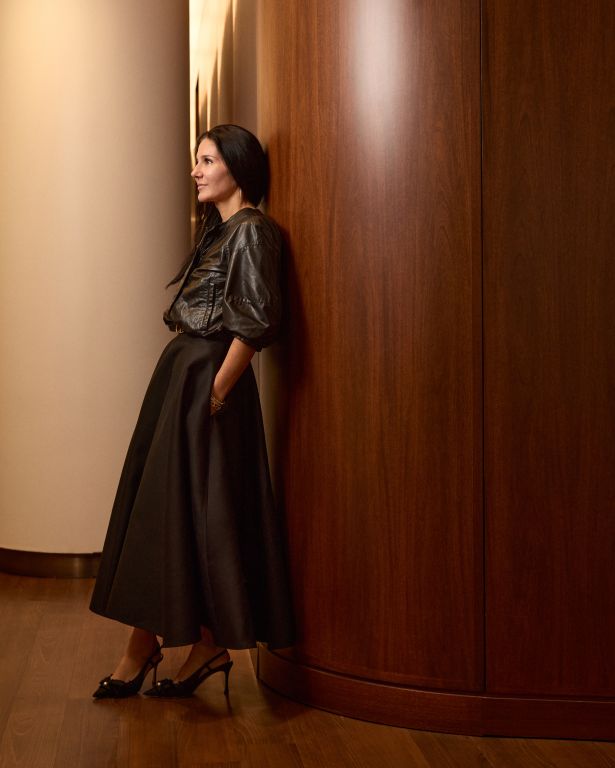
Krystyna Blakeslee was a United States Marine stationed at Camp Pendleton during 9/11, and wound up spending time in Kuwait and Iraq, performing essential duties like collecting the bodies of fallen compatriots.
After her service, Blakeslee earned her bachelor of arts and then, in 2009, her law degree at the University of Connecticut. After a year clerking for a bankruptcy judge, handling workouts, she spent over a decade at law firm Dechert, getting an in-depth education in real estate finance and working her way up to partner in 2017. After almost four years at Willkie Farr & Gallagher as the chair of its real estate finance practice, she joined Gibson Dunn as a partner in 2024.
Blakeslee, 44, credits her time in the Marine Corps with instilling in her a sense of discipline and purpose that she said has provided stark advantages for herself, her associates and her clients.
Commercial Observer spoke to Blakeslee — who lives in New Canaan, Conn., with her husband of 17 years, Alton, and their daughter and son, ages 12 and 9 — about her circuitous path to the law and her views on real estate finance in today’s ever-
shifting economy.
This interview was edited for length and clarity.
Commercial Observer: How did you wind up practicing real estate finance law?
Krystyna Blakeslee: I was a summer associate at Dechert and everyone there was a real estate finance lawyer, and I loved it there. There was never really a choice.
A few partners there — Laura Ciabarra, Kathy Burroughs and Dave Forti, who is now co-chairman — taught me not only the importance of being a good lawyer, but the importance of building relationships. It was obvious to me early in my career that those two things were equally important.
Talk about your work at Gibson Dunn. What is your specialty?
I represent mostly lenders, whether banks or non-banks making loans somewhat related to real estate, whether mortgage loans, mezz loans or preferred equity. Probably 10 to 15 percent of my practice now is also representing borrowers in terms of their financings.
I’d love to hear about your approach to a case you worked on at Gibson Dunn that was either challenging or fulfilling, and how it came to feel defining for you.
The firm represents a public company that started its first real estate debt fund last fall. They got this $2 billion deal in January, a big portfolio of senior housing. We had to do a lot of diligence on it.
We had a great team of Gibson associates on the deal. We were negotiating the underlying loan with a big institutional sponsor, but also another financing. We were dealing with taxes and other issues, too, and it was on a tight, compressed time frame. Everybody was thrilled with the result. It was a chance to see people on my team doing things they’ve never done before. We did a really great job under intense internal and external scrutiny, and we did it with humor and humility. It was awesome to watch and be part of.
Is there a certain type of deal you most enjoy working on?
I really like doing big deals with lots of properties, especially if you add in mortgage, mezzanine debt and a lot more loans. The interplay between the senior and subordinate lenders is really interesting, as is having lots of different properties. It gets more complicated. It’s more paper.
So, if I had to pick, it would be deals with 40-plus properties with mortgage and mezz — all the things most people hate.
When you’re working on a complex financial transaction, what do you enjoy most?
What I enjoy most is learning about the people on the transaction. Let’s say we’re doing a really hard transaction and we’re negotiating. A really fun part is figuring out opposing counsel. What is the best strategy for getting them to say yes, or to meet in the middle? What is the best way to get my team to stay up all night to do the thing I need them to do? Some people like free dinners. Some people like “attaboys.” It depends.
That part is really fun because at the end of the day I don’t see that much that’s new. You talk to your client about where we need to end up, or what’s going to be acceptable and not. They know that, too. It’s not a big secret. So those things are probably the most fun, especially if they’re people that I haven’t dealt with before.
I can’t help but notice that no matter what I ask you, your answers focus on how it affected the people involved, as opposed to the particulars of the thing itself.
Well, the particulars are less interesting.
A lot of lawyers would say, “Oh, we have to do this and this, and deal with this statute.” You take a very different approach. What do you think that says about you?
Maybe that people matter first. I don’t mean to suggest that the documents or the paperwork weren’t important. Of course they were — that’s what we were all talking about and arguing over and learning about.
But the difference between a transaction that feels like a home run and one that just feels closed is how everyone behaved during the transaction, and how everyone feels about each other after that. On my transactions, I always want everyone, especially the people working directly for me, to feel really good about the work they did, even if there were mistakes and difficulties along the way.
There’s so much volatility in finance today, with tariffs, rate issues, political shifts, war. How has that affected the challenges you face in getting deals done?
The new deal pipeline has slowed a bit. I think the war in Iran is probably to blame for that. But the stock market’s still doing well, so it’s hard to say. You look at the news, especially in Europe and elsewhere, and people elsewhere are much more concerned about the impact of the war than it feels like — if you look at our stock market, at least — we are here in the U.S. So it’s hard to square it all together.
But I think where we’re at right now will continue for a bit through the summer, almost like last year with the tariffs, where, by the end of the summer, even though they were still in place, everyone just moved on.
Certainly the interest rate increases meant there weren’t a lot of deals. It’s harder for owners, developers and sponsors of property to make the numbers work, and for banks to find deals. The real estate M&A market hasn’t really opened up. You see green shoots of that coming, but the floodgates have definitely not opened up, and you need that to open up transaction value.
And there’s a lot of competition, especially on the debt side, although there’s also competition on the acquisition side, especially for top-tier properties and portfolios. All of that means that if the economics and the terms are otherwise the same, now you’re just competing on relationships and reputation. I think you’re seeing that play out with who’s winning deals, whether large acquisition deals or financing deals. A lot of people are winning deals on certainty of execution, because the other features are so similar there’s not really a path to deciding.
Also, regarding competition, there are a lot of new entrants in the market, not only on the non-bank level, which is primarily where all of the new entrants used to be, but also at the bank level. You’ve seen a lot of people move from banks to other banks, which hasn’t happened for a long time. I think people want to transact. It’s just a matter of timing it right.
On a local level, how has the changing economic environment here in New York, in part due to Mayor Mamdani, affected the commercial real estate landscape here?
I’ve had clients that have wanted to talk to folks at Gibson who have connections with the administration to talk about where they potentially see things changing. People are really interested in that conversation. But I haven’t seen it affect deals in a way that I could tell, “This is a New York issue versus a Trump issue or a war in Iran issue or the issue that interest rates are still too high.”
It’s hard to know exactly. People are definitely interested in talking about it, but I haven’t seen that be the driving reason for not transacting.
Where did you grow up?
I grew up in Waterbury, Conn. My mother was a single mother, so it was me, my mother and my brother. My mom was a nurse. My dad was around, but not particularly involved. Mom worked nights so she could spend a lot of time with us. She coached all our sporting events. She was always around.
When and how did the idea of going into the military occur to you?
Probably senior year of high school. I had applied to colleges, and my mom said, “You can’t really go that far unless you get scholarship funds.” I wanted to join the Peace Corps, but that had some obstacles. Then a Marine recruiter called and told me that they had scholarship funds if I did well on the Armed Services Vocational Aptitude Battery (ASVAB) — which is the aptitude test for enlisting — plus this other bucket of incentive money, and the GI Bill.
Each of those buckets of money was more money than my mom made in a year. So I took the ASVAB, and they were like, “You’re entitled to all three buckets.”
Before that came up, what did you think your career would be?
I always wanted to be a lawyer. I grew up watching Perry Mason and Ben Matlock. I didn’t know what kind of lawyer, but I definitely wanted to be a lawyer. My mother was big on, “You have to go to college. That’s the path toward success.” Part of the fear about me joining the military was, “You’re not going to go to college after this.”
I thought my life was going to take a normal trajectory, and in some ways it’s better that it didn’t, because when I think about taking leaps of faith on myself and other people, the military teaches you so much more about who you are and what you’re made of than if I had taken the easy route in life and just checked the next box.
You were in the Marine Corps for four years and achieved the rank of sergeant. When did you first enlist?
About 1999.
Where were you stationed?
I was in Camp Pendleton in California. Around the time when people normally get orders to go to a different base, Sept. 11 happened.
We were basically figuring out what to do for awhile, and then we got sent to Kuwait and Iraq to offload. The military has pre-positioned fleets of ships that have enough stuff on them to fight a war for about 30 days. So we were offloading all those vehicles.
When you first got there, how did you find it and what were your biggest challenges throughout all this?
The biggest challenges were that you’re pretty alone. I mean, you’re there with the people you’re serving with, but I had just turned 18. I didn’t know anyone. But it was really fun and exciting. We were basically working out all the time. The military does a lot of drills, and you’re doing that with the same 50 people all the time.
The hard part was that there were almost no women, and it was a bit of a culture shock. But I was taking classes part time at a community college nearby nights and weekends, and then working all day, which included a platoon-level workout — running on the beach. We were a support battalion, so we made sure that whatever was needed, whether it was vehicles or gear, was ready.
What was it like being one of the only women there?
When I look back, it was fine. There were probably times I should have been more offended, but I never felt afraid or “less than.” The harder part was always knowing that whatever relationships the men had with each other was never going to be like my relationship with them.
So I always did feel a bit on the outside. But I wouldn’t say anything was their fault. There’s nothing they could have done to change that.
Talk a bit more about what it was like being a Marine on 9/11. What was it like on the base?
It happened very early California time, probably 6 a.m. or so. The base was on complete lockdown. We didn’t leave for days. Nobody knew what was happening, or if there was going to be another attack. Most of the information we got, especially initially, was from CNN. We were glued to the TV all day long.
Then, after a few days, we were allowed to leave. At that point, you could tell there were going to be orders coming down for people to go to wherever. I wasn’t part of a specialty unit, like the Navy SEALs or the Rangers. But there were people at the base who did stuff like jump out of helicopters. Those kinds of people were much more in the know about what was happening early on.
But for probably nine, 10, 11 months, you just went to work every day not knowing if today was the day you were going to be told you were going. Even into the summer of 2002, when we were getting ready to go to the Middle East and knew we were going, we didn’t know when. They would basically be like, “Pack your stuff, be ready to go tomorrow.” That went on for a long time.
What was the mood on the base throughout this?
People were angry, but very much like, “We’re gonna win. We will fight back.” People weren’t afraid. I mean, on the day, on Sept. 11, people were pretty afraid because it was like, “What is happening and how did we miss this?” But when it was obvious there wasn’t another attack on the way, people were just angry.
Did you see combat?
Not technically, but we saw things. We were there for support, tracking personnel and equipment. We had lots of vehicles, and all of those vehicles were the supply chain for infantry men. So whether they needed garbage pickup, ammunition, food or help with removal of the dead, you would be sending in vehicles to pick that up.
We went into Baghdad. You would hear guns off in the distance.
You were picking up the bodies of fallen soldiers. What was that like?
It was hard. The hardest for me was that we had this private first class who was in my unit who had been on a convoy with a different team, and he died in an accident. Having to identify his body was probably the hardest, because I knew him. It was just really sad.
When did your service end?
July of 2003, but I was still in Iraq around that time, so I think I got out around August or September of 2003.
When you look back on it, what were some key lessons you learned, or ways the military changed you?
One really important thing I took from it is the sense that time is running out every day. I don’t mean like doomsday — I just mean life is really short, and you have to pack as much as you can into every day, which means I often have very little patience. But it also means that I feel like, “Well, we should just do this now. Why wait two weeks? Now is better than any other time.”
Being in Iraq was a lot of doing nothing, just waiting for something to happen. There was a lot of thinking time. And I remember sitting in Iraq one night with a bunch of other people just feeling like, “I don’t want to die, and, if I get out of here, I’m definitely going to do a lot.” I was just feeling like life is really short, especially after seeing a lot of young people die. That’s what war is.
So that’s one thing. Another is the sense that, compared to war, not that much is a big deal. If you take a breath and put everything in perspective, things will blow over or get better, or there’s a path out of it.
What the military also does a really good job of in particular is, for every mission, you would be told that the commander’s intent is X, the overall objective. But, if you were supposed to achieve the objective by doing steps one through 10 and you ended up doing steps 17 through 20, that was also fine. That lends itself to a lot of freedom in terms of making decisions about work, how to implement something, how to think about ideas — that there’s really not one right path to get somewhere as long as everyone knows what the end goal is and you’re all achieving the end goal.
The military taught me that the objective is what matters. How you get there matters less.
You’re a strong advocate for women at the firm. Talk about your work in that area.
It’s really important to me that women see there is not a straight-line path to their career — you don’t have to check all the boxes to achieve your goal. You can get there in a sort of circuitous way. You don’t have to take the traditional path.
It’s also important to me that they see that no one’s going to give it to you. You have to take leaps of faith in yourself and tell the world what you want, and then you have to try to get what you want. The idea of, “Well, I’ll just put my head down and do good work, and someone will notice me one day,” isn’t going to be enough. It’s always been obvious to me that you have to both maintain and have really good relationships, and also do good work. You have to do both of those things.
We do quarterly women’s meetings on various topics, and I do a lot of women’s events with clients. We also do a lot of growth training for associates on topics like how to become a leader even if you don’t have the title. That kind of stuff is really important to me.
Where do you see your career going over the next few years? Do you see any significant shifts, or a straightforward, more-of-the-same path?
Definitely not more of the same. I have spent a considerable amount of time learning. I mean, AI is here to stay, and I think the practice of law is fundamentally going to change. I think we’re at one of those transformational periods in history with technology, as a civilization. The impact AI can have on the way humans work and the way we do business is pretty revolutionary.
If you have access to it, it is imperative that you learn how to use it, to talk to it, and, in some ways, to do your job through it.
Do you think there’s a risk of your job, at the partner level, being taken over or made obsolete by AI?
Yes and no. AI is not good — at least today — at judgment and thought. It has no situational awareness. AI is really good at hard tasks that are measurable. It can surf through thousands of pages of documents in seconds.
But I think that AI will definitely change not only the way we practice law, but the way that law is used — the way clients use law firms. In that way, my job might be different, but I don’t think it will be obsolete.
Maybe this is naive of me, but AI will fundamentally replace the administrative work of the job, in the same way that computers, typewriters, fax machines and printers replaced hundreds of secretarial staff. But the need for people who can problem-solve and think and be creative is still going to be there.
Larry Getlen can be reached at lgetlen@commercialobserver.com.


