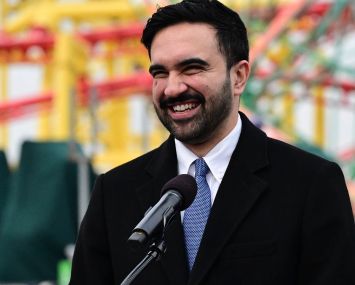
Mamdani’s Proposed Property Tax Hike Has Few Cheerleaders
By Mark Hallum February 20, 2026 7:00 am
reprints
It’s a rare thing that unites the upper echelons of the commercial real estate industry, elected officials and workaday New Yorkers. But Mayor Zohran Mamdani’s recent proposal for a 9.5 percent property tax hike appears to have done the trick.
Mamdani stated that the tax increase would be a last resort to meeting New York City’s budget needs if enough savings could not be identified and contributions from the state and a wealth tax could not be implemented. However, elected officials were more skeptical that middle-class homeowners would shoulder the majority of the burden of higher property taxes.
The two-year budget gap Mamdani inherited from Eric Adams is estimated to range from about $5.4 billion to $7 billion. Mamdani said he would prefer either a tax on the wealthy or additional help from Albany, which has already contributed $1 billion to the city’s coffers this year.
Either option requires action from lawmakers at the state level.
Gov. Kathy Hochul reiterated her support for Mamdani as a partner in government, but strongly opposed a property tax increase out of concern that investors and homeowners would be forced to find greener pastures.
She also stressed the city’s budget for fiscal year 2027 announced earlier in the week was preliminary, and that a property tax increase would be needed only if all else fails.
“I don’t support a property tax increase on New Yorkers, and I’m not wavering from my position that I don’t want to drive more people out of our state by increasing taxes from what is already a high-tax state,” Hochul said in a Wednesday press conference. “I’m the one who’s trying to cut taxes. I instituted the largest middle-class tax rate cut in 70 years. So I need to create an environment that’s more affordable for people. So we’ll keep working with the mayor through this process.”
Commercial real estate leaders were also on edge at the prospect of higher taxes.
“Instead of encouraging homeownership and real estate investment, it signals that property owners will be expected to shoulder the cost of expanding his unpopular policies,” Compass Vice Chair Adelaide Polsinelli told Commercial Observer. “Commercial real estate markets are highly sensitive to policy signals. Uncertainty alone can heighten perceived risk for long-term capital allocations. Institutional investors and private owners rely on predictability. When there is ambiguity around future tax burdens, underwriting becomes more difficult, projected returns shrink, and investors will deploy capital elsewhere.”
In a way, merely proposing a tax increase across the board confirms some of the industry’s fears about Mamdani expressed during his mayoral run — particularly that his resume is lacking — and adds another turbulent chapter to an already tumultuous decade.
“The mayor’s inexperience in business is on display once again,” Polsinelli added. “While he attempts to pressure the governor, he appears to be missing the broader economic reality facing New York City’s real estate market. … The market has not fully stabilized since COVID. Introducing additional uncertainty at this stage will almost certainly be reflected in pricing across all asset classes.”
The damage would be felt across all property types and would be shared among landlords and tenants.
“In multifamily, the consequences are even more pronounced,” Shimon Shkury, founder and president of Ariel Property Advisors, told CO. “Free-market buildings would see immediate margin compression, while rent-stabilized properties — already constrained on revenue and lacking tax relief mechanisms — would face accelerated financial and physical distress.”
Office, retail and hotel owners and operators will also likely see fewer opportunities in the New York City market amid shrinking profits and a diminished sense of economic security around the ability to raise rents or prices.
Even commercial tenants with leases that predate tax increases are exposed to such market conditions through tax escalation clauses, in which they absorb a portion of that overhead through reimbursements
“Affordable housing is especially vulnerable. As tax abatements expire, higher operating costs could push more projects into distress unless the government acts proactively,” Shkury added. “At a time when the city needs investment, housing production and stability, materially increasing property taxes might move the market in the opposite direction.”
Market-rate apartment rents can more easily be adjusted as units become available, but only if demand can support the kind of rent increase the landlords need to implement to make up for the tax load.
For Briggs Elwell, CEO and founder of RLTYco, the mayor throwing out the idea of taxing property owners possibly created public friction between Mamdani and Hochul, who have been on good terms since his victory in the June Democratic primary. It also disrupts the stability he has shown in City Hall thus far.
“This definitely is a political reaction to the governor not willing to increase personal income taxes at this time, and I’d say that from a perspective of reaction from the people I’ve been speaking to, it’s largely concerning because of the fact that it is an aggressive response in relation to Albany’s take on income taxes,” Elwell said in an interview. “The unfortunate part is, if you were to proceed with this 9.5 percent real estate tax increase, that will impact everybody.”
Mamdani’s proposed tax increase is roughly double the 4.7 percent increase for single-family and residential properties in New York City in 2025, according to the New York City Department of Finance.
Minneapolis-based investment bank Piper Sandler said in a report that a 2 percent increase on the wealthiest New Yorkers, who can simply move to the suburbs, would likely have a different effect than a blanket property tax increase, in that the latter could again create greater wealth inequality.
Big businesses and small businesses would also handle the tax increase very differently, with Fortune 500 companies absorbing the cost and those on a smaller scale foundering, according to Piper Sandler.
Following Mamdani’s announcement on Tuesday, stock prices for real estate investment trusts (REITs) exposed mainly to office — such as Vornado Realty Trust, SL Green Realty and BXP — took a dive, while those with portfolios composed of apartments were essentially unchanged, according to Piper Sandler, indicating an overreaction from office REIT investors.
“The ultimate tax decision faces a tough road to reality, as the consequences are evident. It’s certainly not in Mamdani’s interest to disrupt the New York City office market or cause millionaires to flee,” the Piper Sandler report said. “By contrast, we think apartment investors may be missing the risk of increased taxes, if rents can’t be raised commensurately.”
A property tax increase would have the unique effect of putting commercial real estate investors and everyday homeowners in the same boat.
“Under no circumstance should we consider balancing our budget on the backs of working-class New Yorkers, especially seniors on fixed incomes and public sector workers who keep our city running,” Queens Borough President Donovan Richards said in a statement. “In this new era, Queens homeowners desperately need our city to reform its already broken property tax system — one that sees Black and brown homeowners in middle-class communities paying more than brownstone owners in the city’s most affluent neighborhoods.”
Richards added that the tax hike would increase wealth inequality and exacerbate housing affordability — two issues that Mamdani campaigned on while running for mayor.
“If we do not go down the first path, the city will be forced to go down a second, more harmful path of property taxes and raiding our reserves — weakening our long-term fiscal footing and placing the onus for resolving this crisis on the backs of working- and middle-class New Yorkers,” Mamdani said in a statement. “We do not want to have to turn to such drastic measures to balance our budget. But, faced with no other choice, we will be forced to.”
Both City Councilmember Phil Wong of Queens, who would be among local lawmakers voting to approve such a measure, and Staten Island Borough President Vito Fossella said they would first like to see the administration display fiscal responsibility before raising property taxes.
“In one of the highest taxed cities and states in the country, we cannot keep relying on property taxes and other new revenue instead of auditing programs that don’t serve New Yorkers, ending wasteful no-bid contracts, and taking a hard look at the endless tax burden tied to services connected to the migrant crisis,” Wong said in a statement. “I cannot go back to my constituents and ask them to pay more until City Hall proves it is living within its means and prioritizing essential services.”
Moreover, dipping into the city’s cash reserves would also only put the city in a state of budgetary uncertainty in the coming years if economic uncertainties persist, New York City Comptroller Mark Levine explained.
“We are left with no easy options,” Levine said in a statement. “But to avoid the harm of increasing property taxes and drawing down reserves, we need to find greater efficiencies and savings across New York City government and reconfigure programs that are growing at an unsustainable rate. We also undoubtedly need greater assistance from Albany, to further rectify the years-long funding imbalance between the city and the state.”
Mark Hallum can be reached at mhallum@commercialobserver.com.