

Rithm Capital CEO Michael Nierenberg On Using M&A to Get to $100B in Assets
The real estate investment trust has an almost dizzying array of financial business lines
By Brian Pascus December 9, 2025 12:00 pm
reprints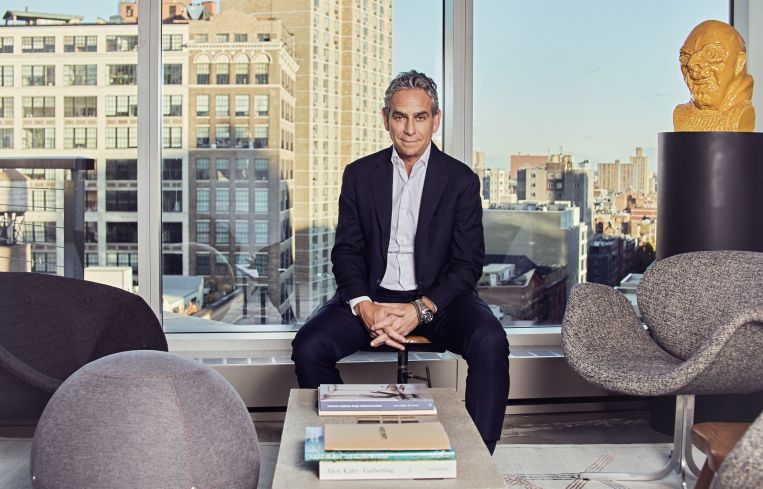
Michael Nierenberg is a man on the move. Nierenberg is the chairman, CEO and president of Rithm Capital, a publicly traded mortgage-servicing real estate investment trust that has morphed over the last 12 years into a large alternative asset manager. It boasts more than $100 billion in assets to its name after a series of strategic mergers and acquisitions, particularly in the fields of U.S. commercial real estate and private credit.
As recently as 12 years ago, the firm had $2.7 billion assets under management, but that figure has grown to $55 billion today, with a $47 billion balance sheet and $8.5 billion of permanent capital. Its real estate and credit strategies are executed across several operating companies that include Genesis Capital, NewRez and Sculptor.
Nierenberg’s latest big play came in September, when it was announced he was acquiring Paramount Group and its 13.8 million-square-foot New York and San Francisco office profile for $1.7 billion. This came days after Rithm acquired Crestline, a $17 billion private credit firm. (Nierenberg declined via Rithm to discuss aspects of the Paramount deal because it hadn’t closed.)
Nierenberg sat down with Commercial Observer in late October to discuss his career, which began in the 1980s at the now-defunct Lehman Brothers and Bear Stearns and took him to Bank of America’s Merrill Lynch following the Global Financial Crisis (GFC), where he was head of global mortgages and securitized products, and then to Fortress Investment Group, where he quarterbacked that firm’s mortgage-related assets.
Most know Rithm Capital’s name, but not the story of its rapid growth nor why Nierenberg opted to buy into U.S. office at a time when many others shun the asset class entirely.
This conversation has been edited for length and clarity.
Commercial Observer: How did you get into the world of finance, and, more specifically, the world of commercial real estate finance?
Michael Nierenberg: I actually started in the business in 1987, when I went to work at Lehman Brothers. My first job was in Lehman’s mortgage finance group, and, then, a year later, I went to the mortgage trading desk and I became a mortgage bond trader, which I did for many years. So I stayed at Lehman Brothers for seven years. My mentor was a gentleman named Wes Edens, who started Fortress Investment Group. He left seven years later to do his own thing, and I went to Bear Stearns in 1993, as a bond trader, and stayed till the end [March 2008].
During my career, I’ve really been a fixed-income guy. I’ve done everything from running rates [financial performance projections] to mortgages to trading bonds, and then during the GFC I went to J.P. Morgan for a short stint, and then ended up at Merrill Lynch, helping those guys clean it up before it got bought by Bank of America. My role was running mortgage and securitized product in commercial real estate and anything around what I would call mortgage-consumer commercial real estate.
So my commercial real estate experience really goes back a long way. When I was at Merrill, we had $21 billion of legacy commercial real estate deals, particularly in hospitality, that needed to be dealt with during the financial crisis. That included Hilton, Harrah’s, Motel 6 — all these deals that were done by the very large sponsors who the bank had loaned money to and ended up with their losses on the balance sheet. So I worked with all the folks that lead these organizations to try to clean these deals up.
Why did you decide to start Rithm Capital?
Fast forward to 2013. I went to Fortress, at which point I became CEO of a mortgage REIT named New Residential, which ultimately became Rithm Capital. Over the course of the last 12 years, we took New Residential, where we started it with $1 billion of equity, to today we now have $8.5 billion of permanent capital. We have a business that manages $84 billion in total investable assets. That includes everything from credit to real estate to asset-backed finance (ABF), which is a new hot thing, and we have an equity energy transition fund.
So we have a number of different underlying businesses that continue to drive earnings for the parent company.
The other thing we did along the way is we built one of the top four mortgage companies here in the U.S, which is known as NewRez, a single-family mortgage company. We have 4 million customers and we have $850 billion of mortgage-servicing rights. We also have one of the largest non-bank construction lenders called Genesis Capital that we bought from Goldman Sachs back in 2021.
The result of all this is that all the cash flow that comes from businesses that we’ve either bought, built or created has enabled us to expand our platform and grow our business.
Tell us about the Paramount deal. How did that come together?
When a board decides they are going to launch a process on a company, a lot of times we think that creates an opportunity for us to either acquire assets and/or the company at what we think is a reasonable valuation. In the case of Paramount, there were a number of different rounds of bids, and ultimately we prevailed and bought the company.
How we’re viewing this is we now have 13 million square feet of office in two of the best cities in the world — gateway cities here in the U.S., obviously: New York and San Francisco. New York workers are well back to the office. In this portfolio, the properties are Class A, 90-plus-percent leased. And, I think, in San Francisco, the occupancy is in the low 70s, and you’re starting to see back-to-office in San Fran with the AI boom and everything else.
We’re acquiring a company, we’re acquiring some great assets, and when we think about the thesis, it’s “What’s our going-in basis?” Our going-in basis is at 75 percent of what replacement costs would be. And we say to ourselves, “Well, that is a great place historically.”
We look at the cap rates. Cap rates are at 6 to 7 percent, and we think that the Federal Reserve will continue to cut interest rates, although maybe slower than what people want. So the thesis around this is we’re taking this pool of assets, we’re building our asset management business, and we’re going to go out and raise third-party capital against it. That’s really what we’re doing. The whole logic, or the thought process there, is if we could get value based on fee-related earnings, which is how the largest successful alternative asset managers get valued, versus getting valued as a so-called REIT, where you trade at book value or a little bit below book value, our shareholders are going to be the winners.
When you look at what we do and the companies we acquired — we’re acquiring another asset manager called Crestline, all of a sudden, our credit business is almost $40 billion — so we become a real player, and we become relevant to limited partners. We have direct lending, opportunistic lending, we have an insurance business now, we have a couple of great real estate platforms, and we have a multi-stress fund. So the company itself is really primed for growth, but, more importantly, it’s primed for good returns. And good returns are going to enable us to actually grow the business.
But the Paramount deal is mainly about office. That’s a dirty word for many people. What makes you want to go into office now?
One reason, from a value standpoint, is we’re buying assets at a 40 percent discount to pre-COVID levels, where we were buying assets at, give or take, 70 to 75 percent discount to replacement value. We think that there is a shortage of office everywhere, because you can’t build a new office with 2,500- or 3,000-square-foot floor plans and command the rents that you want to get. Some of the Class A-plus properties are commanding rents upward of $300 per square foot now.
So when you look at the Paramount portfolio, you say, “OK, they are $85 to $90 per square foot.” Between Rithm and our affiliates, we need another 100,000 feet of new space, just to give you a sense. Where are we going to get that space? And, so, we looked around the market, and again we went back to the Paramount portfolio at $85 to $90 per square foot. We couldn’t get space in the locations that we wanted for that kind of price.
Is this the same logic you took to the Signature Bank portfolio, which was mainly New York City multifamily, when you looked at that?
Yes, but we didn’t win on Signature. We were there. That ended up going to Related Companies because they had a nonprofit angle. We thought it would be an interesting opportunity, obviously, but what happened with that portfolio over time, the folks that played there, I think, did pretty well. Clearly, we don’t want to own stabilized housing here in New York City if there’s a rent freeze. But, when we look at all these things, we say, “OK, what do we think is our upside and our downside?” And, in the case of this Paramount deal, we think our downside is extremely limited, and we think our upside is pretty substantial. But we weigh the risk/rewards.
Walk us through your decision to transition Rithm Capital from being a public mortgage REIT to this large asset manager. Was that always the play in mind?
When we were at Fortress, there were really two sides of the firm. One was our credit business, which was under Peter Briger, and that was called Drawbridge. The other side of the house was under Wes Edens, which was the so-called private equity and permanent capital business. I was on the permanent capital side, as Wes and I are friends, and I started out working with him, going back to the late 1980s.
In 2017, Fortress was bought by SoftBank [for $3.3 billion], and we knew at some point SoftBank was going to sell us again. So, in 2022, we bought our management contract — because we were all Fortress employees — back from Fortress. We paid $400 million, and we all left. I rebranded the company from New Residential to Rithm Capital with the goal that we were going to set out on raising third-party capital because we didn’t want to continue to just grow our balance sheet.
As you raise third-party capital and create more fee-related earnings, what’s going to happen is you’re going to get valued differently in the marketplace versus just a mortgage REIT.
When I look where we are today, we’ve transitioned from being just a REIT, which we still operate as because it’s a tax advantage play, to now having $55 billion in third-party assets under management, as we continue to generate more fee-related earnings, where you’re getting paid a fee to manage assets.
As we grow that, those earnings get valued anywhere from 10 to 30 times their book value. The whole goal is to revalue the public equity.
Have you started a new trend here by operating as a REIT but deploying many of the lucrative elements of traditional, private asset managers on Wall Street?
No, I look at the bigger, successful players in alternative investments, and this is less about operating as a REIT than it is about where to go directionally.
Listen, we managed funds at Fortress, and we just built this REIT vehicle that we actually grew in a pretty substantial way. What we’re trying to do is get the equity revalued, which we think is extremely cheap, and the way that we’re going to do that is to go into the asset management business versus just being a REIT. That’s really the theory.
And, as we do that, you’re gonna see the stock, which is now at give or take $11.10 book value [as of Oct. 30, 2025]. REITs typically trade at book value or below. The book value for us is $12.83. The stock trades at $11.10, so it’s very cheap relative to book value. But, if you really value it as a multiple of earnings, and you compare that and include the mortgage company and everything else we now have, the net of it is it’s probably a $20 stock.
So you’re waiting for the public to catch on to the fact that Rithm is now much more than a mortgage REIT?
Yeah, we just have to keep doing what we’re doing, reinvesting capital back in our business, and that’s what we do. That’s why we announced the Paramount deal. Never, or very rarely, do you see a company like Paramount come out, where you have 13 high-quality office buildings, and trade in a way where we like the thesis.
Not everybody can play in office. There’s a lot of people that got buried in office, and we don’t have any legacy office. We actually started buying office in 2022, and we bought a building in 2024 in Ballston, Va. I think it traded, pre-COVID, with a $100 million handle. We bought it for $26 million.
You mentioned your acquisition of Crestline Management, a $17 billion alternative investment manager and private credit fund. Does that have to do with real estate, or more with widespread alternatives?
It has to do with widespread alternatives. Let’s assume that you’re an allocator and you’re a sovereign. When I come to you, we want to be able to offer you every credit product, every real estate product, and that could be both single-family mortgages and the ABF strategy, which you probably hear a lot about now. So, as an organization, you’re going to allocate more to fewer companies.
In order to get there, we needed to grow our platform, and that’s why we’re doing some of these deals. When we sit down with one of the sovereigns, they say, “OK, you’re in ABF, you’re in direct lending, you’re in net asset value lending, you have an insurance business, you have a great real estate business, you have a great private credit business.” They can see these guys are good at what they do — look at their returns. That’s how we approach the business.
If that’s the case, how bullish are you on private credit? It’s a $1.7 trillion business, but there’s a lot of risk there without any oversight or regulation.
I think there’s plenty of risk. Things are priced in a lot of ways for, I wouldn’t say perfection, but we’re pretty close. Folks continue to talk about going from public to private in the credit space. You look at a lot of these larger deals, and you have to be really careful around some of the private credit stuff. We just saw this with First Brands Group and Tricolor [which each filed for bankruptcy in September 2025]. But I don’t think these issues with First Brands and Tricolor are systemic, to be honest. One of them was fraud and the other got caught up in tariffs.
You lived through the 2008 financial crisis. Is this where the next crisis brews?
I don’t think it’s just going to do that. I think the economy is going to drive something. When I look at the private credit, it’s a lot of really smart people and a lot of those very same people came out of the banks. I think there’s a lot of tighter controls today, more so than what we’ve seen in the past. So I’m not negative on credit.
You’re going to have periods, or it’s going to be a little bit episodic, where you’re going to start to see some bad actors. But I’m not negative about it. I just think certain products shouldn’t be retail products, and other things should be.
What was the main lesson you took from the 2008 financial crisis?
It was a period of time where there was not enough diligence done on either side. If you go back, you had the banks and the mortgage companies giving out loans to pretty much everybody. There was so much volume. There was not enough due diligence done on the homeowners. There was a lot of fraud — probably, frankly, on the homeowners’ side. The banks didn’t have enough checks and balances around the lending side.
And I think that was kind of your main problem. If you underwrote every single loan, you held homeowners to a standard — and certain people declare second homes versus primary homes — it was really more of a diligence issue and an underwriting issue, and I think today you’re seeing something that’s very, very different.
Your firm has a large single-family rental business. What are your thoughts on the American housing market that appears, due to unaffordability, to be creating a generation of permanent renters across the country?
Would I say I’m reasonably bullish on home prices? The answer is no. Do I think we’re fairly static at home prices? The answer is yes. There’s a shortage of supply. I would point to the recent rally in the bond market. We’ve had two months of the largest amount of what we call locks since 2022. So we were seeing a ton of activity, both on the refinance and the purchase sides, as a result of mortgage rates dropping into the low 6 percents.
But, when you think about generating a whole new community of permanent renters — again, there’s not enough supply. We have a huge portfolio of single-family rentals, a little north of 4,000 units. What you’ve seen there is rents have stabilized or dropped even a little bit lower in recent days, and I do think it’ll create an opportunity for renters.
Overall, you know, the American Dream, I think, is still there. People still want to own a home. I think the shortage of housing created this — I’m not going to call it a bubble because the stock market’s at all-time highs, and you got Bitcoin up and you got gold up, and everything else — but I think home prices are fairly static here. I think rents are stable and trending a little bit lower. I think a lot has to do with the employment market as to where we go from here, but there are people who still want to own a home.
What’s the best advice you’ve received on commercial real estate investing in your career?
I’ll go back to the financial crisis, right? I think you ought to be careful when you’re underwriting. Don’t be too optimistic on your assumptions. And, if you underestimate your assumptions and you see more rental growth, then fabulous, you’re gonna hit a bigger home run. But I think you have to be really careful on your assumptions and your underwriting. No pie in the sky stuff.
Brian Pascus can be reached at bpascus@commercialobserver.com.


