Bowser Leaves Office at Inflection Point for D.C.’s Development
The three-term mayor can point to billion-dollar stadium redevelopments, lots of office-to-resi conversions and affordable housing projects — but challenges like a strained relationship with federal officials and a really high office vacancy rate remain
By Nick Trombola December 1, 2025 4:25 pm
reprints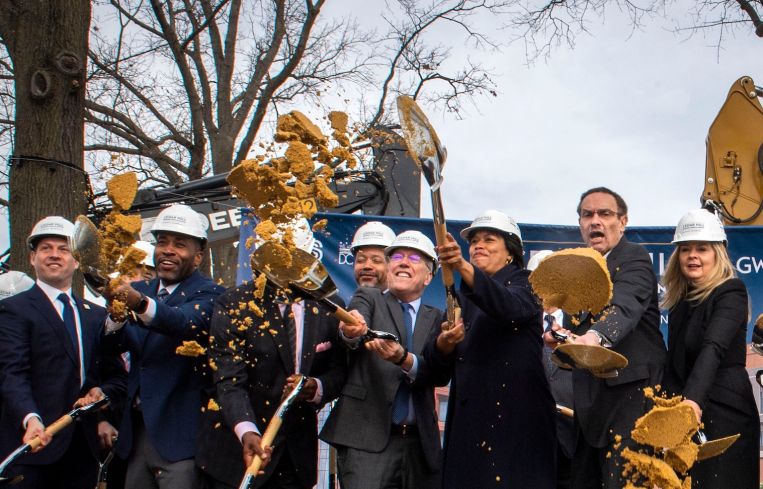


As Washington, D.C., Mayor Muriel Bowser ends her more than decade-long run as the District’s top official, she leaves behind a rapidly evolving commercial real estate community after steering new investment priorities, advancing landmark stadium redevelopments, and aggressively pursuing adaptive reuse as a response to office distress.
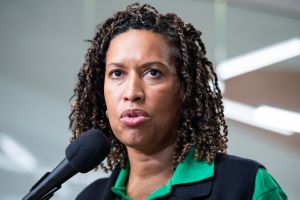
Bowser announced last week that she would not seek a fourth term, claiming that she had “accomplished the things [she had] set out to do” during her administration’s tenure. The D.C. native has served as mayor since 2015, navigating a razor-thin line between pushing for the District’s growth (and holding onto to its most prized assets) and steering the ship around budget deficits, office-use woes and conflict with the federal government and President Donald Trump. Bowser’s current term ends in January 2027.
“It has been the honor of my life to be your mayor,” Bowser wrote on X Tuesday morning. “Together, we have built a legacy of success of which I am intensely proud. With a grateful heart, I am announcing that I will not seek a fourth term. For the next 12 months, let’s run through the tape and keep winning for D.C.”
Chief among Bowser’s accomplishments on the commercial real estate side are the deals she closed to keep the Washington Wizards and Capitals professional sports team within the District, and also to bring the Washington Commanders football team back after nearly 30 years in Maryland exile.
The former came in early 2024, when Bowser convinced Monumental Sports & Entertainment owner Ted Leonsis to keep the Wizards’ and Capitals at Capital One Arena in Chinatown. D.C. will commit roughly $500 million to finance and renovate the arena, as well as parts of the surrounding neighborhood, in exchange for Monumental nixing a deal to relocate the teams to a new $2 billion mixed-use district across the Potomac River in Northern Virginia. The stunning reversal — which came months after Virginia Gov. Glenn Youngkin had already announced the move — will keep the teams within the District until at least 2050.
“[The Virginia deal] was a tough pill to swallow back in December, but we knew it was never quite a done deal,” DowntownDC BID President and CEO Gerren Price told Commercial Observer at the time. “It’s no secret that D.C. has been struggling to gain its footing back since the pandemic, and when Monumental announced they might leave, it exacerbated feelings of uncertainty in people here – almost feelings of despair in some ways. But the city still galvanized really quickly, and, as the Virginia deal began to fall apart, Monumental and Ted Leonsis saw those commitments we were making for the future of downtown as more and more attractive.”
One of Bowser’s priorities from the beginning of her tenure — and one which had evaded four previous D.C. mayors — was her $3.8 billion deal to re-make RFK Stadium and bring the Commanders home. The Josh Harris-owned team, which has played at Northwest Field in Landover, Md., since 1997, will redevelop the 57,000-seat husk and its surrounding area into a 180-acre, mixed-use neighborhood.
The Commanders will invest $2.7 billion to build a new, 65,000-seat roofed stadium that’s scheduled for completion in 2030, as well as two mixed-use districts surrounding the stadium. D.C. will contribute $1.1 billion and develop three other commercial districts. The move amounts to the largest economic development projects in D.C. history, and one of the largest public investments in National Football League history.
Bowser’s role in bringing the football team back was crucial. A March congressional budget bill omitted language that would allow D.C. to spend its 2025 fiscal year budget, effectively causing a $400 million city deficit. It forced Bowser to get creative with the District’s finances. The mayor responded with the “Grow D.C.” agenda that incentivizes fresh economic activity along with aggressive cost reduction efforts, such as scratching the city’s new child tax credit program and cutting Medicaid eligibility in D.C.
“With this budget, we’re not waiting for change to happen — we’re making change happen,” Bowser said in May. “The growth agenda is about creating jobs for D.C. residents and generating the economic activity we need to keep D.C. a world-class city.
The city managed to liberate roughly $800 million to spend on the RFK rebuild by refinancing its debt, scrapping a $400 million plan to build a new jail, and using pent-up funds from the city’s sports facilities tax. Bowser, meanwhile, spent months (if not years) convincing Harris and D.C. Council members to support the team’s relocation, in spite of the city’s budget troubles and offers from Maryland and Virginia.
Given the exodus of many office users from the District throughout the pandemic and the Trump administration’s federal workforce and agency cuts earlier this year, Bowser has also made encouraging commercial investment and cutting red tape a priority. That includes recent legislation to streamline zoning appeals, allow for regulated poker and blackjack tournaments in licensed venues, create an appeals process for what Bowser described as “onerous” taxation on commercial investments, and increase support for small businesses.
With an office vacancy rate still hovering well above 20 percent, D.C. has also become a national leader in office-to-residential conversions under Bowser’s leadership. The city’s Housing in Downtown program, enacted early last year as part of Bowser’s fiscal year 2024 budget, established a 20-year tax abatement to incentivize adaptive reuse projects in Downtown. The District leads all other U.S. cities in residential unit conversions per capita with more than 6,500 units in the pipeline, according to a RentCafe report in August. That includes dozens of new units via two projects from Monumental Realty, which Bowser announced in September as among the latest developers to receive the abatement.
Other major developments under Bowser’s tenure include the $3.6 billion Wharf project and the ongoing Parks at Walter Reed mixed-use district.
“For 10 years, you and I have worked together on an ambitious agenda to restore faith in our government and ensure that every D.C. resident gets the fair shot they deserve,” Bowser wrote in a letter to the D.C. Council regarding her decision to not seek a new term.
Nick Trombola can be reached at ntrombola@commercialobserver.com.