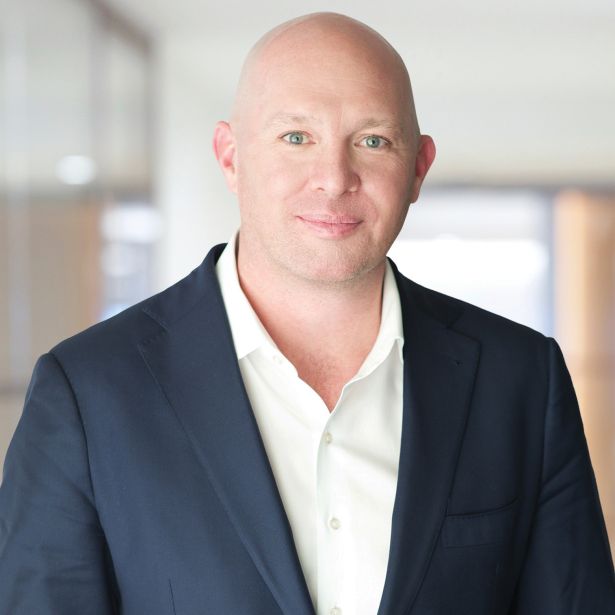
Bryan Donohoe
Partner and head of U.S. real estate debt at Ares Real Estate
With a $14 billion U.S. commercial real estate debt platform, it’s not surprising that Bryan Donohoe of Ares Real Estate oversaw an impressive $5.7 billion of loan commitments across 40 deals in 2025, with 83 percent of those loans exceeding $100 million.
Since Donohoe came onboard six years ago, he’s helped grow Ares’ CRE credit business by focusing on core-plus debt and value-add opportunistic credit, with the annual momentum and success producing new goals: His intention is to increase originations by 35 percent next year.
“We’ve generally tried to focus where we have what could be characterized as ‘a right to win,’” said Donohoe. “We’re heavier in logistics, given our footprint; heavier in multifamily, especially the last 18 months following the value reset … and it’s similar with self-storage, where we have a vertically integrated West Coast team with a national footprint.”
And then there is the size of these loans.
The firm originated a $585 million senior construction loan for Related Ross’ $772 million two-tower office development at 10 and 15 City Place in West Palm Beach, Fla.; a $450 million senior loan to refinance an 834-unit multifamily asset in Brooklyn; and a $532.7 million senior loan to refinance a 12-asset national logistics portfolio spanning 5 million square feet.
“It’s an echo of what we do on the equity side of the business — we want to lend against assets or properties that we’d otherwise want to use,” explained Donohoe. “We want to lend on an apartment complex that we want to live in, or an industrial property that houses tenants we’d buy goods from, and if we’re lending against a hotel, we want to stay in it.”
Ares has found it’s a strategy that its investor base desires. To wit, over 70 percent of its deals are with repeat sponsors, and the flexibility of Ares’ capital base allows the team to support sponsors at every stage of an asset’s business plan, according to Donohoe.
“We want consistent income, low volatility, and we don’t want capital flows to be interrupted because a given market or asset is no longer in favor,” he said.
The Stories Behind the List