

In Pro-Development South Florida, NIMBYism Rises
Opponents of new projects in West Palm Beach, Miami Beach and elsewhere say they’re concerned about the pace of development and the use of a state law to circumvent localities
By Julia Echikson September 16, 2026 2:25 pm
reprints
When Catherine Adler first moved to the West Palm Beach area in 1991, the South Florida city counted only a handful of high-rises, most of which were clustered around downtown. Today, though, she barely recognizes the regional city.
Since 2019, at least nine towers have been completed. More than 10 are now under construction, some rising in residential neighborhoods packed with single-family homes. And more change is likely to come: Another nine developments have already been approved.
“There’s cranes everywhere. You turn around and, all of a sudden, something’s going up,” Adler said. “The beautiful waterfront, the historic neighborhoods, and the charm — I don’t know if that’s going to be around.”
South Florida has long been a bastion of new development. For decades, the region prospered thanks to pro-development policies that fueled a boom in condominium construction that attracted vacationers, retirees, foreign investors looking for a second home and wealthy newcomers.
But, in recent years, South Florida has faced an all-too familiar obstacle: NIMBYism. The “Not In My Back Yard” phenomenon has long been common in places with starkly different politics, such as New York and California, but after years of developer free-for-all, NIMBYism has now finally descended onto South Florida.
“We might be reaching a turning point,” said David Foster, an assistant professor at Florida State University who studies the politics of housing. “There’s nothing inherently partisan or conservative or liberal necessarily about homeowners’ opposition to development.”
While South Florida, like most regions, has had its share of NIMBYism over the years, the movement is gaining significant steam since the COVID-19 pandemic, when millions of Northeasterners moved south to Florida. To meet booming demand for housing, real estate projects proliferated fast, often to the frustration of many locals, including Adler.
This year, she co-founded the Save West Palm Beach advocacy group. Her concerns echo traditional NIMBY grievances over increased density and the strain that new development and residents are placing on West Palm Beach’s infrastructure. She also believes the approval process often lacks transparency.
“There’s bumper-to-bumper traffic during important hours. How do you get to the hospital? How does the fire truck get to the fire?” Adler pondered. “The developers come, they develop, they leave, and we’re left with the city.”
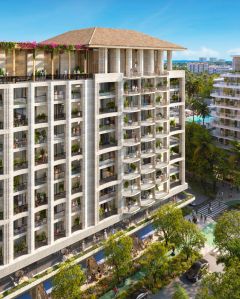
NIMBYism isn’t just a West Palm Beach phenomenon. In March, about 75 percent of Boca Raton residents voted to reject Terra and Frisbie Group’s redevelopment of the city’s downtown government campus into a mixed-use project, even after the high-profile developers scaled back the proposal from 31 acres to just under 8 acres in a bid to assuage residents. Voters also elected the man who led the anti-development campaign, Jon Pearlman, to the City Council. (Pearlman did not respond to requests for comment.)
Some of the heightened concern is due to the state’s Live Local Act. In 2023, the Florida Legislature passed the law, which grants developers tax breaks in return for pricing at least 40 percent of new units within reach of people earning 120 percent of an area’s median income (AMI). Most importantly, if that criteria is met, developers can bypass many local zoning rules to build tall structures without even being subject to public hearings. While the law is intended to boost the housing supply, speed the pace of construction and bring down rents, it has infuriated many municipalities and residents, who believe their rights have been stripped.
In Miami Beach, the law is threatening some of the city’s historic Art Deco buildings, which residents and local officials have fought hard to protect. Take the adjoining Savoy and Arlington Hotels, which were built between 1937 and 1941 along the famed Ocean Drive.
Using the Live Local Act and another state law targeting Florida’s oceanfront properties, the hotel’s owner, the Hadar family’s Allied Partners, filed plans to redevelop the 1.8-acre property into a 38-story tower with 150 apartments, 76 hotel rooms and 257 parking spots. The 480-foot high-rise would be among the tallest in Miami Beach, soaring 27 stories higher than its two neighboring buildings.
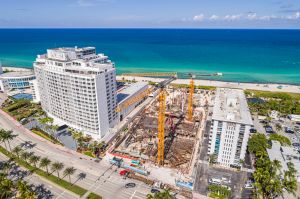
Thanks to the state laws, the application has been moving through the city’s approval process this year without a single public hearing before the Miami Beach Historic Board, as would have been customary for any redevelopment of a historic structure. (A member of the Hadar family has yet to respond to a request for comment.)
“What’s bothering a lot of people is seeing almost this unbridled development,” said Ned Murray, associate director of the Jorge M. Perez Metropolitan Center at Florida International University, who studies housing-related issues (and whose center is named after one of the most prolific developers in the state’s history). “Live Local being enacted may have been the cherry on top of the sundae.”
For Murray, the pricing restriction does not adequately address South Florida’s housing affordability crisis. The 120 percent threshold targets working professionals, not the lowest-income residents. Besides the residential component, the Live Local Act also grants a sizable market-rate, commercial component, further enhancing the economics for developers.
“I think there’s some resentment,” Murray added.
Another factor could also be property taxes. Because they’re generally calculated based on a property’s assessed value, homeowners are motivated to keep values low to avoid paying huge tax bills. The calculus in Florida may soon change. This November, residents will vote on whether to reduce most property taxes.
Once property taxes are restricted, homeowners are incentivized to boost the value of their property and restrict new supply. It’s a phenomenon that William Fischel, a housing economist who taught at Dartmouth College, observed in California after residents voted in 1978 for Proposition 13, which limits property taxes and caps any increases.
The opposition to development in South Florida extends beyond just new residential properties to also include data centers, the latest NIMBY pariah to grip the nation. In August, the Palm Beach County Commission passed a one-year moratorium on data center applications. The decision came after one proposal drew so much backlash that a public meeting lasted 12 hours, with nearby residents voicing concerns over the 2 million-square-foot development’s water consumption, noise, electricity and infrastructure demands.
“Just don’t do it in front of communities, don’t do it in front of schools. I mean, that’s horrible,” Larry Frazier, who lives in a master-planned development near the proposed data center, said at the hearing in July. “Who would even consider doing that?”
The pushback has some developers seemingly worried. Commercial Observer reached out to numerous builders, who either declined or did not respond to requests for comment. Others are concerned that South Florida is falling into the same pitfalls as New York and California. The two fellow coastal states have some of the country’s most expensive, supply-constrained housing markets, in large part because NIMBY opposition has made it difficult to build enough housing.

“You cannot have a community that does not reinvest in itself, that does not build for tomorrow. Otherwise, that community will die,” said Russell Galbut, a prominent South Florida developer, adding: “You see what’s happening in L.A. It’s a very sad situation.”
Galbut acknowledged that developers need to do a better job at pitching their projects to the community — and stay the course when the going gets tough. After purchasing the Galleria Mall in Fort Lauderdale last year, he and his partners unveiled plans to add nine 30-story multifamily towers, a 170-room hotel and more retail space by using the Live Local Act. The proposal was meant to revitalize the 32-acre mall, whose occupancy rate had mostly hovered below 70 percent in the few years before the sale.
But nearby residents saw it differently. A petition on Change.Org opposing the redevelopment garnered nearly 1,500 signatures, citing concerns over density, increased traffic, noise and pollution. While the project has yet to be approved, Galbut remains confident.
“It may take 20 meetings, it may be 30 meetings, but I really believe in human nature. People want to understand. You just have to explain your position,” Galbut said. “If you want to build a community of tomorrow, you also have to fight for it.”
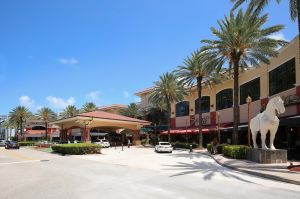
Despite the rise of NIMBYs, their powers are likely to remain limited in South Florida. Local officials have pitched South Florida as a more business-friendly and affordable alternative to New York and California, making them unlikely to embrace policies that could constrain development. And real estate remains Florida’s largest private industry by far.
“In New York and California, they can levy pretty high taxes, become pretty difficult places to build, and still not crush their main industries,” said professor Foster. “In Florida, not quite as much.”
Even the NIMBYs say they don’t want to restrict all development. “We believe in growth. It can strengthen a city,” said Fatima Sanandaji, a co-founder of Save West Palm Beach, who moved to the city in 2020. “But it should be balanced and thoughtful.”
Julia Echikson can be reached at jechikson@commercialobserver.com.


