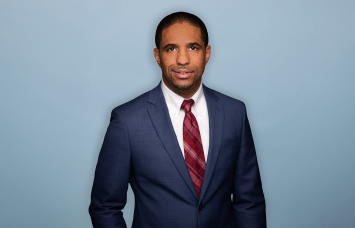
Tom Giordano of Suffolk Construction: 5 Questions
By Amanda Schiavo July 31, 2026 8:00 am
reprints
From a young age, Tom Giordano, general manager of the New York region for Suffolk Construction, had one goal. That was to follow in his uncle’s footsteps and become a lawyer to benefit his community.
After going from litigation to representing general contractors, developers and design professionals on legal matters, he joined Morse Diesel Construction in 1999, then Bovis Lend Lease in 2004 as general counsel. For the last four and a half years, he has been managing the New York office of Suffolk Construction, working in a non-legal executive role.
Giordano is responsible for enhancing the company’s internal organization processes and its infrastructure, as well as ensuring Suffolk is in a strong position to grow and expand construction management projects in the metro area — which for the firm includes New York City, Westchester and Long Island — in the hospitality, health care and residential spaces.
Commercial Observer caught up with Giordano in July to discuss what projects Suffolk has been working on recently, notable market trends in New York City’s construction industry, and how the firm takes a project from an idea to reality.
This conversation has been edited for length and clarity.
Commercial Observer: What is the mission of Suffolk Construction in New York?
Tom Giordano: Our mission is pretty simple. We want New York to be similar to what Suffolk is nationally. We want to be not necessarily the biggest, but the best construction management firm in the New York metro area, and deliver the Suffolk culture here.
We’ve had a New York presence for 13 years, but we’ve really gotten a significant amount of traction over the last five and a half years. We’ve grown significantly. When I started, we were probably doing $350 million a year in revenue. Now we’re doing $1.3 billion, with a real look at $2 billion a year in the next two years.
What kinds of projects does Suffolk work on across New York?
When I started, we were 40 percent residential. Now I’d say we really have a balanced portfolio in New York City.
We’re doing a lot of work in health care, building hospitals. We’re doing some residential and higher education. We’re also doing hospitality. We’re building hotels and we are building life sciences facilities, and we’re doing some public works.
Can you share a few examples?
We’re doing a project on the South Shore of Long Island for a new pavilion for Northwell Health, which is a six-story pavilion next to an existing hospital. We’re also expanding White Plains Hospital in White Plains, N.Y., which is a nine-story tower that will deliver innovative and state-of-the-art health care for an existing hospital, and we’re doing work for New York University. We’re building an ambulatory center right now in Brooklyn. We’re also going to be building a new pavilion in Patchogue, Long Island.
One of our largest projects is the Brooklyn Army Terminal. It’s a tremendous project. It was built as two huge buildings, A and B, that were built in 1918. They have an existing rail yard coming through them, and they were really purposed for carrying munitions and supplies for World War Two, and have since been repurposed to help gestate businesses and manufacturing. There are restaurants there, there are climate-focused technology companies. It really runs the gamut. It’s a huge facility, and we’re involved in various projects that they’re doing to upgrade and fully fit them out.
In hospitality, we have a job right now where we’re building the Torch at 740 Eighth Avenue, which is going to be 1,800 hotel rooms and 40 stories. There will also be a concrete core that goes up to 80 stories, upon which there’ll be an observation tower, two restaurants and four drop rides. You’ll be able to take a free falling drop ride down the middle.
What’s challenging about construction in New York City right now?
It’s a tough place to build due to certain tax laws that come with construction wage requirements and the different rezonings and legalities.
What we try to do to get a reasonable cost is to get clients involved early in the process, so that we can help them manage the construction aspects of all of those things. To refine and design based on those requirements to do constructability analysis and budgets to make sure that they’re the schemes that are being envisioned make sense from an economic perspective.
We know that the success of a project is largely based on how much you pay for the land relative to what you end up building on it, so we try to get involved early in the process and be a partner even before the project has become real and entitled. A lot of what needs to be done for a project to be successful is done before a shovel is put into the ground.
As a hypothetical, if you were asked to build a 200-unit residential in Manhattan, how would that project go from an idea to reality?
In the beginning, what we would do is we would give a back of the envelope estimate of what — based on our experience and our databases — the construction cost and projected construction costs, and budget would look like.
We would then do constructability analysis to show what logistics would go into the project and how long it would take, which would really evolve into a schedule. During that time, we would also get involved in value engineering to see whether we could help to influence what types of materials are used — like curtain wall or using concrete poured in place, what’s the best — and and then we work with the design team to try to influence what’s being designed to make sure that it not only functionally fits within code and guidelines, but it also fits within an owner’s budget and vision.
Amanda Schiavo can be reached at aschiavo@commercialobserver.com.