Walker & Dunlop Leads $16.5B Fannie Mae Lending Market
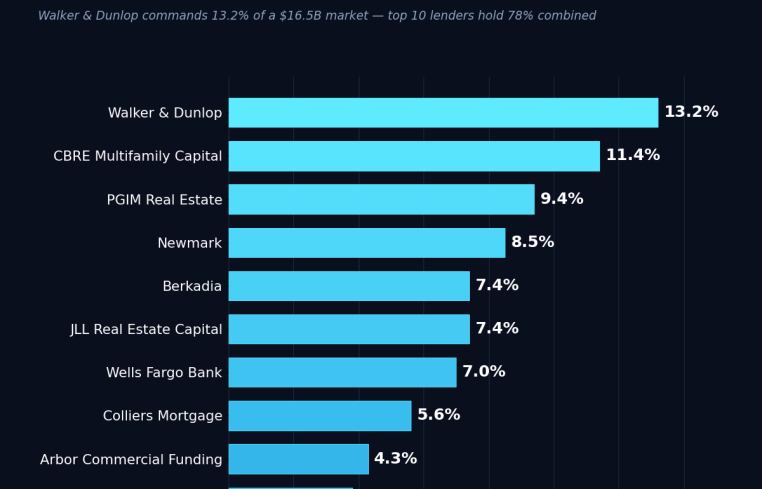
Walker & Dunlop is the top Fannie Mae multifamily lender in 2026 year to date, originating $2.18 billion across 110 loans, according to CRED iQ proprietary loan analytics. The firm leads a concentrated agency lending market in which the 10 largest originators captured roughly 78 percent of all volume through mid-May.
CRED iQ analyzed 1,071 Fannie Mae multifamily loans totaling $16.5 billion issued from January through May 2026. The data reveals a market dominated by a familiar set of agency lending heavyweights, with the top five originators alone responsible for half of all dollar volume.
The Fannie Mae multifamily lending leaderboard reflects the entrenched scale advantages of the largest Delegated Underwriting and Servicing (DUS) lenders. Walker & Dunlop’s $2.18 billion narrowly outpaced CBRE Multifamily Capital at $1.88 billion and PGIM Real Estate Agency Financing at $1.56 billion. Newmark ($1.39 billion), JLL Real Estate Capital ($1.22 billion), and Berkadia ($1.22 billion) rounded out the upper tier.
Loan count tells a complementary story about origination strategy.
Berkadia led all lenders with 172 loans, signaling a high-
volume, smaller-balance footprint, while Walker & Dunlop’s 110 loans carried a higher average balance. The average Fannie Mae multifamily loan in 2026 YTD measured approximately $15.4 million.
Fannie Mae multifamily origination volume accelerated through the first quarter of 2026 before moderating. Monthly volume climbed from roughly $3.1 billion in January to a 2026 peak of $5.6 billion in March, according to CRED iQ data, as borrowers moved to lock in financing amid shifting rate expectations. March alone accounted for more than one-third of first-quarter volume.
Refinancing is the primary engine of 2026 agency activity. Refinance loans represented 62.8 percent of total volume ($10.3 billion), reflecting a wave of borrowers addressing 2026 and 2027 loan maturities and replacing higher-cost bridge debt. Acquisition financing accounted for 36.1 percent ($5.95 billion), with supplemental loans making up the small remainder. The refinance-heavy mix underscores how maturity management — rather than transaction velocity — is defining this lending cycle.
Gateway and Sun Belt metros dominated 2026 deployment. The New York–Newark–Jersey City metropolitan statistical area led all markets with $1.6 billion in Fannie Mae multifamily
volume, followed by San Jose–Sunnyvale–Santa Clara ($750 million) and Los Angeles–Long Beach–Anaheim ($720 million). High-growth Sun Belt markets including Phoenix ($690 million), Miami–Fort Lauderdale ($630 million), and Dallas–Fort Worth ($600 million) also ranked among the top destinations for agency capital.
The 2026 Fannie Mae multifamily landscape is defined by concentration, refinancing demand and a resilient appetite for gateway markets. With the top 10 lenders controlling nearly four-fifths of volume, scale and DUS relationships remain decisive competitive advantages.
Mike Haas is the founder and CEO of CRED iQ.