First LIRR Strike Since 1994 Hits NYC CRE Industry
By Andrew Coen May 18, 2026 1:49 pm
reprints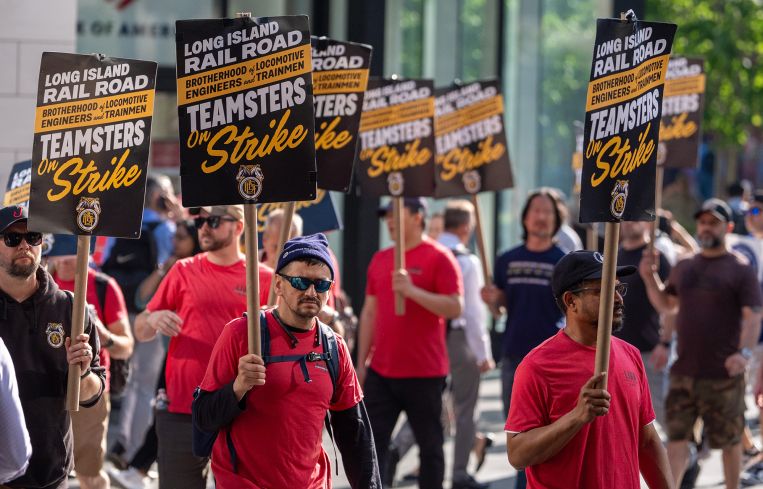
The first Long Island Rail Road (LIRR) strike in more than 30 years has added a new obstacle for a New York City commercial real estate industry that has faced a series of challenges in recent years, forcing many to work from home.
LIRR workers from five unions went on strike at midnight Saturday morning after failing to reach an agreement on a new wage increase with the Metropolitan Transportation Authority (MTA) before a May 16 deadline. The first LIRR work stoppage since June 1994 continued through the weekend into Monday, affecting nearly 300,000 workers who use the railroad to commute from suburban Long Island into New York City.
Dan Berman, managing partner of U.S. real estate at law firm HSF Kramer, navigated the LIRR disruption by taking an Uber into Manhattan early Monday and booked a hotel room in the city for the night. He said going into the office was essential since HSF Kramer is hosting all its global managing partners this week, nearly a year after the law firm previously known as Kramer Levin merged with London- and Sydney-based Herbert Smith Freehills.
“It would be hard for me to not come in this week when people are coming from all over the world and as far away as Australia,” said Berman, whose commute took over an hour longer than normal by car on Monday. “I was a little concerned that all the hotels would be sold out but there seems to still be rooms.”
The MTA — which oversees the LIRR — and the unions resumed talks Monday morning to try and iron out a deal. The groups have failed to reach a new contract since 2023 over differences in salaries and healthcare contributions.
The LIRR strike happened to coincide with the annual ICSC conference in Las Vegas, which many in the New York City CRE industry are attending, including Joseph Fingerman, president of commercial real estate at Peapack Private Bank & Trust.
“While I and some of my team are in Las Vegas at ICSC, back home Peapack Private’s financial centers are open, fully staffed, and ready to serve our valued clients, with many employees working remotely, yet the economic impact on the region is significant,” Fingerman said. “While a deal must be reached immediately, it is just as critical that the resolution be financially sustainable for all parties.”
Fingerman, who was formerly head of CRE lending at Signature Bank, stressed that there is great urgency to strike a deal soon because of how important Memorial Day weekend is for the New York City region’s retailers, restaurants and small businesses. He noted, though, that any deal must also be one that the MTA can afford, in order to avoid more fare increases or tax burdens on businesses to fund the system.
Gov. Kathy Hochul has said some of the demands from the unions would force the MTA to raise LIRR fares by as much as 8 percent.
Andrew Coen can be reached at acoen@commercialobserver.com.