

More Women Than Ever Are Assuming Leadership Roles in Proptech
But capital-raising in the field still feels like an old boys’ club
By Philip Russo March 31, 2026 9:00 am
reprints
Yes, more women than ever are assuming leadership roles as entrepreneurs and investors in proptech.
But those leaders know better than anyone the efforts required to attain such status. And while anecdotal evidence tells them that there’s more women leaders than before, those same observations tell them there’s room for growth, especially when it comes to capital.
“For proptech commercial real estate-specific (retail/office/industrial assets) female founders, no one even bothers to publish numbers, as it is literally a handful of us,” Sienam Ahuja, CEO at Mountain View, Calif.-based Bryckel AI, an artificial intelligence-powered commercial lease review and abstraction startup, said in an email. “Most women are concentrated in
multifamily housing.”
Ahuja cited industry numbers from 2019 that underscore what it means to have more Women in PropTech now. “Only about 10 percent of proptech founders in the U.S. are women, and in CRE–focused proptech that figure likely falls below 1 percent.”
Women in proptech, then, are highly aware of their challenges in entrepreneurship and in obtaining funding for their companies, she said.
“Access to funding remains the most significant structural barrier even though there is customer love,” Ahuja said.
An estimated 10 to 13 percent of the approximately $16.7 billion deployed into proptech in 2025 went to companies with female founders, Ahuja said, citing data from the Center for Real Estate Technology & Innovation.
“However, that figure is skewed by a small number of large rounds, masking the broader reality that most women founders struggle to access capital at all,” Ahuja said. “Notably, no widely available proptech-specific breakdown of funding to women exists for 2025 — an absence that highlights a meaningful data gap in the industry.

“From my own experience as a founder, the challenges are consistent but take different forms. Generalist Silicon Valley investors are often willing to engage, even if proptech is outside their core thesis. In contrast, proptech-focused investors tend to either ghost, require disproportionately high traction as risk mitigation, or direct founders like me toward costly programs as a prerequisite for access. If others in tech feel like they’re climbing a ladder, women in proptech, especially in CRE, are climbing Everest without oxygen.”
Sandeep Ahuja (no relation) is CEO at Atlanta-based Cove, which bills itself as the world’s first architecture firm built around AI. She agreed that women have a tougher time finding funding for their companies. The nature of proptech’s clientele is part of the problem.
“I’ve raised capital in venture broadly and in proptech specifically, and I’ll be direct: Proptech is worse,” Sandeep Ahuja said in a statement. “The biases that exist across venture — pattern matching on founder profiles, underestimating women-led companies, requiring more proof before writing the same check — all of that gets amplified in proptech, where you’re also navigating a real estate old guard with deeply entrenched networks.”
However, she sees a game-changer in AI.
“Our market cares about one thing — can you deliver high-value outcomes, at low cost, fast?” Ahuja said. “That’s it. When I pivoted Cove to become an AI-powered architecture firm, the client conversations shifted overnight. Nobody asked about my pedigree. They asked how fast we could deliver and what the results looked like. That’s the unlock for women in proptech right now.
“If your product compresses timelines, reduces risk and drives better outcomes, the market will find you — regardless of what you look like. The women winning in this space aren’t waiting for a warm intro from the right [limited partner]. They’re building things that work, and the results are doing the talking.”
The share of proptech CEOs who are women hold a particular significance for Lisa Nickerson, who in January was named CEO at Boston-based Infinityy, a virtual listing platform for real estate agents. Nickerson said that even though female-led companies consistently outperform on return on investment and revenue, their low numbers reflect a broader industry contradiction: the intersection of two historically male-dominated domains, real estate leadership and venture-backed technology.
“As a general statement, I believe more men are coming from a traditional tech background into property technology, and they face hurdles they’re not expecting because the real estate industry is so inconsistent in how decisions are made or how different things touch each other,” said Nickerson. “If they’ve come from a traditional tech background, they’re expecting more of a wash, rinse, repeat as to how decisions are made. Whereas I see a lot of the women coming from a more real estate background, having that deep expertise. I think that is my value prop per se — my experience across various real estate verticals, and that I understand the ecosystem.”
Lindsay Liu, co-founder and CEO at Super, which is building voice AI for real estate property management, said the divide between the perception of women entrepreneurs and capital is still daunting.
“I think that in the last few years there’s been a lot of conversation broadly in the tech and startup industries around access to capital for women and getting more diverse teams in place,” said Liu, noting that the share of general technology venture capital for women-led companies actually fell to 2 percent in 2024, down from from 2.4 percent a decade earlier. “It’s interesting because I feel like we’re having big conversations, but it’s not necessarily translating into the capital.”
Perceived cultural differences with male founders continue to be a challenge for women in proptech, Liu said.

“There are quite a number of stats on how men are promoted for potential, whereas women are promoted for proof,” she said. “So, professionally, those men advance because their confidence is rewarded, while for a woman to advance in her career, she really has to have a track record. Now, as a founder, I think that sets us up to be better founders, because you’ve gone through these reps, climbing uphill and figuring out how to make sure you’re getting noticed, and delivering results along the way. It builds resilience, and, as a founder, you need to be able to survive in so many ways. I think knowing that the bar is higher gives you an advantage going into the very difficult world of starting a company.”
Many proptech women leaders must rely on industry trade conferences to network and grow their influence.
An acknowledged presence in that networking world is Nikki Greenberg. She is the founder and global ambassador of Women in PropTech, and a member of the Real Estate Board of New York’s technology committee.
“What I’m finding is that we are seeing more women in the space, and we’re seeing a lot more success stories, which is good,” said Greenberg about her ongoing discussions with female entrepreneurs and investors. “I think that more women have come into the space because it’s something that’s very relatable, and it doesn’t have the same level of bro culture.
“Real estate deals happen slowly, but tech can be more nimble and fast-paced,” Greenberg added, with women leaders in proptech not just participating, but redefining the industry. She said their strength lies in execution: building high-performing cultures, fostering genuine client relationships, and delivering measurable results through companies such as EliseAI, Tulu, and Hello Alfred (all women-led).
Still, women leaders face significant obstacles in proptech, said Arlinda Dine, co-founder and co-CEO of Klipster, a platform for live property tours and real-time interaction with brokers and owners.
“Women aren’t new to real estate, but in proptech the gap isn’t presence — it’s power,” Dine said in an email. “You still don’t see women proportionally represented in capital or at the highest decision-making levels. But where women are making an undeniable impact is in what actually gets built and, more importantly, what actually gets used.
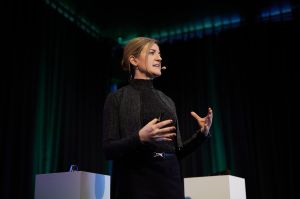
“A lot of proptech has historically been built from the outside looking in. It has been tech-first and often disconnected from how deals really happen. What we’re seeing now is a shift toward building from the inside out, and many women in this space are driving that. They’ve been operators first — brokers, marketers and deal-makers — so they’re building products that reflect real workflows, not idealized ones. That shows up in adoption. The market doesn’t reward theory. It rewards tools that people actually use.”
As a real estate professional who has moved from commercial real estate to venture capital and who is now the CEO at sustainability platform Measurabl, Maureen Waters has seen the growth of women in leadership, particularly in real estate technology.
“I do see more women in proptech, for sure,” said Waters, whose employees are 47 percent women, with a 40 percent female leadership team. “I think that there are many paths today because of the diversity within proptech. I mean that when you think about it, proptech also kind of leans partially into fintech, depending on the stage. And I would say that there are many more women that are starting at the ground levels in building their careers within proptech, different from my path, which was more on the real estate side and then coming into proptech. It was a little harder for me to make the transition — not because I couldn’t make the transition, but for being accepted as having the experience to transition from real estate into technology. Today it’s much more acceptable for women to actually start from that and go into proptech.”
A large residual issue for women in proptech is the relative lack of mentors, Waters added.
“I think it’s still very, very important for women, and for anyone, to understand that they need mentors along the way,” she said. “They’re super helpful as what I would consider an external mentor type — someone that actually helps you to grow and build your career — but also as what I would call more of an internal mentor, which sometimes is known as a sponsor, who is within the organization. The latter can help you navigate the politics of how to grow within that organization specifically.”
Philip Russo can be reached at prusso@commercialobserver.com.


