Behind Cryptocurrency’s Commercial Real Estate Moment
It seemed far-fetched only a few years ago, but now tokenization has opened the possibility of trading real estate with virtual tender
By Brian Pascus March 31, 2026 8:00 am
reprints
Thirteen years ago, Grant Cardone, CEO of Cardone Capital, a multifamily syndication firm with $5 billion in assets today, was paid for a speaking engagement in 115 BTC, or Bitcoin.
For the uninitiated, Bitcoin is the most famous currency in the cryptocurrency universe, an enormous network of digital currencies invented over the last 17 years to facilitate peer-to-peer transactions on a decentralized, mathematically encrypted blockchain ledger, all without banks and traditional clearinghouses acting as intermediaries.
Cardone never got around to trading his crypto for dollars, but over the years saw the value of that one-time BTC payment fluctuate with the overall price of Bitcoin, which started as low as $14 for one BTC in 2013 and rose to $46,000 in 2021, then fell back down to $15,000 in late 2022, and hit an all-time high of $126,000 last year.
Today, Bitcoin sits at around $69,000 per coin — meaning Cardone’s 2013 remuneration is worth $7.9 million. Not bad for an hour’s work.
“I’d never heard of Bitcoin at the time, I didn’t know what it was, and our executives, all the way to the top, said, ‘No,’ ” Cardone told Commercial Observer (as in they wanted him to steer clear). “Over the years, I started to become interested and curious because I’d been onboarded and didn’t know I’d been onboarded.”
As he grew his businesses, Cardone began studying Bitcoin, learning more about cryptocurrencies. He even attended a conference that explored which asset carried more intrinsic, long-term value: commercial real estate or Bitcoin.
At the end of the debate, he asked himself, “Why not put the two of them together?”
Late in 2024, Cardone Capital launched its 10X Space Coast Bitcoin Fund by buying a 300-unit multifamily property in Melbourne, Fla., for $72.5 million cash, and adding $15 million worth of Bitcoin to the capital stack, giving the single-building syndication fund a total value of $88 million — with the express goal of buying more Bitcoin with the cash-flow returned from the real estate.
“You get benefits of the real estate, the cash flow, the tax write-off, the appreciation going forward,” explained Cardone. “The property will cash flow at 4 percent or 5 percent per year, we’ll send out 5 percent per year, and, rather than that going into your checking account, we’ll divert the money, we’ll buy more Bitcoin with it by dollar cost averaging every month over a six- to eight-year term.
“We raised money on that faster than any project I’ve ever done, and we’ve done 47 real estate projects,” he added.
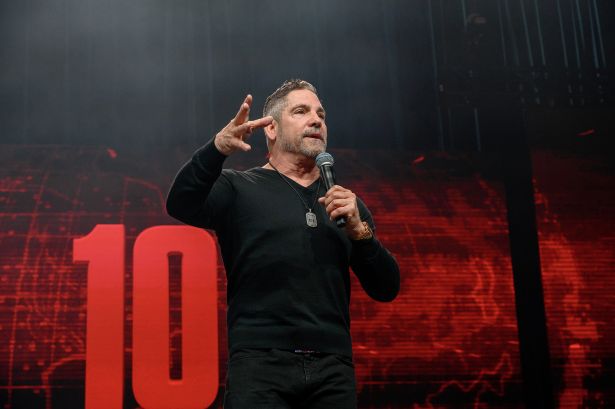
As Cardone sees it, this structure offers stable real estate and a hope note on Bitcoin for himself and his investors. The worst case is, even if the price of Bitcoin plummets, everyone gets their money back (so long as the asset itself doesn’t collapse in value). Under the best-case scenario, the structure becomes lucrative, exponentially so, if the returns the asset generates rise in tandem with the price of Bitcoin, which overall has increased in value by 25 percent in five years, despite some serious dips along the way.
“Grant is merging two asset classes into one fund, they’re in one bucket, and if they both go up, it’s a home run; if they both go down, it’s not; and if one goes up and one goes down, they even themselves out — it’s like buying a hotel with some gold,” explained Chad Carpenter, a CRE investor at Reven Capital. “I like the way Grant thinks. He’s innovative.”
Cardone is hardly alone in seeing the promise of integrating cryptocurrencies into commercial real estate. BlackRock CEO Larry Fink has argued that in the future “every asset,” including stocks, bonds and real estate, will be placed on the blockchain. Meanwhile, Congress has passed, and is still debating, far-reaching legislation that would radically integrate cryptocurrency into the U.S. financial system.
In February, Starwood Property Trust CEO Barry Sternlicht, who oversees $125 billion of assets in his real estate investment trust (REIT), announced that he hopes to one day allow investors to buy “tokenized” cryptocurrency shares, or fractional ownership, of Starwood’s hard, illiquid real estate assets that can be traded on a secondary market across the blockchain network.
As a REIT, Starwood is prohibited under current securities laws from offering this. But private firms like Cardone Capital and the Trump Organization, the firm run by the president’s two elder sons, are already offering investors the opportunity to buy small, individual shares — hundreds or even thousands of them — of standalone or pooled real estate projects through this process of cryptocurrency tokenization. In this tokenization, non-fungible tokens (NFTs) represent value and ownership of bit pieces of assets across the blockchain.
“In the current real estate investment climate, sometimes we see joint ventures with two or three players, but that’s for very large transactions and large institutional shops, whereas tokenization could, in theory, make CRE more accessible to retail investors,” said Stijn Van Nieuwerburgh, professor of real estate and finance at Columbia Business School. “It’s a way of potentially giving real people access to a larger group of assets, democratizing the asset class.”
Bina Ramamurthy, who teaches cloud computing and computer engineering at the University at Buffalo, said CRE is “an absolute killer example of tokenization,” as it can be used for a 100-unit apartment building, an entire 100-story office tower, or even 100 acres of empty developable land. Tokens can be issued to investors with estimations of the value different shares in different parts of the building can generate.
“There’s something about real estate in that it’s illiquid, but if you tokenize it becomes a liquid asset, and it becomes similar to stocks,” she said, referring to the potential of CRE tokens to be sold across cryptocurrency secondary markets, which are in their infancy and largely unregulated.
Tokenization is expected to transform commercial real estate in the years ahead, far beyond innovating recordkeeping by placing deeds, titles and mortgages on the blockchain, which many firms are already doing.
The Deloitte Center for Financial Services predicts that $4 trillion of global real estate will be tokenized by 2035, up from $300 billion today, with much of that coming from tokenized private real estate funds, tokenized ownership of loans and securitizations, and tokenized ownership of undeveloped land or new construction projects.
But the estimates vary. Roland Berger, the German consulting firm, calculated the global market for tokenized real estate hit $119 billion in 2023, but also predicted it will reach $3 trillion by 2030.
“If the only advantage of tokenization to real estate was automation of compliance and disruption accounting and ledger, then it’s great and still worth doing, but, after adding the chance for liquidity, it just explodes,” said Steven Streetman, founder of Grotto, a real estate tokenization company. “So, yeah, I’m very optimistic.”
The catch
Like any important concept in finance, it’s never so simple as a promised explosion of wealth, returns and vastly improved efficiencies.
First, in order to unpack the implications of cryptocurrencies’ attachment to traditional CRE financing structures, we need to understand some basics about crypto, which is among the more nebulous and poorly understood regions of the entire financial system.
Bitcoin began as the first decentralized cryptocurrency back in 2009, when an anonymous person or entity, known only as Satoshi Nakamoto, created a peer-to-peer electronic currency that could be used instead of the dollar on an interconnected, secure blockchain ledger that stores value away from traditional banks. While economist Milton Friedman first mused about a digital “e-cash,” as early as 1999, Bitcoin and modern-day crypto flowered in the wake of the Global Financial Crisis (GFC).
As time went on, early-era Bitcoin, and its competitor coins like Ethereum and Tether, weren’t so much used to facilitate payments (though some drug lords, extortionists and other criminals saw value in that respect) as much as they were used for pure speculation, primarily around the price valuations of the many different cryptocurrencies themselves.
“Cryptocurrency started out as a very niche project that was popular among civil libertarians interested in money free from government control and was used on dark web marketplaces to buy drugs on the Silk Road,” explained Molly White, an independent cryptocurrency researcher, referring to an online black market.
“Since the pandemic, options trading of cryptocurrency and memestocks has become widely accepted, and now we’ve seen a real push to institutionalize it with huge financial institutions offering Bitcoin [exchange-traded funds] or allowing trading crypto on their platforms,” she added.
Even the sitting president has enthusiastically embraced crypto, the Constitution’s emoluments clause be damned. President Trump infamously launched his own crypto token — a meme coin — shortly before his second inauguration in January 2025, where it reached a high of $73. Today it trades at just over $3.
And, while meme coins are tokens, not all tokens are meme coins. In fact, tokens should be viewed as the means of exchange that create cryptocurrency transactions and represent assets, with no token more important to the blockchain than stablecoins.
A stablecoin is a type of cryptocurrency that is pegged to a stable reference value, like the U.S. dollar. There are also Euro-pegged stablecoins, PayPal stablecoins and dozens of others. Unlike Bitcoin or Ethereum, which have a floating price and are volatile, stablecoins retain a relatively stable value, trading at $1, though they haven’t always done so.
But they are not dollars. No crypto exchange, like CoinBase, has any legal obligation to redeem stablecoins for dollars, nor is any stablecoin protected by the Federal Deposit Insurance Corporation (FDIC).
“People wanted a cash-management tool and something that could serve as collateral for crypto loans, so they developed stablecoins, a coin backed by a reserve of real world assets, usually some cash and Treasurys,” explained Hilary Allen, a law professor at American University Washington College of Law. “They are called the poker chips in the crypto casino.”
If this sounds confusing, innovative and even volatile, that’s because cryptocurrency is all those things and more. To some skeptics, it might even be a house of cards waiting to collapse.
“Cryptocurrency is exactly what people think it is: It’s a Ponzi scheme,” said Allen, who noted the blockchain itself is in essence a ledger of payments, debits and credits, of one account to another, fueled by a network of currencies that have no value beyond what enough users have projected onto them in the present moment.
“It’s a pure supply and demand — if everyone in the world decided they’d abandon Bitcoin, it would go to zero immediately, as there’s nothing behind it, there’s no productive capacity. The value comes from someone willing to pay more for it today than yesterday,” she said.
Others point to the inherent volatility of the price surrounding different cryptocurrencies, which impact the stablecoins and memecoins that investors and businesses trade across the blockchain and use as collateral for transactions valued in dollars in the everyday world.
“Bitcoin was $120,000 a few months ago, now it’s $60,000, so what if the collateral becomes $5,000 or $10,000?” noted Tomasz Piskorski, professor of real estate at Columbia Business School. “The challenge is financial institutions view it as cash, but it’s not cash — it’s a highly volatile asset. Crypto could be worth one-tenth what it used to be.”
Noam Franklin, managing director at Northmarq, sources debt and equity from institutional investors across the globe every day. He said not a single institutional private equity fund has ever spoken to him about integrating cryptocurrencies with commercial real estate, at least in a serious manner.
“I don’t think people will transact in crypto right now because they’re so scared of whether it will head further up or further down,” he said. “Why would I want to buy a condo with crypto today, and 12 months after it’s delivered the price is up or down 40 percent?”
Despite the criticisms of crypto skeptics, the market does seem to find tremendous value in the new kid on the block.
The New York Times reported in March that stablecoins’ market value has grown from roughly $20 billion in 2020 to $300 billion in 2025, and that the Federal Reserve estimates the value could reach $3 trillion in five years.
“Forty years ago we used cash. Then we got an ATM, then credit cards, now Venmo and Apple Pay, they all exist,” explained Ramamurthy. “It doesn’t mean these other forms of currency that exist have taken over entirely, but there’s a need for each one of them.”

A new CRE
The question, at least for capital markets participants, is what commercial real estate will look like should cryptocurrencies mature and become fully integrated into institutions across Wall Street.
With a value of roughly $27 trillion, commercial real estate is the nation’s largest asset class. A vast majority is privately held, with almost all the documentation of deeds and title searches organized in an arcane recordkeeping system, as big and small players alike buy and sell property amid closings that can take weeks or even months to finalize.
In short, it’s an industry ripe for disruption.
When it comes to ownership, whether that be a large office building, an apartment complex or even a chain of shopping malls, at an initial level that’s limited to large institutional players who finance transactions via credit or equity, with the latter using opaque limited liability companies (LLCs). Others, especially private players, pool investors’ money into funds that buy, sell or renovate specific properties, a process called syndication, which is popular across the multifamily space in particular.
Tokenization aims to challenge this established system in several ways.
“Most of the time, you’re a line on someone’s spreadsheet or paper certificate that says you have X number of shares in an LLC, but now you have a token that proves you own it on the blockchain, so it’s a little more concrete,” said Grotto’s Streetman. “Real-world tokenization allows you to invest into the syndication of an apartment building, where your ownership is something that’s provable, plus it’s a lot easier to distribute returns and manage accounting.”
David Yermack, professor of finance at New York University’s Stern School of Business, enumerated the many virtues of CRE tokenization. These include using the liquid tokens to improve transparency around investors’ security interest in properties, creating a secondary market of debt and derivatives that’s secured by the blockchain code, and allowing property interests to be easily transferred in the event of defaults while avoiding cumbersome liens that might upend deals.
“The crypto tokens are a lot easier to transact — it’s quicker, cheaper, more secure and more transparent,” he said. “In the next generation, all the stocks and bonds and commodities, all these things will be tokenized, simply because it’s a better way to represent property ownership.”
Then there is the bevy of opportunities tokenization creates for syndicators, who can attract ordinary investors outside the institutional sphere for their property pools and funds on the blockchain. But, as several crypto skeptics have pointed out, a sophisticated, transparent investment ecosystem already exists for mom-and-pop investors.
“We already do this, and it’s called the REIT market. And we have tokenization, it’s called public equity markets,” said Piskorski. “The benefits are you have SEC regulations watching your back.”
With REITs, investors cannot buy shares or fractions in individual office buildings or apartment towers. They can, however, buy shares of SL Green, Equity Residential or Simon Property Group, multibillion-dollar firms, and sit back and earn passive returns as CEOs and entire companies figure out how to grow income and ensure appreciation, all while insulating themselves from scams, illegalities and get-rich-quick schemes, which have plagued the syndication industry.
But there are drawbacks to the existing REIT structure.
The difference with tokenization, as Cardone argues, is that the REITs are shackled by securities laws that require them to distribute 90 percent of their annual taxable income to shareholders as dividends in order to keep their status as tax-exempt entities. This law, in particular, prohibits them from tokenizing their own individual assets, as Sternlicht hopes to do with Starwood, or from adding Bitcoin investments to the capital stack, like Cardone is doing with several funds across Cardone Capital and its 14,200 apartment units.
“I don’t want to be a REIT, because the REITs can never hold Bitcoin — it’s a 65-year-old structure that doesn’t allow them to hold any currency,” said Cardone, who noted himself other private syndicators are using tokenization and Bitcoin to create an alternative to the traditional public REIT investment network.
“We found this glitch in the real estate industry, just last year, that none of the REITs can ever hold Bitcoin on their balance sheet,” explained Cardone. “So we’ll get money from institutions that have a mandate to own real estate that cash flows, and is safe, but they’d also love to have exposure to Bitcoin.”
Even so, Cardone admitted that he’s held off tokenizing his entire real estate portfolio, which would create a secondary market for his multifamily investors to buy, sell and trade tokens of his buildings. He is concerned that crypto tokenization simply doesn’t have enough liquidity at the moment to form a viable secondary market.
Columbia Business School’s Piskorski emphasized this detail, noting there’s no point in turning CRE into crypto tokens if those tokens can’t be traded like shares of public companies, or even Bitcoin.
“It’s an economic problem. Not every asset deserves to be traded on a stock market, and there’s no demand for trading these tokens,” he said. “Simon Property Group, Equity Residential — they are big enough REITs and there’s enough volume where someone wants to buy their shares, but a token from a random multifamily tower in Dallas will have very few buyers.”
However, both Streetman and Yermack argued tokenization opens up commercial real estate investment to average Americans interested in putting customized pieces of their own savings into specific, diverse assets. For instance, they could place 10 percent of their net worth in 10 different apartment buildings in different markets with 1 percent interest in each.
Constantine Korologos, an adjunct professor at NYU’s Schack Institute of Real Estate and a capital markets consultant at Cornerstone Research, pointed out the numerous pitfalls in this type of passive investment, namely the valuation question: How can small-time investors in buildings have an accurate understanding of an individual building’s value, or what it can be sold for, or what any third-party valuations might tell them about their investment?
“One of the good things about real estate is the value of a building isn’t swinging back and forth like a share price during a volatile market, but present value versus future expectations changes all the time, which impacts longer-term market value,” he explained, before tackling essentially the complete lack of regulation around the cryptocurrency space.
“Could [a crypto syndicator] be less transparent in the information they provide token owners?” he asked. “Absolutely. So how do you regulate the dissemination of information to make sure there’s a certain level of timing, accuracy, and that the buyers and sellers of the tokens understand all of that?”
Additionally, Korologos pointed out that, unlike fixed-income securities, commercial real estate assets — two office buildings in the same city, for example — might be the same age and look identical, but they’ll still have very different financial characteristics, and small-time token investors likely won’t be getting the granular transparency of rent rolls or loan documents that institutions enjoy.
“That information is enough for shareholders buying into a company that owns real estate. People can get their arms around that better than owning a little piece of a building,” he said. “I just don’t see how the market gets to the point where I can be trading out of apartments and retail centers like day trading.”
Brian Pascus can be reached at bpascus@commercialobserver.com.