

Not My First Rodeo: Beverly Hills Sees Surging New Investment
With expansive retail and residential expansions, even exclusive and elite Beverly Hills is getting a glow-up
By Patrick Sisson March 20, 2026 2:55 pm
reprints
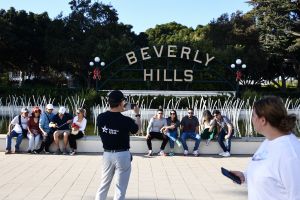
In the wealthy enclave of Beverly Hills, excess appears to be the defining feature. From a steak dinner at Mastro’s to a full spa day at the Beverly Wilshire Hotel to a special bespoke tailored suit — with trademark yellow lining — at the world-renowned House of Bijan, anything exclusive, elaborate, and in short supply can be found for a price.
But in the rarefied world of Beverly Hills real estate, scarcity rules. Brokers try to work out new retail leases on the city’s globally recognized shopping streets years in advance, owing to the infrequent opportunities to move in.
That’s why a series of ongoing shifts in and expansions of the city’s real estate landscape is set to radically alter the city’s profile.
“At this moment, Beverly Hills is having a real renaissance,” said Avison Young principal and managing director Chris Bonbright.
On the site of a former shopping center on Wilshire Boulevard, the 17.5-acre, $10 billion One Beverly Hills mixed-use project — combining a five-star Aman Hotel and luxury condos, 200,000 square feet of retail gunning to become a more exclusive Rodeo Drive, and a spacious public garden and park — further expands the city’s hold on high-end retail.
“We are transforming [Beverly Hills],” Jonathan Goldstein, CEO of co-developer Cain, told Commercial Observer in September. “In creating the public spaces, the retail center, revitalizing the classic Beverly Hilton — in the way that we’re doing — is going to reshape the center of Beverly Hills.”
This sought-after project, which started pouring the foundation in November and aims to open before the 2028 Olympics, adds premium space for new stores and dining just as existing retail destinations like Rodeo Drive command record-setting rents, north of $1,000 a square foot, and the globe’s most luxurious brands scramble to rent, or, in increasing numbers, buy their place in this very limited retail firmament. Rents have soared 50 percent since 2019, per CBRE, with one property renting at just shy of $1,400 a square foot.
Finally, a quirk in statewide zoning regulations may help the city add significant new housing options. Known as Builder’s Remedy, it’s a California law that states that if development-averse municipalities like Beverly Hills don’t properly plan, zone for, and entitle increased housing production to help make up the state’s yawning housing production gap, builders can get permission to erect projects that override local zoning restrictions. A number of such projects are taking shape in Beverly Hills right now, including a cluster of four towers around Olympic Boulevard and South Beverly Drive.
“More than in the past, Beverly Hills is benefitting from not being in Los Angeles,” said Bonbright.
The city’s commitment to public safety and streetscape infrastructure stands in contrast to L.A., where the city has simply stopped repaving streets since last summer. More importantly for real estate, Beverly Hills doesn’t have Measure ULA, the so-called mansion tax passed in 2022 that adds an additional 4 percent levy on property sales between $5.3 million and $10.6 million, and an added 5.5 percent tax on transactions for $10.6 million or more.
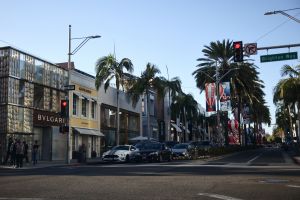
“Beverly Hills spends a lot of money on the way it looks and feels, and that seems to be making a bigger difference today than it’s made in a long time,” said Bonbright. “Everyone is looking to buy there.”
Buying there — specifically, the shopping meccas of Rodeo Drive, Cannon Drive and Beverly Drive — has become even more lucrative for retailers, as social media, celebrity, and soaring incomes among the upper crust have driven more attention and accumulation to those stores. A desire to make these true destination spaces has led to gardens and dining being fused with stores, such as the Gucci Osteria rooftop restaurant or Patek Philippe’s concept store with a rooftop garden.
Commercial corridors like West Hollywood, Melrose Avenue and Abbot Kinney may get some of the hipper, up-and-coming brands. But a spree of lease signings and transactions have shown the immense and enduring value of these Beverly Hills high streets, especially compared to a regional retail landscape — which a recent Matthews report found was suffering from poor performance, a plateauing population and regulatory challenges.
One Rodeo, another luxury location at the corner of Rodeo and Wilshire, sold last year for $211 million. Hermes just spent $400 million on a 25,000-square-foot store at 338 North Rodeo Drive, double the size of its current Rodeo outpost. Anta, China’s answer to Nike, opened a flagship store on Rodeo in February. Louis Vuitton plans to open a 45,000-square-foot, Frank Gehry-designed, four-story experiential flagship store on Rodeo with dedicated VIP shopping space and a venue for product launches. And luxury conglomerate LVMH plans to build a three-story Tiffany & Company flagship on a former hotel site they purchased in 2021 for $200 million.
“They only do this because they think L.A. is a very important place to be long-term,” said Newmark executive vice chairman Jay Luchs. “In this case, on Rodeo Drive, they want to always control their destiny.”
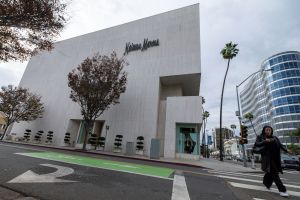
Even retail activity in nearby areas commands premiums: Ben Ashkenazy’s investment firm paid just $50 million for a two-block parcel at 9700 Wilshire Boulevard, the 184,000-square-foot Neiman Marcus building. According to JLL Managing Director Matthew Fainchtein, more than half the property on Rodeo Drive is now owned by brands instead of leased, as they see the value in owning real estate (and shutting out competitors). And owners of the remaining rental properties see the value in their holdings and will be aggressively negotiating upcoming renewals.
While citywide, about 7.4 percent of retail space remains empty, on these key streets vacancy currently sits at functionally zero.
“Beverly Hills seems to be immune to all this sort of cyclical stuff happening in the market and in the economy,” said Fainchtein. “It’s very much in its own bubble.”
Another subset of developers, namely those that focus on multifamily and affordable projects, also have gone to great lengths to establish a foothold in the city. Beverly Hills is pretty much built out, and it can be prohibitively expensive to buy property, tear it up and build new. That is, except for Builder’s Remedy projects.
Despite the city trying to stand in their way, Bonbright says they’re going to get built — hundreds of units were approved throughout 2025.
“There is always controversy around height in a mid-rise market, right?” Bonbright added.
Alan Nissel, a law professor at Pepperdine Caruso School of Law and partner at the developer Wilshire Skyline, currently has a Builder’s Remedy project proceeding on 9229 Wilshire Boulevard, adjacent to the retail triangle bounded by Santa Monica Boulevard, Wilshire Boulevard and Canon Drive. The 116-unit, 14-story tower is “particularly well-suited for high-density development and an opportunity to provide another architectural landmark to the city,” said Nissel. And, since it’s a commercial site, it won’t entail any residential tenant displacement.
“Developing in Beverly Hills is very difficult but there is no better place to live,” he said. “Beverly Hills is one of the few islands of safety, beauty and community left in Southern California.”
Beverly Hills is also doing better than the competing markets, as clothing brands and other major consumer-based companies are similarly paying big bucks for office buildings in the past year and a half like they’re Hermes on Rodeo Drive.
Fashion Nova’s Richard Saghian paid more than $674 a square foot to Tishman Speyer for a 175,000-square-foot Beverly Hills headquarters on North Maple Drive. Alo Yoga paid $90 million — about $1,085 per square foot — for its new Beverly Hills headquarters on Wilshire, marking one of the city’s priciest office trades of 2025. A partnership that includes Jens Grede, co-founder and CEO of Kim Kardashian’s Skims, acquired a nearly 90,000-square-foot Beverly Hills office for $61 million, a roughly 26 percent discount.
And sports gambling company FanDuel paid $71 million — or more than $1,410 per square foot — for a newly built Beverly Hills office also on Wilshire. For comparison, the office towers in Downtown L.A. are trading at around $200 to $250 a square foot since the pandemic.
Thus, Bonbright said office leasing is a niche part of the city’s real estate market. Entertainment bigwig United Talent Agency, signed a 193,591-square-foot renewal at its namesake UTA Plaza in November. Nearby Century City, which has become a dominant West Coast office market with rents approaching double the Greater Los Angeles average, and potentially nearby Westwood, which will benefit from the soon-to-open D Line subway on Wilshire, will remain the local office draws.
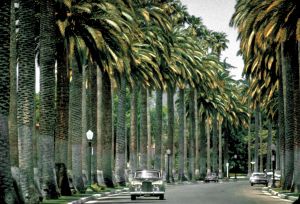
But Beverly Hills maintains its role as a magnet. And while there’s little land to buy, there’s still room for the city to grow. This recent growth surge has taken place at a time when a significant portion of Beverly Hills tourist traffic from overseas hasn’t been visiting; nationally, overseas visitors dropped 6 percent year-over-year in 2025, and JLL predicts this decline in gateway markets like L.A. will hurt luxury retail.
“All this good news that’s happening locally is happening with historically low international tourism,” said Bonbright. “You put that back in the mix, and then you’ve got that many more bodies on the street and dollars going into the restaurants and the stores and the hotels.”


