Insurance Is Taking a Bigger Bite Out of Apartment Revenue
By Liam Mulcahy October 14, 2026 6:25 pm
reprints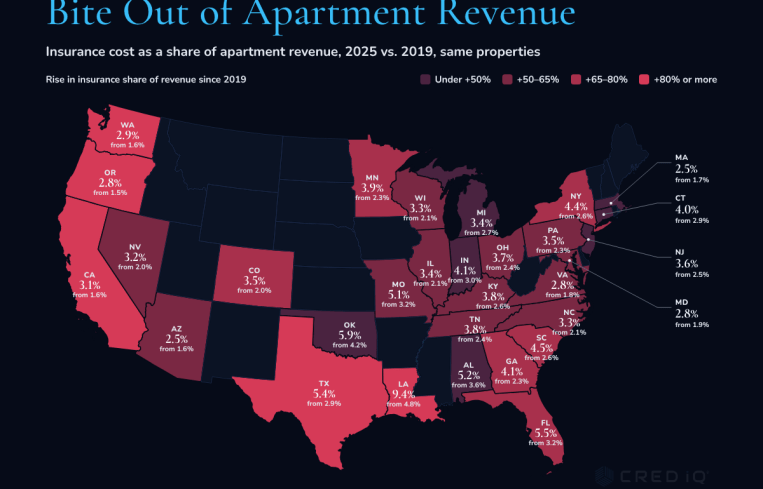
In 2019, a Louisiana apartment property financed in a commercial mortgage-backed securities or Freddie K-Series deal spent about $4.77 on insurance for every $100 of revenue it collected. By 2025, that figure was $9.42, and that is after premiums fell last year.
The Louisiana example underscores the shape of the apartment insurance story. After five straight years of increases, insurance costs on apartment properties fell 2.2 percent in 2025, according to CRED iQ’s same-store analysis of property operating statements. That followed a 28.5 percent jump in 2023. But the relief came off a much higher base: Apartment insurance costs are still more than double their 2019 level.
The pressure has clearly eased. In 2023, 46 percent of apartment properties saw their premiums rise more than 20 percent. In 2025, 24 percent experienced that 20 percent increase, and 36 percent paid less than the year before.
The Sun Belt turned first
The markets with the sharpest run-up are the ones now getting relief. Florida apartment premiums rose 2.5 fold between 2019 and 2024, including a 46 percent jump in 2023 alone. In 2025 they fell 9.8 percent.
Texas apartments’ insurance rates fell 8.4 percent, and Louisiana apartments saw a 10.5 percent drop last year. Nearly two-thirds of Florida apartment properties paid less than a year earlier, as did 57 percent in Texas and 58 percent in Louisiana.
The decline has continued into 2026. In the first half of the year, 59 percent of apartment properties paid less for insurance than in the first half of 2025, up from 38 percent a year earlier. In the Sun Belt, 72 percent paid less, and the typical premium fell 11 percent.
Coastal apartment owners have not shared in the relief. Premiums on apartments in major coastal metros rose 4.8 percent in 2025, and premiums for California apartments rose 6.3 percent. California has now passed Florida on cumulative growth since 2019, with an index of 251 against Florida’s 230, and coastal apartments overall (226) have passed the Sun Belt (221).
Rents never kept up
The bigger problem for owners is that revenue did not keep pace. On the same properties, apartment revenue per unit rose 27 percent from 2019 to 2025, from $14,210 to $19,292 a year. Insurance per unit rose 115 percent, from $339 to $778 a year. Nationally, insurance now takes $4.02 of every $100 of apartment revenue, up from $2.39 in 2019. Insurance outran rent in every one of the 30 states we measured, led by Louisiana, California, Oregon, Washington and Texas.
2025 was a turning point
Last year was the first since 2019 in which apartment revenue grew faster than insurance: Revenue rose 1.4 percent while insurance costs fell about 2 percent. In the Sun Belt, apartment revenue was flat, but insurance fell 7.2 percent, or $65 million overall. As a result, net operating income fell 1.4 percent instead of 2.1 percent.
For lenders, the Sun Belt relief is real and arrives as loans head toward 2027 and 2028 refinancings. But insurance costs for Sun Belt apartments are still more than double their 2019 level, and on the coasts they are still rising. The spike is over. The higher costs stayed.
Liam Mulcahy is senior product manager for CRE data and applied AI at CRED iQ.