Chicago Leads CMBS Distress Among 11 Metros in MLB Playoffs
By Liam Mulcahy October 5, 2026 10:15 am
reprints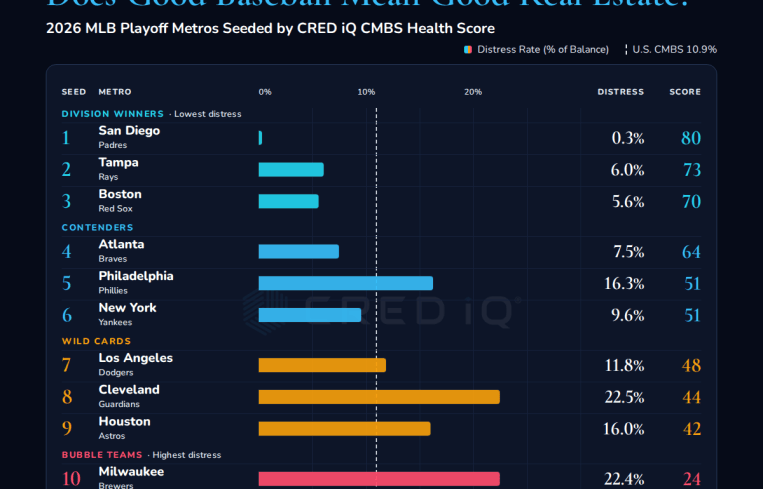
Both the Chicago Cubs and the Chicago White Sox reached Major League Baseball’s 2026 postseason, but the owners of the city’s office towers in the commercial mortgage-backed securities (CMBS) market have not earned similar success. In fact, Chicago is the weakest real estate market in this year’s MLB playoffs.
In July, the $536 million loan on Chicago’s Aon Center reached maturity and wasn’t repaid. The tower, appraised at $824 million when the loan was securitized, is now valued at $195 million. A three-year extension request “was unequivocally denied,” according to servicer commentary.
Further, as of August, 25.3 percent of the Chicago metropolitan statistical area’s outstanding CMBS balance was delinquent or in special servicing, according to CRED iQ. That is the highest of the 11 baseball playoff metro areas and up 4.7 percentage points in a year.
Nationally, the CMBS distress rate was 10.9 percent in August, down from 11.5 percent a year earlier. Preliminary September numbers point to a similar 10.8 percent distress rate. The steady headline masks office, which accounts for 45.5 percent of distressed balance and whose distress rate climbed to 16 percent.
Office is the top source of distress in eight of the 11 playoff metros.
The bottom of the bracket: Cleveland (22.5 percent) and Milwaukee (22.4 percent) join Chicago at the bottom. In Cleveland, $414 million of distressed debt sits within a mile of the Cleveland Guardians’ home stadium, led by Key Center, in special servicing since 2020. Milwaukee’s distress centers on Southridge Mall, where the value has fallen 74 percent.
The middle innings: Philadelphia (16.3 percent) is weighed down by three loans on Market Street West, at 1500, 1700 and 1818 Market, totaling $779 million and representing 40 percent of the metro’s distress. Houston’s distress (16 percent) rose 3.3 points as One Allen Center and Three Allen Center, a $470 million loan on a 71 percent-occupied complex, moved to special servicing and six apartment loans became distressed this summer. The Los Angeles distress rate (11.8 percent) jumped in August when the $1.1 billion ICON/Hollywood Media Portfolio loan transferred ahead of maturity; 20 L.A. loans totaling $2.5 billion became distressed this summer.
The comeback stories: New York’s distress rate fell 2.9 points to 9.6 percent as $6.1 billion of loans were cured, including 1211 Avenue of the Americas ($1.035 billion) and One New York Plaza ($810 million). Worldwide Plaza, with its value down 74 percent, remains the biggest problem. Atlanta’s distress rate fell to 7.5 percent from 14.2 percent, helped by the payoff of a $580 million hotel portfolio loan.
The top seeds: San Diego is the cleanest market in the postseason at 0.3 percent distressed, with the Hotel del Coronado and a 98 percent-occupied Fashion Valley mall among its largest loans. In Tampa (6 percent distress rate), one asset, the
27 percent-occupied Westfield Countryside mall, accounts for 62 percent of distress. Boston’s distress rate of 5.6 percent is dominated by a single life science loan that remains current.
The rundown: The national rate is an average of very different markets. Midwestern office cores are still deteriorating, New York is healing, and in the healthiest cities a few buildings decide the score. For lenders, the question isn’t who wins the pennant. It’s which loans come due next.
Liam Mulcahy is senior product manager for CRE data and applied AI at CRED iQ.