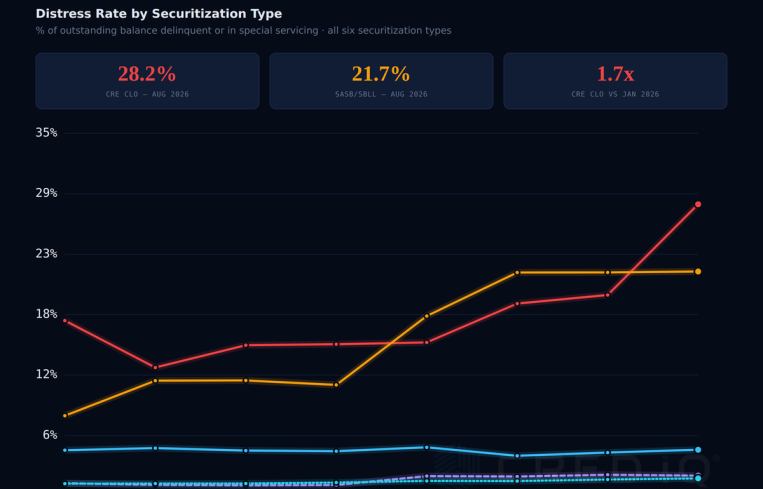
The commercial real estate collateralized loan obligation (CRE CLO) distress rate jumped from 19 percent in July to 28 percent in August, the sharpest one-month move of any deal type this year, according to CRED iQ data. The single-asset, single-borrower (SASB) commercial mortgage-backed securities distress rate has held near 22 percent since June.
Both numbers trace to the same two origination years: 2021 and 2022 vintage loans now carry $3 billion of CRE CLO’s special-servicing balance and $1.7 billion of SASBs, against $27 billion and $17 billion outstanding. In both cases, the distress is in a handful of large, identifiable deals rather than spread across the market.
Distress rates for conduit, Freddie Mac and single-family rental loans have barely moved in eight months, each still under 5 percent. CRE CLO and SASB are the only categories that have crossed into double digits — a divergence specific to 2021 and 2022 vintage collateral, not the broader lending market.
CRE CLO: Most damage in a single portfolio
The FSRIA 2021-FL3 deal is the largest contributor to distress, with $353 million of multifamily collateral now in special servicing across seven loans. It has added a new default roughly every eight weeks throughout 2026, and August brought two more: River Crossing at Roswell, Ga. ($49 million), and Grace Abernathy Apartments in Sandy Springs, Ga. ($42 million), both tied to 2026 balloon maturities. Add the July transfer of 415 Premier Apartments in Evanston, Ill. ($40 million), and this one deal has moved $131 million into distress since spring.
ARCLO 2022-FL1, a similar Sun Belt bridge loan CLO, added the Residences at Medical in San Antonio ($27 million) and Pebblebrook Apartments in Redlands, Calif. ($12 million), this cycle for $210 million of newly distressed collateral in August alone.
Five deals now account for 38 percent of all CRE CLO special-
servicing balance, and the 10 largest deals hold 58 percent. Texas, Florida and Georgia alone carry 44 percent of the distressed balance geographically — bridge loans underwritten on rent growth that never showed up before their floating-rate plans ran out of runway.
SASB: Four portfolios carry two-thirds of distress
SASB’s distress is concentrated instead in four single-
borrower office and lab deals worth 64 percent of the category’s $1.7 billion balance. BXHPP 2021-FILM, a $525 million loan against seven Hollywood studio and office properties, transferred in July. ALEN 2021-ACEN ($203 million, Three Allen Center, Houston) and LIFE 2021-BMR ($190 million, life sciences space across Cambridge, Mass., San Diego and the San Francisco Bay Area) both transferred earlier this year.
The newest addition, BSREP 2021-DC, transferred on Aug. 10: a $162 million loan against eight Washington, D.C.-area office buildings. Its size has roughly offset whatever balance SASB resolved elsewhere this summer, which is why the rate hasn’t moved. California, New York and D.C. now host two-thirds of SASB’s distressed balance.
What it means going forward
Office and mixed-use loans maturing over the next nine months are pricing 170 to 180 basis points above their in-place notes, the widest refinancing gap of any property type. CRE CLO loans in the Sun Belt face the same wall from a different angle: floating-rate plans built on 2021 and 2022 rent growth that never materialized.
Liam Mulcahy is senior product manager for CRE data and applied AI at CRED iQ.