Workforce Housing Mogul Bob Hart Knows His Market Well
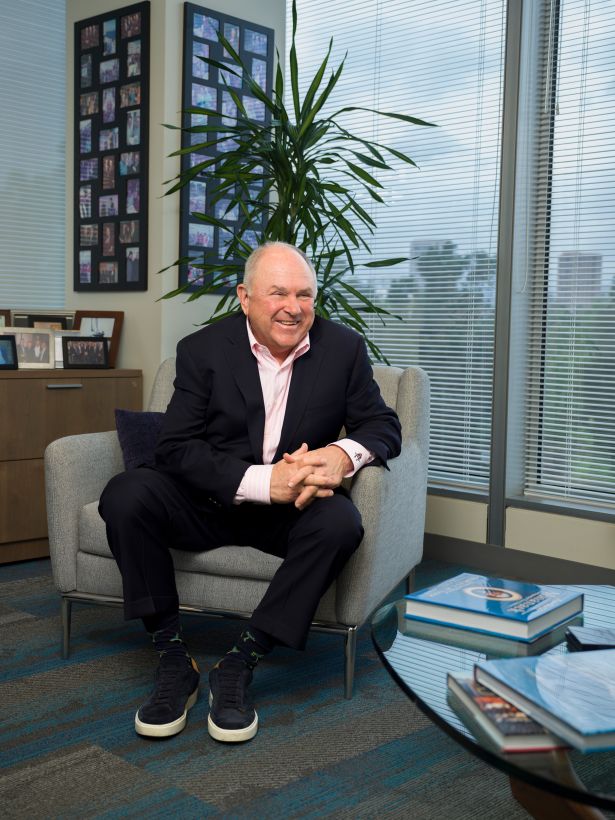
TruAmerica Multifamily’s founder, CEO and president grew up in just the type of housing he’s now providing en masse
By Larry Getlen April 7, 2026 12:00 pm
reprints
In late February 2026, TruAmerica Multifamily announced the close of a $708 million workforce housing fund geared toward the development of affordable rental apartments nationwide.
The fund, the company’s second, fits perfectly into TruAmerica’s mission of producing affordable workforce housing of the kind that the company’s founder, Bob Hart, was raised in.
Ten years into the life of the company, TruAmerica is already the 24th-largest multifamily owner and operator in the U.S., with a platform that touches 16 states and 30 major markets.
Hart, 68, lives in the Benedict Canyon section of Los Angeles with Cynthia, his wife of 38 years. The couple has one daughter, who is currently a junior at Boston College.
These days, Hart spends his nonworking time on his 52-foot sailboat or with one of his 17 vintage muscle cars, or by helping prepare the homeless for job opportunities in Chrysalis, the job-training nonprofit he’s been on the board of for over 20 years. Yet Hart is no real estate legacy. Raised in what he calls the “hardscrabble” Boston suburb of Chelsea, Hart’s father was a clerk at the local post office, and Hart drove an ice cream truck for three summers to put himself through college.
Hart’s passion for workforce housing no doubt relates to a genuine need in the market, but he also understands as a former resident just how essential this sort of housing remains to American workers and families.
Commercial Observer spoke to Hart in mid-March about his upbringing, his impressive career track, and TruAmerica’s role in creating much-needed housing for the American workforce.
This interview has been edited for length and clarity.
Commercial Observer: Tell us about your upbringing.
Bob Hart: I grew up in Chelsea, Mass., which was prosperous at the turn of the last century, but had some real difficulty after the 1970s. I grew up as an urban kid. My dad worked for the postal service for 40 years. He took the bus to work — no car. I call where we lived a tenement, other people might call it a duplex. We lived on a hill and had jetliner views — you could practically touch the airplane wings that were flying over.
I always was very enterprising — I always figured out a way to make money. I was a pretty good student, and eventually got a scholarship to Worcester Polytechnic Institute, a civil engineering school. I drove an ice cream truck in the summer around the projects of Greater Boston to make enough money to pay for private education.
How did you wind up driving an ice cream truck?
I had worked at a small chain of ice cream restaurants called Friendly’s. A new manager started cutting everybody’s hours, so I went from working 40 or 50 hours a week to 30. So I said, “Let me try this on my own.” I leased an ice cream truck — I had some money saved because I’d been working since I was 12 or 13 — and I developed that into a business over three summers.
I worked from Memorial Day to Labor Day, 100 days straight from 10 in the morning til midnight, just grinding, which is what I’m good at. I can outgrind most people. I made enough money to pay for college and then some.
At that point, you wanted to be an engineer?
I thought I did. I realized when I was applying to colleges that I needed to get a job, even though I would rather have been a history major and gone to Williams. I wound up practicing engineering for two and a half years.
Why didn’t you stick with it?
It wasn’t my thing. I really wanted to get into business. I’d always been interested in real estate, but I knew nothing about it.
How did your interest in real estate develop?
I always had it instinctually, but I didn’t know how to engage with it. I went to business school from 1981 to 1983 and sharpened my skills, and when I got out I tried to figure out how to buy real estate.
I met some people that were much more established in the field to give me some pointers, and landed my first duplex, which was similar to the house I grew up in, in 1986 in Venice, Calif. I bought it for $157,000. I cobbled together $17,000 as a down payment from friends in the area and my own money, and I was off and running at around 29.
Your father was a postal clerk and your mother was a housewife. Where did this business inclination come from?
That’s a good question. I’ve never fully explored that because I didn’t really have any mentors, but I had a good peer group. I guess it came from survival instinct — the desire to climb out of living in what was probably a 100-square-foot bedroom in very tight quarters in a house in a tougher town. I was a kid who wanted to go to prep school but couldn’t. So it was the desire to be something more.
How did you shift from engineering to business?
I went to UCLA Business School, which is now called the Anderson School. That exposed me to a wider range of industries and job opportunities.
One of my first corporate jobs, in the 1980s, was working for the Walt Disney Company. I worked as an assistant to the president of what was then called the Disney Channel. I was involved in the business development of the brand to foreign countries, including Canada, where we launched a similar product to the Disney Channel.
How long were you with Disney?
Under four years.
Talk about some of the business lessons you learned there.
I learned a lot about high-level corporate politics — what to do and what not to do. When Michael Eisner came in in the early `80s, the studio was not doing well because Walt Disney had passed away, and there was no real leadership for many years.
But when Eisner and his team came in to transform the company, the motto was, “If you don’t show up on Sunday, don’t show up on Monday.” It was a hard-driving, highly political environment with a very aggressive peer group, so you got your ass handed to you at times. The standards were so high. If you were writing a business plan, you wrote it 30 times. If there was one syntax error, you got your head chopped off. I learned how to write. I learned about precision.
I learned about branding. I learned about what it meant to work for a company of that status. I also learned that I wasn’t interested in entertainment.
Where did you go after that?
I tried to make a crossover into real estate but wasn’t successful, because the center of operations was still in Florida for real estate. So I left Disney. I had some small jobs that were somewhat entrepreneurial, but I really started investing from my own account in the late `80s.
Talk about some of your first real estate investments, and what your general investment philosophy and goals were at the time.
There was no philosophy. It was infill, workforce-type housing, which I understood. I bought some land to develop. I started getting involved with higher-end homes as well. It was really an aggregation strategy. I think I owned like 30 houses at the time and a bunch of smaller multifamily, and was trying to just cobble together a portfolio that eventually I could start to sell off or gain income from. But that was quickly interrupted with the downturn of the early `90s.
So I became a workout guy. That’s how I really cut my teeth from entrepreneur to what we’ll call a corporate real estate guy, where I’m working on things beyond just small apartments. I needed to get a job to have a salary, because you couldn’t sell anything. It was so bad. L.A. went through some very tough times in the early `90s with the Rodney King riots and the loss of aerospace jobs. It was a shitty time here. So I learned how to do workouts.
A friend of mine gave me an opportunity as a consultant for a defaulted insurance company called Executive Life. I turned that into a four-year assignment to liquidate the entire real estate book of the company, because it was seized by the State of California. It’s one of the largest insurance takeovers in U.S. history. So that really launched me into institutional real estate.
What were some of the most important real estate lessons you learned around that time?
Don’t overleverage. Don’t get real estate that devours cash. If you don’t have a lot of reserves, you’ve got to be careful.
And the biggest lesson I learned was to do everything with partners. I had a few, but they were not of the ilk I have today. I learned that it’s better to diversify risk and spread it out.
I view the world today very differently. I view my portfolio as a big mutual fund. I put a little bit of money in and a lot of real estate, and I do it with partners. Better to make other people rich alongside you and really build a business that way, with less leverage and more scale.
What came next for you?
I did workouts from 1993 to 2000 across the Executive Life trust, followed by a stint at Heitman Capital in Chicago, where I was also doing workouts. By 2000, there was nothing left to work out. The distress was over.
I ended up working as an acquisition officer for the Kennedy Wilson company. They were not involved in apartments at the time and I knew a lot about apartments, so I started out as an acquisitions officer. I built the company’s multifamily platform from zero to $3 billion over the course of those years, building a West Coast specialty focus on workforce housing.
One of my partners there outside of the company was a very large life insurance company in New York called Guardian Life. They had been a strong investor in my platform within Kennedy Wilson, and they approached me. I was not planning to leave. But they said, “Bob, why don’t we do this together?”
So we made a deal to form a company that became TruAmerica.
We started out in 2013 with 10 people and $10 million in working capital. We started out very small, but it ignited an opportunity, because I had always known how to raise capital. We started to buy in a big way. Over the last 13 years, we’ve probably been one of the largest acquirers in the country — we’ve accumulated 65,000 units, and we’ve sold 25,000 units. So it was really through that relationship with Executive Life Insurance and the people there that believed in me that I formed TruAmerica.
What was the initial goal for TruAmerica?
We had a five-year business plan on the back of a napkin. I think I still have the napkin somewhere. We were having clandestine meetings at beach resorts on the East Coast to maybe form a regional-based company in the West, and maybe grow it to a couple billion in assets.
I never thought it would be a company as large as it is today. We’re the 24th-largest operator in the country now.
Was there a determination on your part from the beginning to mainly pursue workforce housing?
Yes. I grew up in workforce housing. It’s the largest cohort of multifamily, because the United States has a financing system a lot of other countries don’t have, which allows developers and owners to own or build workforce housing. That’s where your demand is — in the middle. We call it the missing middle. It’s an area that has an insatiable demand for housing.
Has TruAmerica always been an acquisition company?
It was an acquisition company for the first 10 years. We built a lot of relationships around joint venture capital. We have over 50 different institutional firms that invested with us. Then we pivoted to form a fund management company. We raised $600 million with the first fund, and about $700 million with the second fund. So we also became an adviser/fund manager.
Then, in the last several years, we pivoted toward new verticals that were aligned with workforce, given what I felt was going to be an even greater need over the years, and that is capital “A” Affordable — the Low-Income Housing Tax Credit business. We’re now a small player in that.
We acquired a portfolio of assets in California and Texas with a partner who’s a big insurance company, Manulife Canada, and we plan to further entrench ourselves in that business.
Concurrently, we formed a development company. That company was initially focused on the build-for-rent space, which was very hot in the last five years, but has reached a certain crescendo of competition and so forth.
We’ve pivoted now to a broader base development strategy where we’re doing infill development with both affordable and either build-for-rent or conventional, mixed together in the same community. We’ve tied up many sites and we’re working on capitalizing them and starting to build. It’s a brand-new business for us. We’re focusing on California right now. We have about five projects going.
We also formed a business around being an allocator or lender to other sponsors like us who are either developers or aggregators by having a preferred equity platform. So we’re getting into that. We just got a mandate to do that, and we’re building a small team around that. That business is just starting up.
Tell me about the second Workforce Housing Fund.
We spent the last few years in a very difficult environment trying to raise a new fund, and we spent a lot of time focusing on international because the domestic markets were a little tougher. We raised about 35 percent of that fund from Japan, the Middle East and Israel, and the rest came from domestic. We re-upped a lot of folks that invested in us the first time, and found some new investors.
And it’s discretionary. We have full discretion. This strategy is similar to what we’ve always had, which is selective markets, workforce housing, Class B and acquisition rehab. One of our strengths is that we buy real estate that needs either better management or rehabilitation, and we have our own teams to do that. We deploy from regional offices across the country.
So we’re very hands-on. We’re not just allocators from a New York office. We’re very much street guys — working on the ground to approve the real estate, and getting our fingernails a little dirty.
Why do you think international investors have been so eager to come aboard for this?
It’s the United States economy. No matter how many times you try to kill it, with all these different wars and everything, you can’t kill the strongest economy in the world. It’s still a safe haven for capital. It’s got good laws and a demand for workforce housing, and the rentership is sticky. It’s not like office or other verticals that can go dark on you. Everybody needs a place to live.
People understand that most countries don’t have the same kind of workforce system we do. Japan has it to a certain degree, but Great Britain didn’t have it. Everybody lives in either social housing or condos. The United States has a unique system that is centered around government-supported financing from Fannie, Freddie and our banks, so that creates an underpinning ability to build this workforce housing.
You occasionally buy luxury developments as well. How does that fit in with TruAmerica’s mission?
It’s another diversification strategy. We represent a couple of separately managed accounts, and those mandates are more for core-plus and core, so we’re starting to buy more urban housing. And more of what we’ll call core, mid-rise and some high-rise. So that’s a new area that we’re focusing on because of the type of capital that’s leading us there.
Any exciting new initiatives on the horizon?
We’ve already invested $300 million of that $700 million fund, so we’re judiciously deploying that capital. We’re excited about closing this mega-affordable housing deal here in California and Texas, about a billion dollars of assets across 6,000 units. We’re very excited about a half-dozen projects we have in the development pipeline in California. It’s more of the same, and an extension of the brand through these new verticals.
To get these verticals off the ground, you have to nurture them. You have to find the talent and make sure they’re working.
Beyond TruAmerica, what is your take on the country’s housing situation in general, and what are some things you’d like to see happen on the political front — whether regional or national — to help improve it?
You have markets right now that are grossly oversupplied. Austin, Texas, built 500,000 units. So, right now, they’re going through a difficulty of absorption. And there are other markets like that, like Denver, Phoenix, Las Vegas — they’re a little bit soft because they’re trying to absorb all that.
The prognosis long term is outstanding because we just don’t build enough housing. In this current changing of cycles, the new development pipeline has slowed across most major cities because of challenges in financing. I think the biggest challenge you see is being played out in California and Massachusetts. You have a tremendous amount of NIMBYism, where people don’t want mid- and high-rise housing in the shadow of their neighborhoods. California is putting in a lot of by-rights laws now to allow development, but there needs to be more support of the developer — encouragement to get projects out of the ground.
Some cities are doing better than others. L.A. is still a big challenge because of regulation and the difficulty in permitting. So each community is a little different. Massachusetts is struggling with affordability right now. They’re thinking about enacting statewide rent control.
So you have a lot of blue states that feel their answer to affordability is rent control, when their answer should be to stimulate more housing. That’s why you can get a good deal in Austin, Texas, because they stimulated so much housing.
How do you think growing up the way you did ultimately impacted your career and your path forward?
I think we’re all a product of our upbringings, and the humility of how I grew up gives me a lot of humility in how I approach the world. I don’t take anything we do for granted. I look at our projects as opportunities to do something better for the world and to deliver something of quality.
It’s not just about making money. It’s about providing a true service, a safe and clean environment that people can actually afford. My concern is the affordability of American families to live properly. That’s going to be a challenge.
Larry Getlen can be reached at lgetlen@commercialobserver.com.