Newmark’s North America Leasing Chief, Liz Hart, On AI, Tech Firms and Talent
'When I entered the industry in the Bay Area, the highest ranking that I thought I would get was what I hit when I was 31 years old.'
By Amanda Schiavo March 30, 2026 6:30 am
reprints
If we may paraphrase a line from Gene Hackman’s character in the 2000 football movie “The Replacements,” to win in the real estate game you need “miles and miles and miles of heart.”
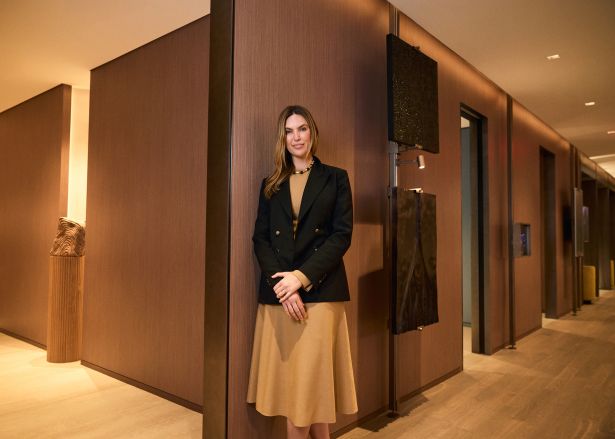
Newmark has that literally and figuratively in Elizabeth “Liz” Hart. She became the brokerage’s president of leasing for North America in 2023, giving her wide-ranging responsibility over one of Newmark’s key business lines in the U.S. and Canada.
Hart, a native of Palm Springs in Southern California, started her career in San Francisco in 2005 as a broker assistant for Cornish & Carey Commercial — which would be acquired by Newmark in 2013 — just after the dot-com bust and on the cusp of the birth of social media.
Hart spent a lot of her early career representing technology entrepreneurs in their search for office space. She represented ride-share giant Uber in its office lease at 505 Brannan Street in San Francisco in 2015 as well as Twitch, Accel, Zendesk and OpenDNS (later Cisco) on the tenant side. Hart also represented the landlords in deals with Pinterest, Stripe and Square.
Newmark’s overall leasing fees were up 13.6 percent annually in the fourth quarter of 2025, while leasing revenues for the year were $1 billion, a 16.9 percent year-over-year rise.
Some of the bigger deals that Newmark worked on in North America in 2025 included a 1.4 million-square-foot industrial lease by DrinkPAK at 3144 West Passyunk Avenue in Philadelphia, as well as Horizon Media’s 360,000-square-foot office lease at 75 Varick Street in New York. (These are but a sampling of the remit of Hart and her team. Hart says she has completed 35 million square feet of transactions valued at over $4.2 billion.)
Commercial Observer sat down with Hart, 43, in early March to discuss her career journey, gather some industry insights, and get her perspective on the impact artificial intelligence is having on the real estate space.
This interview has been edited for length and clarity.
Commercial Observer: What makes you stand out as a leader in the real estate space?
Liz Hart: When I was in college — University of California-Berkeley, class of 2005 — I took a test at the career center because I didn’t know what I wanted to do. I didn’t have a family background in real estate, so there was no necessarily compelling reason to go into this industry. The woman at the career center who interpreted my test said you match — I think it was 98 percent or some insane amount — with people in real estate. I had never thought of that before.
So, I did what any 22-year-old would do at that point, and I started asking around. This was the very first days of LinkedIn, it was a very small company at the time, and I would look on LinkedIn and try to find profiles of people in commercial real estate. Then I would just call them, and try to figure out how to get an in in this industry.
I started as a broker assistant, which was the most basic level that you can enter into in the industry at a company that Newmark later acquired. I’ve been at the same company continuously, and what’s really interesting about that is I’ve seen 20 years of market cycles. But also I’ve seen what it’s like to be starting off in the industry, to be a senior associate in the industry, to be a rising star in the industry, and to be at that point of trying to figure out your speciality.
Having that really hands-on experience of brokerage is a differentiator in leadership at Newmark. If someone on my team calls me trying to figure out how to solve this client’s problem, I’ve actually had hands-on application of that work, so it’s not theoretical for me. I can take the knowledge that I’ve gained over time and actually really apply hands-on knowledge and expertise toward it.
What has been your area of focus over the course of your career?
For 20 years, I spent time mostly representing tech entrepreneurs. I had landlord clients as well, but the majority of my time was tech entrepreneurs. And, even when I was representing the landlord, it was usually with technology companies on the other side. Because of that, I got this amazing education in the background of what’s happening in product, what’s happening in development, how to think about technical skills, and how to think about naming of companies.
I remember so many entrepreneurs asking what they should name their company. I worked with very early-stage companies. Often it was one or two entrepreneurs in the car that ended up being a publicly traded company later. You know, when you’re sitting with someone driving around trying to decide what office space they’re going to have, you get an enormous set of insight into how that leadership team makes decisions, how they want to be positioned from a brand perspective in the market, and how they want to grow their business.
Can you talk about your leadership style at Newmark from the perspective of being a woman in an industry where there are not as many women in these positions?
There’s many steps along the way to go from being a broker assistant to running a deal to having a team, and then being a leader in the region and a top producer in the region. It’s correct that there are not as many women in roles at this level. And that was also one of the decision-makers for me. I really wanted to make sure we had role models.
I have a stepdaughter who is 16 — she’s awesome and a great athlete, she’s very motivated. And having been in the professional world for so long now, something I’ve seen is how important it is to talk about what’s happening in business in front of your children. I hope I do it enough for her. When she was younger, I would try to exit the room when I was talking about business. But then I’ve just seen through other people that I’ve interacted with in business that the earlier you’re exposed to these topics and these conversations, the more likely you are to start to frame that thinking. And now I really try to do as much as I can in front of her — have those conversations — and it’s awesome, because she’s a little entrepreneur in the making.
I also believe that there is so much strength in the different kinds of opinions that we have across our business. When you think about female leadership, and what it means, part of it is leaning into getting clarity around business decisions through asking questions, and never has that been more important than in the age of AI.
What is your opinion on AI in CRE?
I think it’s an exciting moment for us to continue to evolve as an industry. There’s been a lot of talk about it, and I think it’s true that it will automate some routine tasks, but automating routine tasks frees up great human talent — which is something that Newmark has always invested in, we’re a top talent-based firm — to do other things that are client serving and that can be better amplified.
So, being able to, as an example, understand data in much greater detail is going to be a really good advantage for advisers, because it will add a layer of dimensionality to their advisory. To be able to understand big, complex data and give that advice, and being able to even predict into the future versus just looking retroactively at the market — I think that’s the moment that we’re really bridging right now.
How have you seen AI tech adoption impact the real estate industry?
As an industry, we are in the early innings of what’s going on, but I have already seen returns from automating more manual tasks as well as giving better insights to the advisers on how to grow. I do think we’re seeing that already, but it is going to take a continued governance and stewardship of the artificial intelligence tools to ensure that we’re really doing it in a way to grow the business and to grow client service.
You don’t just set the agent and let it run. You really need to continue to monitor it, and we’re doing that in a very scaled fashion for that reason. You need to make sure that you’re keeping the core of what your business has been and how you built it. We feel really confident that our talent strategy of investing in the top talent is going to be the right one for the age of AI, because those people are going to be able to maximize and amplify their skills.
How has Newmark adopted AI within the firm?
We have a mix of tools that we’ve used that are both custom built by us as well as tools that are more off-the-shelf tools and tools that you can buy from other companies. We have certain things that we’re using across large portions of people, and then we have others where we have, you know, more piloted groups that are doing specific tasks to move ahead. But there’s certain things that we’ve done where you see, you know, pretty big upticks in productivity from reducing that manual work. We know that when you give people more time, they will go reinvest that in building the business.
More generally, I think where the industry is seeing that happening is around abstraction. You’re seeing abstraction of complex documents, a lot of things around questioning business plans and how do you move business plans forward? You have this great companion with you now.
I constantly use it for prep work. I even have one prompt that I go to about once a month that says, “Based on everything that you’re seeing me do, what should I be doing better?” I basically ask it to critique me all the time and to tell me what I should be doing that’s more impactful to the business.
So there’s the automation, but there’s also the self-amplification component at its most basic level.
As a leader in the industry, what is your approach to mentorship and helping cultivate the next generation of industry leaders?
I’ve had so many different role models over the years, and they evolve, they’re never constant, they are never the same. My approach to role models, and also the way I role-model for others, is, I think, in real estate often people choose one role model, and then they try to emulate that one role model’s way of thinking. And I think what is much more productive and what is going to accelerate a career more is looking at a variety of different mentors that can give you different perspectives, so that you have the broadest perspective to drive how you think.
This is all about your real point of view as a leader. For me, I look back at certain clients, both on the tech side, but also on the landlord side, that were incredibly influential to me, because they really talked to me about what’s happening inside of their business. They gave me so many insights into their own businesses that I was able to look through and say, “OK, now I understand this complex problem. I can advocate for you in a more meaningful way.” That happened significantly in the first five to 15 years of my career. There were just people that were really driving me in an amazing way.
How are you seeing the next generation of women in CRE shaping the industry?
One thing that is great to see is there are a lot more women and more different kinds of people in general — just different backgrounds — that are entering commercial real estate now than there were in previous generations that I’ve experienced. When you have a good, strong base like that, it will lead to having that throughout the duration of their career, which is good.
In general, women bring a lot of collaboration to the table. I’m seeing that from the next generation, and not just from women. Really, that next generation tends to be quite collaborative and quite willing to discuss things to get to the right answer. I think that’s something that’s really strong.
It happens in every generation, but, as more and more women get to different roles, then it’s going to become more visible for them, and, because of that, there is a different dream. When I entered the industry in the Bay Area, the highest ranking that I thought I would get was what I hit when I was 31 years old — which was equivalent to an executive managing director role. And I thought that would be it, because that’s what I saw. And it wasn’t really until much later that I was like, “Oh, wow, there’s this whole other chapter that could be unfolding, and I can keep going.”
Now there are so many more women in the C-suite and as CEOs, making decisions in every industry. It’s encouraging for people to see that. Every room should be about making the best decision for the business and making sure that that is constantly what’s happening, and it happens more when you’re in a situation with people from different backgrounds.
Amanda Schiavo can be reached at aschiavo@commercialobserver.com.