CRE Distress Rate Falls Slightly to 11.6% in February
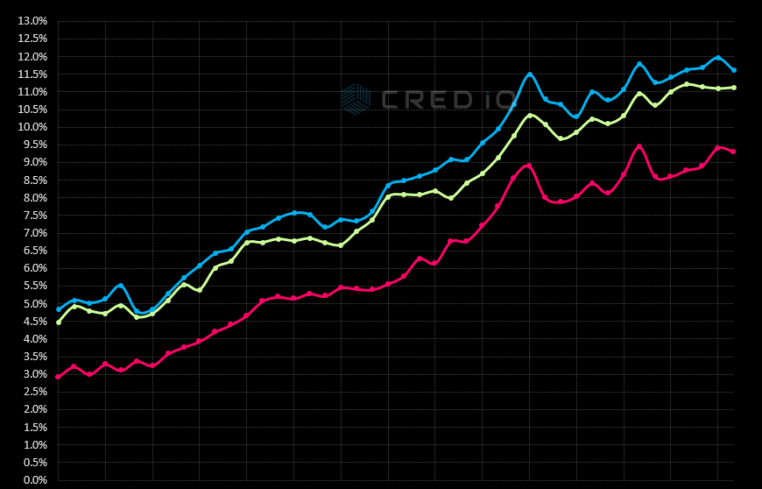
Commercial real estate credit stress remains stubbornly elevated heading into the spring lending season, with CRED iQ’s latest data showing the overall distress rate — encompassing loans that are delinquent, specially serviced or both — registering 11.63 percent in February 2026.
While that marks a modest pullback from the January 2026 cycle high of 11.98 percent, it would be premature to interpret the retreat as a trend reversal. The delinquency rate alone hit 9.31 percent in February, down marginally from 9.4 percent in January but still representing one of the highest readings in this cycle. February’s 9.31 percent delinquency rate is also more than triple the 2.93 percent rate recorded in July 2022 when this distress wave began.
The specially serviced rate tells a similar story. At 11.13 percent in February, it remains near peak territory after climbing steadily from 4.47 percent in mid-2022. The convergence of the delinquency and specially serviced rates reflects the maturation of the distress cycle — loans that entered special servicing 12 to 18 months ago are now resolving or failing to resolve, pushing delinquencies higher even as new special servicing inflows show early signs of moderating.
Macro backdrop: Cautious optimism with real headwinds
The broader economic environment provides a mixed backdrop. The 10-Year Treasury has retreated to approximately 3.94 percent, down meaningfully from year-ago levels, offering some relief on cap rate compression and refinancing economics. The Federal Reserve has cut the lower bound of the federal funds rate to 3.5 percent, with short-term benchmark rates following suit — a notable improvement from the restrictive policy environment that defined 2023 and much of 2024. Inflation, while not vanquished, has cooled considerably, with the headline Consumer Price Index running near 2.4 percent year-over-year as of Feb. 28.
Yet the labor market is showing signs of softening. The most recent data shows the unemployment rate edged up to 4.4 percent in February, and monthly payroll growth has slowed considerably from the robust pace of prior years. A weakening jobs picture feeds directly into multifamily fundamentals and retail foot traffic — two sectors already navigating elevated credit stress.
Office remains the most distressed major property type, with delinquency readings pushing into the low double digits across commercial mortgage-backed securities (CMBS) loan pools. Multifamily — increasingly a concern given the wave of floating-rate bridge loans originated in 2021 and 2022 — continues to see elevated delinquency pressure, though moderating Secured Overnight Financing Rate rates provide a partial offset. On the capital markets side, private-label CMBS issuance is running below year-ago levels, reflecting reduced transaction velocity and persistent lender caution on certain asset classes.
Year-end 2026 outlook
CRED iQ projects the overall distress rate to remain in the 11 percent to 12.5 percent range through mid-year before beginning a gradual descent in the second half of 2026, contingent on continued Treasury rate stability and no material deterioration in employment.
The substantial wall of CMBS and CRE collateralized loan obligation maturities due in 2026 will be a critical stress test — loans originated in the 2021-2022 vintage at compressed cap rates and aggressive underwriting assumptions face the steepest refinancing hurdles. Office distress is likely to push toward 13 percent to 14 percent before finding a floor, while multifamily stress could stabilize meaningfully as floating-rate borrowing costs continue drifting lower.
The path to recovery is visible, but it runs through a prolonged workout period that will define the CRE lending landscape well into 2027.
Mike Haas is the founder and CEO of CRED iQ.