Supreme Court’s Tariffs Ruling Leaves Commercial Real Estate in a Familiar Spot
There are some fans of the decision, but most see little clarity from the justices’ decree
By Orion Jones February 27, 2026 4:18 pm
reprints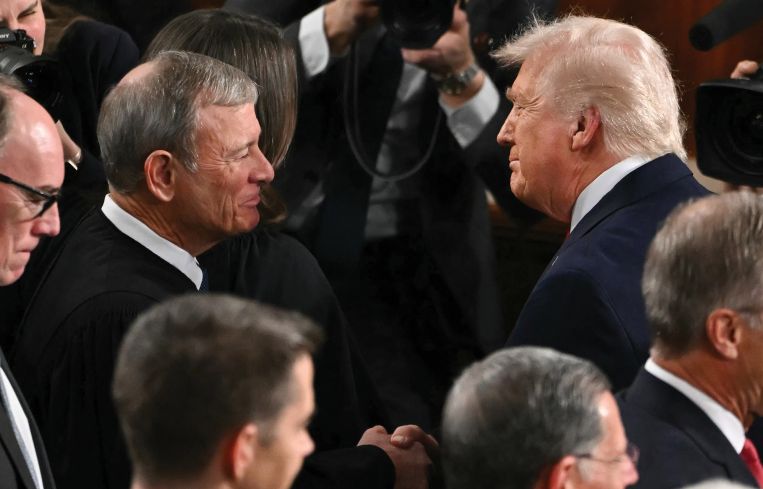
Just a week ago, it looked as though the tariff clouds were clearing for commercial real estate.
The Supreme Court had invalidated a major portion of President Donald Trump’s tariff policies, dangling the prospect of $175 billion in refunds to the more than 300,000 businesses estimated to have paid import duties since Trump launched major trade taxes almost a year ago.
“I was initially really excited,” said Justin Pelsinger, chief operating officer of Charney Companies, a multifamily developer that made its name in the Gowanus neighborhood of Brooklyn. “The effect of the tariffs has increased costs of construction.”
The court’s ruling was the strongest rebuke to date of Trump’s signature trade and economic policy that has upended global supply chains, diplomatic relations and geopolitical alliances.
Always one to raise the bet, Trump replied to the court during his State of the Union address Feb. 24 by airing the idea of replacing the federal income tax with tariff income. The famously starry-eyed speech affirmed that tariffs remain at the center of Trump’s economic and trade agenda.
While the administration hopes to find a stronger bulwark to legal challenges, the regulatory whiplash has meant more uncertainty for CRE companies and their bottom lines.
“Tariff uncertainty is one of the worst threats to sustained infrastructure investment this country faces,” New York Building Congress President and CEO Carlo Scissura said in a statement.
“The recent SCOTUS decision gave some clarity to the invalidity of previous tariffs,” Scissura added, “but the immediate pivot by the administration to announce new tariffs” means builders can’t source materials or plan future projects with surety about their bottom line.
Not everyone in real estate is making the same calculation. Because of the political climate, several people and organizations in CRE, including brokerages, declined to comment for this story or did not respond to interview requests.
“The bottom line is simple,” said Compass Vice Chair Adelaide Polsinelli. “Tariffs tax foreign goods so Washington doesn’t have to tax us. If tariff revenue helps deliver broader tax relief, that’s a direct win for every business owner, developer and tenant.”
For developers, another period of whipsawing regulation means more time spent understanding that regulation’s minutiae of its enforcement as well as creating new business plans to adapt.
“Surely, porcelain tiles must come from another place,” mused Pelsinger, describing how tariff changes have lured him into the depths of a shifting sea of international supply chains.
“For some vendors, the easiest thing is to say, ‘Here’s the bill. Just pay it, and I’ll keep my business going as usual.’ For me, that doesn’t work,” he said.
In ruling against Trump’s tariffs imposed under the International Emergency Economic Powers Act of 1977 (IEEPA), the Supreme Court reversed a 25 percent duty on most Canadian and Mexican imports and a 10 percent duty on most Chinese imports, plus a global tariff of at least 10 percent with dozens of nations facing higher rates. The decision throws into question the fate of more than half of all tariff revenue collected in 2025.
The real estate industry would welcome cheaper Canadian lumber and reduced prices on the many residential fixtures, from flooring and plumbing to appliances, that come from Asian markets. But the White House has been quick to say it will restore the tariffs using other means.
Treasury Secretary Scott Bessent has been busy laying out the statutory groundwork for a new round of global tariffs. The administration claims justification for tariffs can be found in Section 232 of Trade Expansion Act of 1962 and Section 301 of the Trade Act of 1974, as well as other sections of federal trade law.
“Tariff income is unchanged,” Bessent told ABC News after the court’s decision. “We’ll be moving to a Section 122, and then [the U.S. trade representative] and [Department of] Commerce will be doing 301 and 232 studies, and we’ll be layering those in within 150 days.”
Effective now, the White House will use Section 122 of the Trade Act of 1974 to enforce a 10 percent global tariff, expected to rise to 15 percent, for 150 days — the time allotted before congressional approval is required. With Congress unlikely to approve the tariffs, Trump will use investigative powers given to the Department of Commerce under the 1962 trade expansion act in addition to the 1974 law to establish a more durable legal footing.
While the invalidated tariffs relied on perceived emergencies over fentanyl and international trade imbalances, future tariffs may hinge on other grievances familiar to Trump supporters.
“His tariff strategy is leverage,” said Polsinelli. “American markets [are] exploited with the stealing of intellectual property and flooding the U.S. with subsidized goods.”
The specificities of those complaints, long lodged against China in particular, may prove decisive in the administration’s new round of tariffs. But statutory gymnastics are a far cry from the certainty that business interests desire.
“Congress needs to step up and assert its role in tax and tariff policy,” said Scissura. “Until then, things will continue to be a mess.”
Scissura was likewise vocal over the federal funding freeze that brought construction to a halt on the mammoth Gateway train tunnel project between New Jersey and New York. After a lower court ruled in early February that the funds must be released, the White House relented and a financial line was restored.
“There are some downsides [to tariffs],” Polsinelli concedes. “Material costs shifted. Timelines moved. But New York’s real estate industry has survived recessions, pandemics and interest rate shocks. We can handle a trade realignment.”
Pesinger’s highest hopes for a Supreme Court windfall were dashed early as tariffs on steel and aluminum, based on Section 232 of the Trade Expansion Act of 1962, were left in place. Steel is used to frame office towers, while aluminum is used to build multifamily facades.
“A lot of construction [companies] and developers did end up paying that [IEEPA] tariff, but we paid on plumbing fixtures, flooring, stuff like that, which have an impact,” Pesinger said. “Not as big of an impact, but they have an impact.”
Jeff Rosenfeld, a managing partner at construction lender North River Partners, estimates the cost of IEEPA tariffs to be in the low single digits as a percentage of a project’s overall budget, far below the rate at which other expenses, particularly insurance, are rising.
Rosenfeld said that as tariffs increase the cost of materials, the finances of a given project are ultimately balanced by flexibility on the labor side of the equation.
“A lot of general contractors have been busy over the last four years who now have a lot of free time,” he said. “That’s why many of them are able to absorb tariff increases. Laborers are fighting for opportunity, and, as such, they’re willing to take a hit on their margin. The end user, the developer, is close to break even, so they’re not the ones eating the cost. It’s really the person who’s performing the job.”
Developers like Pelsinger who have direct contacts to overseas suppliers are more likely to incur higher costs due to tariffs since there is no middleman to eat the import fee. And, while Pelsinger said he wouldn’t hesitate to ask for a refund if tariffs are ultimately struck down and refunds are issued, he expects “a song and dance” from suppliers.
“Maybe they would say, ‘How about a discount on a future job?’ That’s how I think it would work out.”
Any business looking to pass tariff costs on to end users must consider supply and demand dynamics in local and regional markets. For the supply-constrained multifamily market in New York, tenants in new construction might absorb a portion of the tariff-related cost increases.
However, in Austin, Texas, according to Rosenfeld, “you can’t pass the cost on to the end user, which is the renter, because there are 25 other options that might be better quality and cheaper, so there’s not as much price elasticity there.”
While the Trump administration stays one step ahead of a deeply skeptical judiciary, the value of any tariff relief diminishes over time.
“Unwinding a tariff is not as simple as saying, ‘OK, let’s go back to the old days,’ because other things have changed in the meantime,” Pelsinger said.
The longer that tariffs are in place, the less economic upside results from striking them down because supply chains gradually shift away from importers who incur the steepest tariffs.
One aim of Trump’s tariff policy is to reshore more of America’s manufacturing. None of the industry professionals interviewed for this story saw evidence of that occurring, but “there were existing manufacturers already onshore that probably had a pickup in their business,” Rosenfeld said.