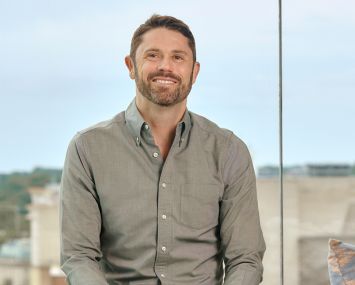
Hantz Févry of Geolava: 5 Questions
Spatial intelligence-driven valuation startup CEO talks of journeying from his native Haiti to the U.S. and beyond
By Philip Russo January 27, 2026 9:30 am
reprints
Hantz Févry is the CEO and co-founder of Geolava, a San Francisco-based startup that aims to revolutionize property valuation and management by using spatial intelligence and artificial intelligence to provide detailed, real-time data on buildings.
Févry and his fellow native Haitian Pierre Frédéric Mombeleur both landed at Google prior to co-founding Geolava. Focused on the U.S. and Canada (for now, said Févry), the startup has been operational for a year, using high-resolution satellite imagery and contextual data to create comprehensive property profiles. In doing so, Geolava seeks to move real estate from manual, reactive surveying to predictive property intelligence, with a platform that unifies zoning rules, land-use constraints, tax exposure and deed transparency into a single spatial intelligence layer — eliminating blind spots that impact valuation and risk.
Last week PropTech Insider spoke with Févry about why he believes that spatial intelligence using multiple forms of optics, not more raw data, is the next major shift in real estate and investment decision-making.
The following conversation has been edited for length and clarity.
PropTech Insider: How did you and Pierre Frédéric Mombeleur come to start Geolava?
Hantz Févry: My previous company was called Stoovo. We were working on optimizing the income of gig workers, and we noticed that the biggest problem that delivery workers would face would be in the last 100 meters. They wouldn’t know where to park, where to enter the building. So we realized that if we could give them that information about those properties they would be more efficient.
Then we realized that it’s not only about parking or entrances. There’s a big problem in the physical world — it’s still offline, relying on boots on the ground and bespoke data to basically understand properties. Major investment decisions are being made basically on reports that are most of the time obsolete. So we decided to use technology to solve that problem. Fast forward, and we are now building a spatial intelligence platform to take the physical world online.
Geolava seeks to cover what you have called a real estate technology “blind spot” in how buildings are surveyed, valued and de-risked. How do you do that?
Exactly. Our spatial intelligence basically means the ability for a system to understand the physical world, reason about it, and understand how it will evolve in space and time. So we’re using spatial intelligence to basically be that invisible eye on the ground to assess all properties and investments, in order to understand all the factors that can affect the valuation of the property in the present and in the future, positive or negative.
With spatial intelligence, you can use the imagery from rented private satellites that will give you very high resolution for more insights beyond optical. We’re going to get thermal, LiDAR [light detection and ranging], spectral, SAR [synthetic aperture radar] — a lot of imagery that can help us perceive even better than a human-only perceived optical. When we have the perception engine, then spatial intelligence needs context to be able to reason and understand how that physical world exists and evolves in space and time.
To do that, we’re going to gather contextual data. For example, zoning laws around a property: What’s the area’s crime, and what’s the foot traffic?
You and your co-founder are from Haiti. How did you come about your journey to the U.S.?
I grew up in Haiti, born and raised. I moved to the U.S. in 2009, and I studied at Stony Brook University in New York. I studied finance, operation management and technology ecosystem management. I had a company that was focused on early-warning systems for earthquakes [such as the 7.0 quake Haiti suffered in 2010] and it got attention from Google, which hired me after college.
I moved to Poland for them, and while in Poland found that there was a program with Stanford University to learn deep learning, which was becoming very popular. So I focused on AI. After that, Google brought me to Mountain View in Silicon Valley. I’ve worked in very deep AI, and my team right now is part of Deep Mind. I then left Google and did a specialization in quantum computing from MIT and went on to build Stoovo, my previous company that we sold in 2024.
My partner as well is from Haiti. We’ve been to the same high school, same university, we’re roommates, and on the same team at Google. He was also my co-founder at my previous company. So we’ve been working together for a while.
I understand that Geolava is working on a possible partnership with JLL. Can you say anything about that?
So, for now, it’s in very early talks. We’ll let the public know a bit more about that partnership when the time has come.
What are your immediate and long-term ambitions for Geolava and who are your prospective clients?
That’s a great question. So, for me, I believe that spatial intelligence will reshape real estate and infrastructure in the next few years. And, in my opinion, predictions flagged as speculative but high conviction will basically change. So insurance companies will start to price things continuously. Our finance terms will adopt real-time risk. Cities will be able to regulate based on simulation, not just codes or static data, thanks to Geolava, but also thanks to spatial intelligence.
Our clients will be owners or property investors, people who have skin in the game. So, if you’re making an investment, you want to know what will happen with those properties in the next five to 10 years. If you are a large corporation and you’re investing billions of dollars in many properties, you want to not only make the right decision, have the right data, but you also want to monitor all your portfolio and assets. For now, we’re targeting a lot of property owners, asset owners and investors, and property investors.
Philip Russo can be reached at prusso@commercialobserver.com.