Data Centers Continue to Vacuum Up the Investment Dollars — Is the Return Worth It?
The dreaded word ‘bubble’ dogs commercial real estate’s breakout asset class even as more private money lines up to underwrite it
By Brian Pascus January 5, 2026 9:48 am
reprints
If 2025 will be remembered for anything — outside of the return of President Donald J. Trump and the rise of New York City Mayor Zohran Mamdani — it will undoubtedly be the establishment of artificial intelligence across the American economy.
And with this revolutionary technology has come the concomitant explosion of U.S. data center development — real estate assets solely capable of operating, and powering, the new landscape of AI technology.
An S&P Global study from December, first reported by CNBC, found that more than $61 billion of new investment capital flowed into the data center space in 2025, which is just ahead of the $60.8 billion that entered the space in 2024.
Ratings giant Moody’s expects global investment in new data centers will reach $2.2 trillion combined in the five years preceding 2028, while U.S. Census Bureau data forecasts that data center construction spending will surpass all U.S. office building construction spending by next year.
One major player, Mark Zuckerberg’s Meta (neé Facebook), estimated it spent between $70 billion and $72 billion in building out AI infrastructure in 2025, per third-quarter earnings.
“Everything’s moving into data centers,” said Jay Neveloff, chair of U.S. real estate at HSF Kramer, the global law firm. “So, what I’m telling clients is, at some point, we’re going to be oversaturated with data centers, and I don’t quite know what the exit strategy is for being in the data center space.
“Having said that, I think we’re really at the infancy of that industry,” he added
With money flowing this quickly, and in such large amounts, into a single commercial real estate asset class — an untraditional one, by any measure, that fuses land, utilities, power and fossil fuels, big tech, local politics and Wall Street under one big umbrella — questions are starting to emerge as to whether a bubble is forming around AI data center spending.
“The projections of data center development by major tech players are truly eye-popping,” said Chris Russo, vice president of the energy practice at Charles River Associates, an economic consulting firm. “But there’s a growing number of questions whether the projections are, in fact, real, and if the investments being made by Meta, Google, Microsoft, among others, can be justified by future revenue.”
This concern about revenue and monetization lies at the heart of the data center development conundrum. For instance, OpenAI, the Silicon Valley firm that initiated the AI wave three years ago through its revolutionary ChatGPT large language model (LLM) application, is not merely one of the biggest players in the data center space. It’s an underwater one, as well.
The fact is, despite the hype, OpenAI is currently generating the largest cumulative losses ever for any startup before turning a profit.
A Dec. 4, 2025, study by Deutsche Bank economists found that OpenAI has revenue forecasts of $345 billion between 2024 and 2029, but it comes after $488 billion in spending on data center computer power. That means the firm will run a cash-flow of negative $143 billion.
Patrick Wilson, a portfolio manager at CenterSquare Investment Management, said the largest hyperscale data center developments haven’t yet been able to monetize AI technologies, and that, at some point, capital expenditures will start to plateau if investors continue to spend like this. That would signal a risk to investors who are paying for enormous valuations without much in the way of consistent and long-term revenue streams.
“At some point, by 2027 or later, the market will want to see some sort of path to monetization for a lot of this spending because the return on investment capital is so paltry, if not nonexistent,” Wilson said. “So I do start to get concerned.”
Investors aren’t scared yet. The National Association of Real Estate Investment Trusts found that publicly traded real estate companies increased investments into data centers by 15 percent last year, while research from Refinitiv, part of the London Stock Exchange Group, found that debt market players borrowed $100 billion for data center development in 2025.
“2025 was a bit of the early stage of a gold rush, per se, with tons of new entrants, operators, capital providers and tenants,” said Andrew Kaskel, head of data centers advisory at Walker & Dunlop. “While there certainly were a lot of projects announced and funded, it’s really still the early stage of a big growth cycle.”
But is it a bubble?
Kaskel admitted that, sure, there’s always a chance we’ve entered into a bubble and that things will go south once interest rates rise and demand shifts, as has happened before, particularly during the 1999-2001 dot-com bubble. But this rush of data center development, and AI spending, is fundamentally different for one critical reason.
“What we see, day in and day out, and across the data center space, is that the majority of the capital being allocated and invested is backed by the largest, most stable companies in the world, with the healthiest balance sheets on the planet,” said Kaskel. “It’s foundationally built upon really secure companies for the long term.”
JLL research found that of the 8 gigawatts of U.S. data centers currently under construction, 73 percent is pre-leased, while vacancies are expected to remain below 5 percent into 2027, and likely hold closer to 2 percent.
“Looking at the fundamentals, there is no bubble,” said Sean Farney, vice president of Americas data center strategy at JLL. “Ninety-seven percent of the existing product is utilized, we are the envy of every other industry on Earth. … So the fundamental demand for the product is there, and it’s only getting higher as supply is getting lower.”
Even so, this same JLL research report concluded that data center co-location vacancy rates that sit near zero percent are “constraining economic growth and undermining national security,” and that the “restrictive market conditions are counterproductive over the long term.”
So, while the money is there, questions abound and answers are few as to who wins and loses as U.S. data center development explodes — with all eyes on the uncertain path the hyperscalers might chart to monetization as the central metric of whether the hundreds of billions of dollars in investment capital will actually be paid back.
“We’re a big believer in AI and data enters over the short term, the medium term and the long term,” said Rich Hill, global head of real estate research and strategy at Principal Asset Management. “But every single data center investor might not have a good experience.”
Whole new ballgame
To understand where data centers might be going, it’s important to understand what they are as an asset class, as like any piece of real estate there is nuance in the bricks and mortar.
Since emerging out of the telecommunications building boom that laid the groundwork for the rise of the internet in the 1990s and 2000s, data centers have evolved today into an asset of three distinct classes.
There are cloud data centers, which are used to power Americans who shop on Amazon, or search Google, or use their iPhones to save photos on an invisible cloud network. Then there are AI inference data centers, which power the large language models of ChatGPT. Finally, there are much physically larger (and prohibitively more expensive) generative AI data centers, or factories, which are a training model for future AI use — often referred to as “neocloud” — that is still unknown.
Data centers within these three classes are either leased to hyperscalers, like Oracle or Meta, or are co-locations, meaning multi-tenant tenant spaces that could include up-and-coming cloud platforms like CoreWeave and Fluidstack.
“There’s a lot of money going into generative AI data center development, and we view it as much more speculative, with not as much pre-leasing occurring,” said Principal’s Hill. “I’m not here to tell you if it’s good or bad, a bubble or not a bubble, but we think it’s a much better risk-adjusted return focusing on cloud and AI inference data centers.”
Today there are 4,165 data centers in the U.S., an average of 83 per state. The nearest countries by count — the United Kingdom and Germany — have only 499 and 487, respectively, per Statista, a statistics website. Those numbers themselves suggest room for foreign competition on the data center front, and on AI, adding another level of uncertainty to the growth and demand in the U.S.
Kristina Metzger, vice chairman at CBRE’s data center capital markets, said national core data center fundamentals are “fantastic,” with less than 2 percent vacancy, 80 percent of the development pipeline pre-leased, little to no speculative development, growing rents, and positive earnings (15 percent year-over-year), all on the back of cloud computing.
But it’s the gen AI hubs that have given her pause, mainly due to questions on long-term use and overall business models.
“What we’re now working through are new facets of the industry with these AI factories, and neocloud operating models, and those [business models] remain to be determined,” she said. “There isn’t the same overall story as there is in core data centers.”
Dave Powell, a partner at law firm King & Spalding, specializes in data centers. He noted that there are numerous expensive questions associated with any data center development. For instance, is an end-user lined up? Is it a big tech firm or not? Will it be a hyperscale site or co-location? And, most importantly, is there a reliable source of power to make the investment pencil?
“We really see that it’s all about power — electricity generation is reaching new heights … and with respect to electricity, it’s divided up by markets, and not all markets are created equal,” said Powell. “To develop a data center, you need reliable electricity, which should be relatively inexpensive, you need land, you need to be near a major metropolitan area with favorable, or non-penalizing, regulations from the local government.”
Even after all these questions are answered, and the data center is finally built (in compliance with the maze of local zoning codes, of course), perhaps the biggest open-ended question is how investors will make money on an asset class whose tenants still haven’t figured out how to monetize the actual “data” propping up the multibillion-dollar “center.”
“It’s a question we hear day in and day out: What is the exit and how do people ultimately get returns? And it’s still to be determined,” said Walker & Dunlop’s Kaskel. “Right now, so much of the capital is being invested on the construction and development side, and these projects are three- to five- to 10-year developments before they reach 100 percent stabilization.”
Generational dollars
Even amid a laundry list of uncertainties, money has poured into the space since ChatGPT came online in 2022. By 2025, even after years of Wall Street capital behind it, what pushed data centers to another level was the Trump administration’s support for the industry, primarily Trump’s announcement of a $500 billion private sector investment in the construction of 20 new data centers, collectively spanning 10 million square feet, on his first full day back in office.
“We have a clear policy to support the data center builds and the recognition that data centers are part of a strategic advantage,” JLL’s Farney said of the nation at large. “[The industry] came into its own in 2025, where there was wide recognition, not just in [big tech] but in financial services, that AI is a critical component of the economy and the value-prop for every company on the face of the Earth.”
The evolution of AI has come as the data center space has experienced its own metamorphosis in recent years when it comes to investment capital. Previously, data centers as an asset class were a long-term, buy-and-hold play by public real estate investment trusts (REITs), which don’t tend to sell. But the public REITs eventually realized that cash flows on data centers tended to plateau once they were leased, making them a dilutive investment for public market investors always under the gun to raise debt or equity to acquire more assets and generate quarterly returns.
Cue the private equity music.
The early 2020s saw Blackstone buy REIT QTS for $10 billion, American Tower purchase CoreSite for $10.1 billion, and KKR scoop up CyrusOne for $15 billion. In 2024 and 2025, the big deals continued. DigitalBridge and Silver Lake bought Vantage Data Centers, a hyperscale data center developer, in a $9.2 billion equity investment, while a consortium backed by NVIDIA, Microsoft, BlackRock and xAI purchased Aligned Data Centers for $40 billion, the largest deal to date. For many of these acquisitions involving the big-name hyperscalers, the money is chasing profits in the nebulous AI factory space, where many risks remain.
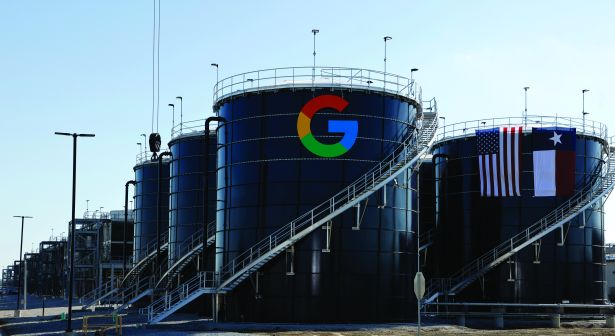
“AI factories are quite sizable, so you’re looking at construction budgets north of $20 billion in many instances, so from an equity perspective that takeout remains to be determined, or if it’s something better suited for the public markets,” said CBRE’s Metzger. “There’s just some unknowns. None of these have delivered yet, so that process of overall monetization hasn’t taken place yet … and for some investors these might be very long-term holds.”
One reason why investors have jumped so eagerly into the data center space, including the generative AI factory arena, is because of the valuations hyperscalers have experienced in the last five years, especially since AI went mainstream in 2022.
Since December 2020, Google’s stock price has increased 258 percent; Microsoft’s has risen 119 percent; Meta’s 144 percent; Apple is up 105 percent; and Oracle’s stock price is 205 percent higher.
“People have a general sense of a bubble, but for me it’s irrational investment behavior, and that can be both on the investment side, with capital going in, but also irrational valuations around the companies that are in there,” said CenterSquare’s Wilson.
Wilson emphasized that before 2025, public REITs drove the capital into the sector. But today, with hundreds of billions of dollars required for development platforms, REITs are “incredibly small scale” compared to the private players, particularly the Big 4 Silicon Valley firms. He said Amazon, Google parent Alphabet, Meta and Microsoft were estimated to deploy $350 billion into the space through 2025 and are expected to invest another $511 billion in 2026.
“There’s some thought it might go up, but it will get tougher and tougher to deploy starting in 2028,” he added. “A lot of the physical space will be taken up and installed, there’ll be tremendously tighter markets, and you’ll be going into the tertiary markets in North Dakota, Louisiana, west Texas, and so you do start to bump up against the level where capital expenditures plateau.”
Snap, crackle and pop
To even a true data center bull like JLL’s Farney, ever since Wall Street jumped into the industry in the early 2020s, the valuations for AI and data centers have been “bonkers,” but that doesn’t mean they’re dangerously priced.
“Absolutely, there’s a bubble in equity pricing, along the entire value chain, but when it comes to the fundamentals of business, it’s in no way [a bubble],” he said. “No one can show me the demand is not there.”
Sure, demand is all well and good, but industry experts like Chris Russo, who makes a living advising on data center economics, argue there are major, existential questions on how generative AI will be monetized. It could come in the form of all of corporate America adopting a gen AI Microsoft Co-Pilot, which is powered by ChatGPT, or life sciences firms adopting AI hyperscaler technology for research, or every white-collar business in the country automating its human workers as AI chatbots. But those remain theories, if not science fiction.
“All of the investment in AI is to ultimately produce LLMs, or AI generative intelligence, but at some point people need to pay to use it as a product,” Russo said, emphasizing that revenue must appear in the flesh to justify investment.
“If trillions of dollars are being committed in capital, then there needs to be trillions of dollars of revenue to support it,” he added. “The money needs to come from somewhere, and where the money comes from right now is still questionable.”
Right now, AI relies on a subscription model, where users pay per month. While the expectation is that large-scale corporate subscriptions will integrate these different AI technologies into their numerous businesses, the real bet is on AI getting intertwined into the everyday lives of ordinary Americans in myriad, unheard-of ways.
“The hope is it gets embedded into a lot more areas of your life, and so as these things get better at image recognition, machine learning through visuals, it might integrate into wearables, and it could be embedded into autonomous vehicles diagnostics,” said Wilson. “That’s the thought, but we’re at this precipice, and, if anyone says they know where this technology is headed, call them crazy.”
Another wild card in the entire narrative is the power struggle. The Electric Power Research Institute estimates data centers could account for anywhere from 5 percent to 9 percent of all U.S. electricity consumption by 2030. The Environmental and Energy Study Institute forecasts data center electricity demand will reach 130 gigawatts by 2030, and account for 12 percent of U.S. electricity demand.
And some of the numbers now being forecast are not just jaw-dropping, but in some cases fanciful. CNBC reported the Electric Reliability Council of Texas projects 220 gigawatts of large data center developments have asked to connect to the Texas electric grid by 2030.
Mike Hogan, senior adviser to Regulatory Assistance Project, a nonprofit think tank that advises on energy policy, noted that 225 gigawatts of new data center demand in Texas is almost six times the current peak load of the whole state, which is projected to be 40 gigawatts by 2030, and that the U.S. power grid is 900 gigawatts total.
“It’s very, very difficult to imagine that all of that development is for real,” said Hogan, who noted many data center development contracts counted are duplicative across states, or speculative. “I’m far from alone in thinking that we’re in the middle of a bubble. But it’s also true that if only 10 percent of that comes through, it’s a significant amount of new load.”
Russo, another skeptic, noted that, right now, data center developers are “almost indifferent to what energy costs,” because returns are currently so high, while the average American voter might not be so amenable to increased energy bills due to the wave of new data center deals.
“Data centers are making clear one of the fundamental principles of markets: When something is scarce, it becomes expensive, and, at the moment, there is a very large demand for electricity from data centers and consumers, and that increases prices,” he said. “Everyone loves market incentives, but nobody likes the side effects of higher bills.”
Even if the access to power for data center developers has immediate solutions — JLL’s Farney noted that large consumers are creating their own multistate natural gas arrangements, while also investing heavily into alternatives to existing grid technology via nuclear power, coal and solar — there is still the threat inherent in the technology itself. Unlike railroad infrastructure or telecommunication fiber optic cables, the chips built today that power data centers won’t be useful in five years, let alone 100 years, according to Russo.
“The speed at which this technology depreciates — and a lot of the value is consumed very quickly — is astonishing compared to other industries,” he said. “It’s like developing an office building and replacing the plumbing and wiring almost immediately.”
CenterSquare’s Wilson said the bubble threat to the market isn’t so much like the Global Financial Crisis of 2008, but more like the boom-and-bust cycle that occurred during the growth of the railroad industry in the 19th century.
“I do think this is a huge inflection point in society going forward,” he said. “This isn’t a fad, but there will be, like there always is in bubbles, if we can call this a bubble, wreckage, and there will be losers.”
Brian Pascus can be reached at bpascus@commercialobserver.com.

![Spanish-language social distancing safety sticker on a concrete footpath stating 'Espere aquí' [Wait here]](https://commercialobserver.com/wp-content/uploads/sites/3/2026/02/footprints-RF-GettyImages-1291244648-WEB.jpg?quality=80&w=355&h=285&crop=1)