Jason Carney of Gensler: 5 Questions
By Larry Getlen December 18, 2025 6:00 am
reprints
British auction house Bonhams was founded in 1793, and is one of the largest in the world for the sale of fine art and antiques, with showrooms or regional offices in 25 countries.
It stands to reason, then, that when the firm sought a new home in New York for both exhibitions and sales, the company’s leaders decided on a location with both historic prestige and contemporary relevance.
After being housed in around 30,000 square feet at 580 Madison Avenue since 2008, Bonhams will relocate to 42,000 square feet at 111 West 57th Street, home to the 84-story Steinway Tower and, at its base, the 100-year-old Steinway Hall, former showroom and recital hall for Steinway & Sons pianos and a New York City landmark.
The street-facing portion of Steinway Hall has been vacant and closed to the public for roughly a decade.
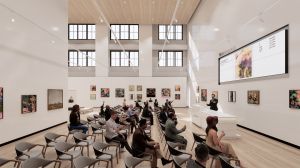
Now, Bonhams’ new home will greet visitors with the Steinway Rotunda, including an 80-foot glass atrium that will serve as the company’s grand reception area, as well as offering a triple-height gallery and two massive auction rooms for the firm’s more than 60 cultural categories of prestigious auctioned items.
JDS Development Group led the hall’s restoration, and global design firm Gensler designed the interiors. To gather insight into the new space and how it came to be, Commercial Observer spoke with Gensler Design Director Jason Carney, who led the project for the firm.
Bonhams will open its new headquarters to the public on Feb. 9, 2026.
This interview has been edited for length and clarity.
Commercial Observer: What was it about Gensler’s proposal that ultimately helped the company win this project?
Jason Carney: The variety of skills we have under this roof. One of the benefits of being a larger organization with the scale we have is the experience levels we have across multiple practice sectors. We’re able to pull in people who have worked on cultural projects and museum projects who may not be involved day to day, but have a knowledge base that’s accessible to us. Plus, we can tap into a great depth of knowledge across not only our office, but other offices in the firm as well. That is a strong differentiator for us.
And, ultimately, the way we approached the physical building itself. It’s a fascinating space. You have the Steinway building, the 16-story limestone building on 57th Street, but then there was an L-shaped annex in the back, on 58th Street, which is a masonry building that is also 16 stories. So you had this L-shaped site.
When JDS redeveloped the building, they completed the square, buying the additional parcel on 57th Street. The tower was then able to come down through the center of all this. So between the structure of the tower and the two existing building types that were there originally, you had this really beautiful puzzle of architecture coming together, and it created a lot of fantastic spaces that are almost in between all of these buildings. That’s what we really extrapolated from to inform the design.
JDS’s renovation was great, and it created a lot of interesting conditions that could have been challenges. But our initial directive was to embrace all of that, and to let that guide what the design could be in order to fulfill Bonhams’ programmatic needs.
You have a site with a deep cultural heritage, and then you have a new organization going into it with its own heritage. Talk about balancing those two factors.
Bonhams, as an auctioneer, is a platform. Their identity is more about treating the objects and the art that they sell in the proper way. We didn’t need to imprint anything over or cover up any of the heritage of the Steinway building. It works quite well, because between the historic and new portions of the interior, it creates a landscape of different types of exhibition spaces.
Some are very grand, with 60-foot ceilings and lots of natural light coming in through huge glass facades. Then, some are much more intimate, like the rotunda. You can imagine jewelry, watches and smaller precious objects being exhibited in that space. Then there are two other exhibition halls. This all gives Bonhams the ability to curate their sales and exhibitions in a way that’s very responsive, and creates a rich variety across their entire offering.
What are some of your favorites among the design elements Gensler came up with for the Bonhams space?
One of the great benefits of the space was also a challenge, which is the amount of natural light coming into the space. There are a lot of different varieties. The rotunda is much more intimate in scale, with limited natural light. Adjacent to that is what we call the atrium, with 60-foot ceilings, 80-foot exposure onto 57th Street, and lots of natural light coming in.
On the third floor there are two galleries: a larger gallery that has 30-foot ceilings and faces north onto 58th Street, with a lot of natural light; and then another, midsize gallery on the third floor that has no natural light whatsoever.
Given the variety and the range of art objects they display, lighting requirements can run the gamut. Some of these objects don’t want natural light. Some need very specifically oriented artificial light. So, ultimately, the spaces need to be flexible, because these exhibitions change consistently. They have a very short run period.
So how we designed the lighting systems was a key challenge, and I think we met it. To be able to provide the flexibility to create artificial lighting for these objects where needed while providing the ability for them to quickly pivot was certainly one of our key considerations. The end result is a beautiful exhibition space where certain areas have a lot of natural light, which is a hard balance to achieve and something we don’t see very often. That will be one of the key features of this space — that dialog between the exterior and the more controlled conditions on the interior.
Also, you had asked about how their brand, or their heritage, overlaid with Steinway’s and the aesthetic details and qualities of the historic preserved space. We certainly didn’t want to just re-create that as a pastiche or something we just painted on, but we wanted echoes of that to come through. There are a variety of different types of spaces, and we wanted to celebrate those differences, but we wanted a core DNA.
So there are certain echoes. I don’t want to say motifs, necessarily, but when we think about the rotunda, there are these nice, heavy drapes. Think about the curtains from a theatrical performance. If you think about musical and theatrical performances having these theatrical curtains, we used that as an idea for cladding in the main atrium.
One of the shear walls of the tower comes down, and it’s a massive concrete shear wall. It’s a very tall tower. So we clad that core coming down with a GFRG [glass fiber reinforced gypsum] system of this semi-organic corrugation that runs up the spine of this very tall, 65-foot-high core coming in.
Not to get too technical, but GFRG is a gypsum wall, which is what sheetrock is made out of. You can make a slurry out of it and then create molds. You pour it in with a fiberglass netting, which gives it its rigidity and strength. It’s a very plastic material. You can be sculptural with it, but it can also go up very easily on surfaces, and can be taped and sanded just like regular drywall. We ended up with this beautiful atrium core coming down that has no seams.
We tried to get the echo of the ripple of the curtains coming in, but much more modern, much more contemporary and much cleaner.
We’ve talked about the balance, but were there specific design elements that spoke more to Bonhams’ history and tradition?
It wasn’t so much about specific design elements. The biggest thing, to help future-proof them, was flexibility. Flexibility was key.
The array of objects they sell is so great that it’s hard for them to even think about what they would need. So the idea of the ultimate level of flexibility was continuously brought back to us as a directive as we were thinking about the design.
Also, the two galleries that have a lot of glazing and a lot of natural light need display surfaces — solid wall surfaces. We balanced that by creating plinth walls that float just inside the perimeter of the building so we’re not covering windows. You’re still getting the bar of natural light coming around these plinths, but it gives Bonhams the amount of hanging space they need so they can have as much of their property up as possible for their exhibitions. That flexibility was the key directive.
There are other slight, nuanced reflections back to their brand. That very tall core I mentioned, that we clad in GFRG, does have a couple of windows on the third and fourth floors.
On the third floor is additional gallery space, so it’s nice to have a visual connection between the two levels of the gallery. On the fourth floor is their office space, and they have a very large boardroom that also has a very large window in its core that overlooks the atrium. And, the ceilings are painted a rich blue, which is Bonhams’ heritage color.
So, within that atrium, you get a glimpse up through the windows, looking up to the ceiling, of their brand color. We have very subtle references back to Bonhams, but, ultimately, the star of the show is the property, and the art and the goods they are exhibiting.
Were there any major obstacles to achieving your design goals?
The technology had to be fully integrated so, when they run their sales and auctions, they have multiple locations where they can do so.
Depending on the size of the sale and how many people are going to be present, they can locate that sale appropriately. But there’s a pretty robust audiovisual and technology component required for that.
In the main gallery space on three, we have a series of large digital screens embedded into the wall. When they’re running auctions, the screens will show prices in five or six different currencies. Plus, they often have virtual bidders, so the auctioneer requires information from them. There’s a pretty intense choreography between the technology, the AV and then the physical space, to allow for them to quickly take an exhibition space and turn it over into a space that will host an auction, and then quickly turn it back.
Larry Getlen can be reached at lgetlen@commercialobserver.com.