2026 Commercial Real Estate Lookahead: The Asset Classes to Watch
New York office, top malls and AI-driven data centers are among the property types that have a busy year ahead of them — as does the financing behind them all
By Mike Seemuth December 30, 2025 9:00 am
reprints
It’s all going to depend.
Commercial property owners will face a friendlier economic environment in 2026 if the pace of inflation is slower and interest rates are lower. Even without declines in prices and borrowing costs, commercial property owners should do well in certain asset classes, including high-end retail stores, AI-driven data centers and Manhattan office space.
But the 2026 economy may not be friendly enough for some owners to grow revenue faster than expenses and to repay maturing loans on their income-producing properties. A survey of more than 850 executives in the commercial real estate industry by the Deloitte accounting firm found that some of them don’t expect their companies to repay property loans in full when they mature in the coming year.
New York office
The office market in Manhattan, the nation’s biggest, is now comparable to an exclusive restaurant where reservations don’t come easy. And it’s likely to stay that way for a while.
In the third quarter of 2025, 16.6 percent of Manhattan’s office space was available for lease, the city’s lowest availability rate since the pandemic-ravaged fourth quarter of 2020, according to a report by brokerage CBRE. Office leasing volume in Manhattan surged to 23.2 million square feet in the first nine months of the year, up 40 percent from the same period in 2024.
“I think 2026 looks to be a very good year in leasing and investment sales. I think the trends will continue,” said Bruce Mosler, the New York-based chairman of global brokerage at Cushman & Wakefield, citing a surge in the total volume of Manhattan office lease deals in 2025.
“We’re probably going to end the year at 38 million square feet or greater. … It’s the best year we’ve had, post-COVID, since 2019,” Mosler said. Along with office lease volume, investment sales of Manhattan office buildings totaled $6.5 billion in 2025, up 30 percent from 2024, he said.
Office availability in Manhattan is tightening as rents rise, Mosler said, citing a scarcity of newly built office space in Manhattan and a mass return to offices by employees who worked remotely during the pandemic. “What occurred in the past several years was the return to office,” he said. “That’s what drove this demand.”
After the pandemic, many companies leased additional office space as remote work waned, but they underestimated how much space they were going to need, said Scott Rechler, chairman and chief executive officer of RXR, a New York-based real estate owner, operator and developer.
“Almost every tenant that took space earlier, coming out of the pandemic, had to materially increase their space and expand as employees came back,” Rechler said. “Companies like IBM just ended up taking a lot more space than they thought they were going to need.”
Nothing major is imminent in New York City’s office-construction pipeline following the lease-up of newly built office space at two major Manhattan developments, Hudson Yards and One Vanderbilt, and the debut this fall of J.P. Morgan’s 270 Park Avenue headquarters. “That has all been absorbed,” Rechler said. “So there really isn’t new supply that’s going to be coming on the market until 2030, `31 or `32.”
All this translates to: a landlord’s market.
Manhattan office tenants are in turn seeing less upfront concessions, such as a rent-free period, from their landlords in exchange for renewing a lease or expanding the amount of leased space, said Mary Ann Tighe, CEO of the New York tri-state region at CBRE.
Along with the return-to-office trend, conversions of office buildings to residential properties also reduced office availability, first in Lower Manhattan and then in Midtown, Tighe said. “We learned all about that downtown, but now we’re seeing it happen actively in Midtown,” she said.
Tighe expects Manhattan office availability to decline in 2026 while the market’s 2025 jump in sales will continue into the new year. “It will, indeed, pick up,” she said. “We’re coming out of the [office] price discovery phase, and we’re watching owners and lenders make difficult decisions.”
Tighe and other real estate professionals said technology companies have re-emerged among the most active types of tenants in the Manhattan office market. CBRE expects tech firms to account for 17 to 19 percent of the 2026 volume of lease deals in Manhattan covering a total of more than 40 million square feet.
While owners of Class A office buildings benefit from a flight to quality, for owners of Class B and particularly Class C space, “2026 will likely remain a reset year,” said Sam Chandan, director of the Chao-Hon Chen Institute for Global Real Estate Finance at New York University.
For some office properties in Manhattan, good times came suddenly after years of pandemic-based spikes in vacancy rates and elevated borrowing costs.
“We are trading paper, proposals, on every single floor at 360 Park Avenue South. … We bought that building in 2021, and then the market went very quiet until the last four to six months,” said Rich Monopoli, senior vice president of Boston-based BXP, a publicly held developer, owner and manager of office buildings.
The good times could continue to roll under Zohran Mandami, the newly elected mayor of New York City, because he has made affordable housing a top priority, Monopoli said. “Affordability should be helpful to allow more talent to come to New York,” he said. “That could be supportive of building a vibrant business community.”
NYU’s Chandan agreed that Mayor Mandami’s election may not meet the worst expectations of the business community in general and office building owners in particular.
“There had been a lot of bluster leading up to the mayoral election,” he said. “But at least in the weeks that followed, there hasn’t been a mass exodus from the city that might impair office leasing demand.”
AI and data centers and all that
The development of data centers is key to the expansive efforts to enhance artificial intelligence. But the AI companies behind these developments face ample obstacles, including access to electrical power.
“In many markets, it can take four years or more to have high-capacity power lines extended to new development sites,” according to a report on the outlook for data centers by brokerage firm JLL. “Most of this delay is associated with securing easements and regulatory approvals. … These challenges have led to a shift in site-selection criteria, with land now being evaluated based on available power capacity and proximity to transmission lines, rather than pricing or total acreage.”
Rapid advances in semiconductor technology have put data centers “at the precipice of a transformative era driven by the relentless advancement of artificial intelligence,” JLL reported. Yet sales of data centers are infrequent, “due to significant bid-ask spreads and lack of available product.”

The development of AI is driving the development of data centers, which are designed to make money by leasing server space to users, and the demand is so strong that most server space is spoken for long before new data centers open.
“Roughly three-fourths of our [national] construction pipeline in data centers is pre-leased,” said Carl Beardsley, senior managing director and national data center leader at JLL. “It is the most liquid side of the market for construction financing.”
Development takes time, though, and a lot of it. “If someone is closing on land today, they may not break ground or need a construction loan for three to five years,” Beardsley said. “It can take a minimum of three years, after you close on a site, to get all the supply chain in order and get power to the site. It’s not as if they’re just closing on the site and they’re going vertical, like an industrial project.”
Political resistance to data center developments has spread nationwide due largely to citizens’ concerns about the water and electricity they consume. “There’s a lot of community resistance to data centers,” Beardsley said. “It feels like it’s everywhere right now.”
Difficulty in procuring adequate electrical power is a bigger impediment to new data centers than local community resistance, said Matt Rotolante, president of the South Florida region at Lee & Associates, a commercial real estate brokerage that works with landowners seeking to sell property for data center development.
“The current electrical grid throughout the country isn’t built to handle these additional needs, so it’s probably the biggest thing that everybody’s talking about,” Rotolante said. “I’ve heard stories about agents literally just following the power lines to go look at the substations and seeing if they have room for more transformers.”
Among the most prominent users of data centers are companies such as Amazon, Alibaba, Apple, Facebook, Google, Microsoft and Oracle.
“A lot of these groups have their own AI platforms,” Rotolante said. “ChatGPT and similar groups are leveraging the same systems.” Large users often rely on more than one data center because they want backups in place. “If you have a failure in one area, it just rolls over to the next data center,” he said. “You have redundancy.”
Housing
Home prices nationwide fell 1.4 percent in late 2025, according to data firm Parcl Labs. It was the first overall price decline since 2023, after the Federal Reserve began raising interest rates and residential property values peaked during the COVID-19 pandemic.
The National Association of Realtors forecasts a 14 percent increase in sales of existing single-family homes in 2026, compared with 2025, and a 4 percent increase in home prices while mortgage rates drift downward toward 6 percent.
“Most economic forecasts seem to suggest that interest rates will slowly decline,” said Jonathan Miller, president and CEO of New York City-based property appraisal firm Miller Samuel. Fixed interest rates for 30-year mortgage loans “are expected to slide to 6 but not below, with that occurring in early `27.”
The Federal Reserve made cuts in short-term interest rates this year, and Fed Chairman Jerome Powell has said the central bank expects to cut rates once more in 2026. Meanwhile, the 10-Year Treasury yield, which heavily influences mortgage rates, remained around or above 4 percent all year, up from under 3 percent as recently as mid-2022.
“The administration clearly wants a lot more cuts,” Miller said of the White House. “So, this uncertainty plays into housing in the sense that many consumers are just waiting for rates to be lower. … Consumers who are waiting for a big [home] price correction or for rates to plummet are going to continue to wait. I think it’s just more of the same.”
Many homeowners are unwilling to sell their properties at discounted prices. Zillow estimates that 53 percent of U.S. homes lost value in 2025, the highest share since 2012, and reports that “the loss of value has been most widespread in the West and South.”
New home construction in 2026 may reach its lowest level since 2019, according to Seattle-based Zillow. “Because there’s a large stock of new homes already built, and others still under construction, builders are expected to hold back on starting new projects,” the company said.
Renting, of course, can be a costly alternative to homeownership. For example, apartments at market-rate buildings in Manhattan now commonly command monthly rents in the five-figure range.
“Below 96th Street, the average price per square foot has almost doubled in 10 years,” said Shimon Shkury, president and founder of New York-based investment sales brokerage Ariel Property Advisors. “A three-bedroom that was renting, on average, for $7,800 a month is now renting for closer to $12,000 a month, so the fundamentals are very strong.”
Mayor Mandani’s focus on affordability could help owners of rent-stabilized apartments by restoring tax incentives to convert such properties to affordable housing. “I’m optimistic that he wants to be politically smart and take care of the city,” Shkury said. “It’s a lot about signaling today, and investors are looking to see who he puts in key positions.”
Retail
The best malls and shopping centers will remain a world apart from less popular retail properties in 2026.
“High-quality shopping centers and malls essentially have zero to very little [store space] availability,” said James Bohnaker, senior economist at Cushman & Wakefield. “On the other end of the spectrum are some properties that are less desirable, have weaker tenant bases, and may be running into financial headwinds.”
Bohnaker expects a slight increase in the overall vacancy rate from historically low levels. “Today the vacancy rate at shopping centers is about 5 percent. … We see it going up a couple of basis points [in 2026] but staying below 6 percent,” he said. “That’s still below where we were in 2019. And, going back prior, that’s still very close to a record low amount of vacant space.”
While the number of store closures remains elevated, net absorption of U.S. retail space is expected to average 3.8 million square feet per quarter in 2026, less than half the five-year average of 9.8 million square feet per quarter, according to Arlington, Va.-based CoStar Group.
Among other risks that could worsen the outlook for U.S. retail properties, consumers are “already showing some signs of spending fatigue, [and] tariff-related price hikes could further strain household budgets and dampen discretionary spending,” CoStar reported.
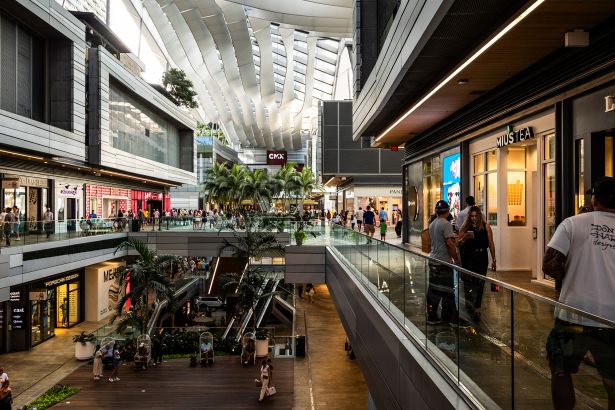
In the first half of 2025, 5,822 store closures put 123.7 million square feet back on the market, according to a research report by the Colliers brokerage firm. Store closures and a near freeze on retail space construction in the last five years have combined to hold down shopping center vacancy rates.
“Since 2020, just 21 million square feet of newly built retail has been listed for lease, representing less than 5 percent of national availability, much of it concentrated in high-growth markets like Texas,” Colliers reported. “Construction costs, which remain 30 percent to 40 percent above pre-pandemic levels, have further limited speculative development, especially for stand-alone retail.”
Across the nation, the lower retail vacancy rates are concentrated in such Sun Belt states as Texas, Georgia and the Carolinas, C&W’s Bohnaker said. For example, he said, “South Florida has a very low vacancy rate.”
The Miami area has “a resilient retail economy because we are a community that spends money,” said Andrew Hellinger, a Miami-based developer.
He built River Landing Shops & Residences, a riverfront mixed-use property in Miami with 528 rental apartments, 150,000 square feet of office space and 345,000 square feet of retail. “Immigrants come here, they make money, they want to buy nicer things,” Hellinger explained. “Tourists come here and do a little retail tourism, and fly home.”
The money behind it all
Refinancing or otherwise replacing commercial real estate loans as they mature is a challenge for many property owners who borrowed when interest rates were lower.
“Five years ago, interest rates were lower. And, so, in addition to all the other increased costs, borrowers are going to have to come to grips with paying more for their loan,” said real estate attorney Bill Kramer with Brinkley Morgan, a law firm with offices in Boca Raton and Fort Lauderdale.
Nationwide, the dollar volume of commercial mortgages that will mature in 2026 is $539 billion, down substantially from $957 billion in 2025, but still well above the 20-average of $350 billion, according to a report by The Kaplan Group, a commercial collection agency.
As of the second quarter of 2025, the overall delinquency rate on commercial real estate loans was 1.57 percent, Kaplan reported, citing bank data from the Federal Reserve, but the delinquency rate among loans tied to commercial mortgage-backed securities (CMBS) was 7.29 percent.
Lenders have extended maturity dates on some commercial real estate loans through so-called “extend and pretend” deals, according to the 2026 outlook report by Deloitte. The report featured results of a survey of more than 850 executives in the commercial real estate industry. More than half said their companies face property loan maturity deadlines in the coming year, and only one-fifth said they expected their companies to pay off maturing loans on time.
“Multifamily and industrial remain the darling asset classes for debt providers,” said Peter Mekras, president of Miami-based Aztec Group. “When 2025 began, access to debt for office was very limited, and now it’s much more available. … For the projects that previously couldn’t get a loan, even though they should have, today they can for office.”
Other asset classes in commercial real estate have uneven appeal to lenders. For hotel construction, “there is financing selectively available. Who’s borrowing the money matters a lot,” Mekras said.
Equity financing is harder to find than debt financing for some types of commercial property developments. “For reasonable levels of leverage, if someone has equity and wants to build a pre-leased shopping center, there is no doubt a lender,” Mekras said. “The question is: Where is the equity coming from? And I would say the same is true of apartments. If you have equity for apartments, there is debt available.”