Florida Voters Approve Property Tax Cuts, Raising Questions for CRE
By Julia Echikson November 4, 2026 1:30 pm
reprints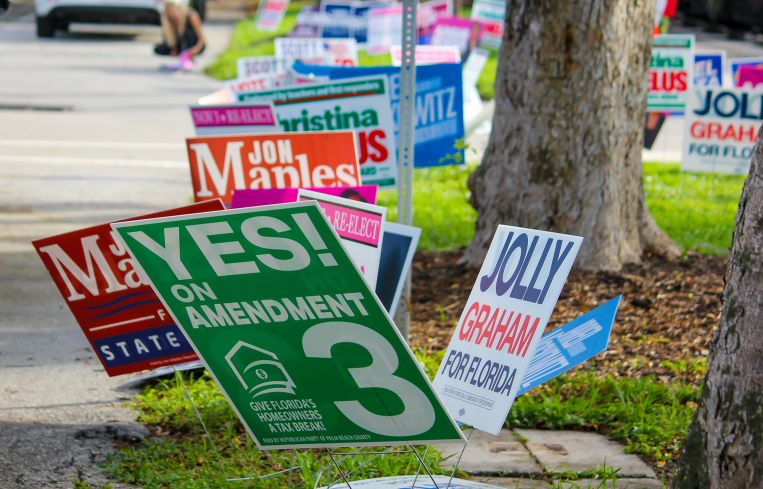
Florida voters approved far-reaching property tax cuts in Tuesday’s election, which proponents say will slash the budgets of local governments, although the impact on the real estate industry remains unclear.
The measure, known as Amendment 3, won 62 percent of the vote, surpassing the 60 percent threshold required to alter the state’s constitution.
The measure would halve the annual cap on increases to commercial properties and second homes, but the biggest tax cuts target primary residences. The homestead exemption, which reduces the taxable assessed value of a primary home, is set to triple to $150,000 next year, then increase to $250,000 the following year, with subsequent hikes tied to inflation.
Florida does not have a state income tax, so most county and city governments rely heavily on property taxes. The changes are expected to cost local governments $4.6 billion in 2027, $8.4 billion the following year, and nearly $12 billion in 2032, according to analysis from the Florida Legislature.
To blunt the cuts in property tax revenue, some counties and municipalities are expected to raise millage rates, the basis for calculating property taxes, and fees, including those for permits — potentially eroding the touted savings.
As homeowners receive the largest tax breaks, local governments may also become increasingly reliant on commercial properties for revenue, and could decide to increase their taxes. Landlords, in turn, could raise rents to offset the higher costs, passing the burden to tenants.
Take multifamily properties, whose tax bills could climb nearly 15 percent, or about $406 per unit, according to a study by Jared Walczak, a senior fellow at the Washington-based Tax Foundation and president of Walczak Policy Consulting.
It’s unclear whether Amendment 3 will boost the housing market and entice new-to-market buyers. To qualify for the cuts, property owners must be Florida residents before the end of the year. Afterward, transplants must wait five years.
Commercial real estate took a beating in other South Florida races.
Robert Rivani lost his bid to expand his office development in South Beach, which stands on city-owned land. Miami Beach voters, by a nearly 63 percent margin, shot down the developer’s proposal to extend the ground lease of the six-story building at 1691 Michigan Avenue by 20 years and add 47,000 square feet.
Still, Rivani will retain control of the office asset, where Playboy and H.wood Group have signed leases. The current lease agreement runs until 2052 and includes two 20-year extension options.
On Virginia Key, Miami voters struck down plans to lease 27.6 acres — which included the Rickenbacker Marina and the shuttered Marine Stadium Marina — to RCI Marine Group and Dallas-based Suntex Marinas. The proposal drew fierce backlash from some locals because it would have forced the closure of the popular Gramps Getaway waterfront bar.
But a bright spot for the real estate community was the election of Vicki Lopez to the Miami-Dade County Commission. The former state legislator was an architect of the Live Local Act, a controversial housing bill that’s made it easier for developers to receive approvals for housing projects. Lopez joined the commission last year to replace Eileen Higgins, who won Miami’s mayoral race.
Florida voters also elected Republican Byron Donalds to replace term-limited Ron DeSantis as governor, extending GOP control in a state that has not elected a Democrat as governor since 1994.
Julia Echikson can be reached at jechikson@commercialobserver.com.