A Third of Maturing Multifamily Debt Needs Cash Infusion to Refinance
By Liam Mulcahy October 19, 2026 4:44 pm
reprints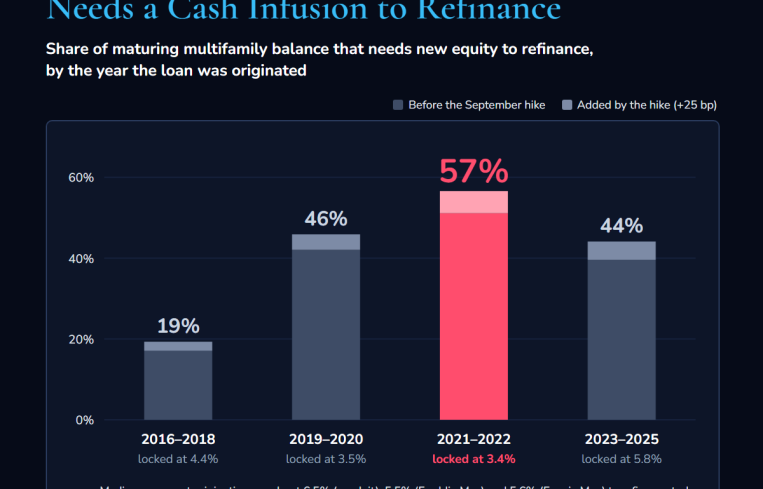
After September’s rate hike, $6.8 billion of fresh equity stands between maturing multifamily loans and a refinance. Loans written at 2021 and 2022’s low coupons are the hardest hit.
20 Exchange Place, a 54-story, 767-unit apartment tower near Wall Street that was built in 1929, was 94 percent occupied in the second quarter, and its loan is current. But the $246 million Freddie Mac loan behind it carries a 4.01 percent coupon and matures in February 2027. The property’s 2025 net operating income of $15.5 million would support a new loan of about $183 million at today’s agency rates, leaving a gap of roughly $63 million. The borrower has been calling capital from investors as needed to cover operating shortfalls, according to servicer commentary.
That arithmetic is now common. CRED iQ resized every multifamily loan in Fannie Mae, Freddie Mac and commercial mortgage-backed securities deals maturing between October 2026 and December 2028, $136 billion in all, at current new-issue coupons plus September’s rate hike. Nearly one in four (23 percent) of those loans, and 31 percent of the balance, could not refinance without new equity. Borrowers would need to bring $6.8 billion to the table. The median shortfall is 15 percent of the loan, or about $25,000 per apartment.
What the hike did
The Secured Overnight Financing Rate jumped from 3.62 percent to 3.85 percent on Sept. 17. Passed through to permanent loan coupons, the hike pushed 178 more loans ($4 billion of balance) below a 1.25 times coverage test and added $846 million to the equity gap. Each further 25 basis points adds roughly $1 billion more. Two more hikes would leave 39 percent of maturing multifamily debt short of a refinance.
The gap is concentrated in loans written at the bottom of the rate cycle. Loans originated in 2021 and 2022, with a median coupon of 3.35 percent, now face refinancing rates roughly 2 to 3 percentage points higher. Some 46 percent of them, and 57 percent of their balance, need new equity, against 15 percent of the loans written in 2016, 2017 and 2018, which had years of rent growth to catch up with higher rates.
Income is the other half of the story: Loans that clear the test have grown net operating income a median 31 percent since underwriting, while those that fall short have seen it drop a median 12 percent.
Where the gap Is widest
Among the largest markets, Western and Sun Belt metros have the widest gaps. In San Francisco, 70 percent of maturing multifamily debt falls short. In Atlanta, the shortfall is 55 percent; in Denver, 51 percent. Chicago’s shortfall is at 13 percent, and Los Angeles is at 24 percent.
New York’s Park West Village shows how fast a gap can open. The 850-unit property’s loan, split across seven conduit deals, was underwritten at 1.34 times coverage, and by year-end 2025 coverage was 0.61 times as expenses rose, according to servicer commentary. It was modified by the special servicer last November and matures in August 2027.
The takeaway
Most maturing multifamily loans still refinance on their own. But for the 2021 and 2022 class, a refinance now means a check, and every additional hike makes it bigger. Expect more paydowns, extensions and rescue capital through 2028.
Liam Mulcahy is senior product manager for CRE data and applied AI at CRED iQ.