New York’s Rent Freeze Was Only An Aftershock. This 2019 Law Was The Quake.
The 2019 Tenant Protection Law damaged rent-stabilized landlords in a way that New York’s recent rent freeze will only make worse
By Larry Getlen August 10, 2026 3:00 pm
reprints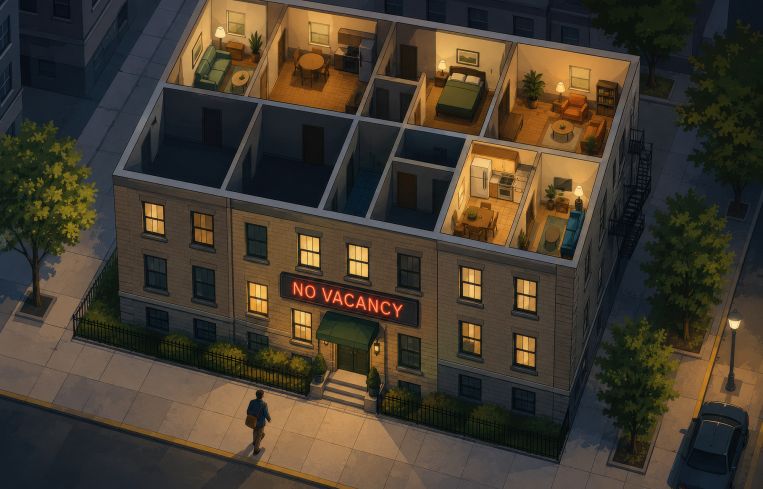
Jose Tur owns two rent-stabilized rental buildings in Manhattan’s Washington Heights with a total of 45 units. The properties have been in his family for over 30 years, and the mortgages are fully paid off.
But Tur tells Commercial Observer that despite this, while he’s reluctant to give an exact number, “more than two or three” units have been sitting empty for an average of over two years.
That’s because, according to Tur’s estimates, it would cost anywhere from $30,000 to $60,000 per unit to return them to a livable state, and that’s money he can’t justify spending in return for the stabilized rent amounts in today’s environment.
“Some of them require more work than others, but for the ones that need significant work — and I mean baseline, just to get them up to livable standards — we’re talking $30,000 minimum,” said Tur, who has testified about these financial challenges to New York City’s Rent Guidelines Board (RGB). “[Oftentimes] the plumbing’s really old because a tenant has lived there for 10 to 15 years, and you have to do the electrical and then lead abatement, which really increases the tally on the job.”
Tur says that the $30,000 estimate is before taking into account more cosmetic fixes like cabinets, tiles and so forth, meaning the total is often closer to $60,000 for a one-bedroom apartment.
Given all this, the fate of his currently empty apartments is uncertain. With no financial relief in sight, it is likely the units will not be lived in again for the foreseeable future, removed from the rolls of New York’s livable spaces — and from Tur’s income-producing properties — as if they had never existed.
The RGB approved a freeze on rent increases for one- and two-year leases for the city’s rent-stabilized apartments in June for lease terms beginning on Oct. 1 or later. Since then, owners of these properties have been screaming from the rooftops that the failure to approve an increase, at a time when costs of items from maintenance to insurance are skyrocketing, gives them no choice but to increasingly keep more units empty as longtime rent-stabilized tenants move, often after lengthy tenures that leave those units in need of significant upgrades.
There seems to be no reliable indicator for exactly how many rent-stabilized units in New York City are offline specifically due to these costs.
In June, Gothamist reported that, according to a letter from New York State’s Division of Homes and Community Renewal to the RGB, 57,421 rent-stabilized units sat empty as of April 1, 2025, an increase of around 8,000 from the previous year. Since then, 57,000 has become the most widely reported metric of empty apartments.
But the news site makes clear that this number may be too high. It includes empty units in new buildings that simply haven’t been rented yet, as well as units empty at the time due to traditional tenant turnover. It could also include units being held back if a building is being prepared for a sale.
A March 2024 report from the New York City comptroller’s office painted a somewhat different picture. Based on the U.S. Census Bureau’s 2023 New York City Housing and Vacancy Survey (NYCHVS), the comptroller’s office found that “the number of rent-stabilized units that are vacant and not available to rent, both in general and specifically due to landlords’ inability to make repairs, fell significantly from 2021 to 2023.”
(The NYCHVS is conducted every three years, the most recent being in 2023.)
The report went on to say that the number of particularly affordable rent-stabilized units vacant at the time due to landlords’ inability to make repairs was “likely fewer than 2,000 that rent for $1,500 or less, representing less than 0.5 percent of the city’s stabilized housing stock.”
Overall, the NYCHVS found that “in 2023, 26,310 units that were vacant but not available were rent-stabilized.”
And, whatever the number of vacant units, the city’s overall rent-stabilization picture does seem to be brightening a tiny bit.
According to a 2026 report from the RGB, New York City saw a net gain of approximately 21,281 rent-stabilized units in 2025, as 32,745 new rent-stabilized units, credited in the report to buildings developed via the 421-a and 485-x tax abatement programs, helped offset the at least 11,464 that left rent stabilization. That’s the highest number of additions to the city’s rent-stabilized stock since the RGB began tracking these figures in 2003.
But, while that’s good news for New York renters as a whole, it’s little consolation for owners forced to keep units offline due to increased costs and reduced rent income.
The main culprit
Talking with owners and others shows that while the recent rent freeze has been the latest culprit in owners’ ongoing struggle to keep rent-stabilized rental units online, it is not the main one.
The current affordability issues for owners of rent-stabilized properties began en masse after the passage of New York state’s Housing Stability and Tenant Protection Act of 2019 (HSTPA), which, among other protections, removed a landlord’s ability to bring rents up to or close to market level after a tenant vacates a unit.
This, more than any other factor, including increased costs or the rent freeze, is the most frequently cited reason for owners of rent-stabilized properties struggling to keep their buildings rentable without falling deeper and deeper into the red.
“Things got really bad after HSTPA in 2019,” said Tur. “It froze our ability to do our job, essentially. It made it much harder.”
Ann Korchak is board president for the Small Property Owners of New York (SPONY), a trade association and advocacy group representing hundreds of property owners. SPONY’s members can own properties with up to 200 units total, though Korchak said the organization’s average member owns one or two buildings with around six to 20 units. Korchak herself owns two 10-unit residential properties on the Upper West Side, with eight of the units rent-controlled or rent-stabilized.
SPONY filed a lawsuit against the RGB in November 2025 presenting a constitutional challenge to the prohibition against raising rents on vacant apartments. The suit is ongoing.
“Korchak places the blame for any increase in empty late units,” said Mark Willis, senior policy fellow at New York University’s Furman Center for Real Estate and Urban Policy. “MCIs and IAIs [allowances for capital improvements to a building and to individual apartments, respectively] were very generous, so they both helped you cover the capital cost, major capital improvements or repairing individual apartments, and they helped you raise your operating income.”
Kenny Burgos, CEO of the New York Apartment Association (NYAA), an owners nonprofit, noted that with these avenues of increased income closed off to owners, the annual increases set by the RGB had been “the only pressure relief valve for when costs increase.”
“There’s nowhere else to go,” said Burgos, who also noted that the inability to reset rents after a longtime vacancy has had a devastating impact on property values.
“The valuations of these buildings have dropped tremendously, over 50 percent in most cases, 90 percent in some extreme ones,” said Burgos. “Because of that, many of these owners find themselves underwater on their mortgages. Banks are not willing to loan on these properties.”
Consequently, an owner facing a hefty bill for an apartment renovation might have no choice but to defer maintenance.
“It’s the only way owners can try and fix their balance sheet,” said Burgos.
But, in doing so, Willis believes we may be “training these landlords to be slumlords.”
“We’re basically telling them, ‘Your prospects for long-term economic value are dim, leaving you with only one short-term option for continuing to cover overhead and earn some net income, which is shortchanging repairs and maintenance,’” said Willis. “That’s what we’re telling them to do, and that’s where we’re headed. As the quality of these buildings declines, tenants will also suffer.”
Korchak noted, too, that since the pandemic, small building owners are likely to have had their reserves depleted, thereby tightening the financial noose.
“A lot of small owners tend to work off reserves,” said Korchak. “For a lot of small families, the original note was paid off maybe by a previous generation of owners, and you would just hold some money in reserve at the end of every year because you knew some capital expense would be coming up. But accessing capital is really hard right now, and most people’s reserves are gone because of COVID. We had that long period of the eviction moratorium and the cancel rent movement, and any reserves just got watered down.”
Matthew Engel is the president of Langsam Property Services, which manages around 300 entirely rent-stabilized buildings with around 10,000 apartments total throughout New York, with a concentration in Upper Manhattan and the Bronx. He also holds ownership interests in some of the properties he manages.
Engel estimated that his management portfolio includes around 25 to 30 apartments that are currently offline. Some have remained unrented for as long as four years, and all will remain so for the foreseeable future. Other landlords he knows have “double or triple that amount,” he said.
“It’s devastating for us financially,” said Engel. “It’s not like some spoiled landlord is holding this offline. We are cash negative in many buildings. It’s horrible for us to keep these offline. There’s no benefit for me to do so. I just can’t afford to renovate them.”
Engel noted that he has units with regulated rents as low as $600 a month. Not only is he unable to reset the rent after a long-term tenant moves out, but he said that apartments vacated after a tenancy of that length could each require $80,000 to $100,000 worth of work.
“There’s no way for me to finance that work,” said Engel. “No bank would lend me $100,000 if I’m only going to be able to collect $6,000 a year in rent.”
Burgos noted that these are the types of apartments most likely to remain offline for an indefinite period.
“When people have their apartments for 30 or 40 years, they have super low rents: $800, $900, $1,200,” said Burgos. “As more tenants turn over their apartments or die and owners know there are no rent increases coming in the near future, those apartments will stay offline.”
And, while owners find their ability to bring in revenue hindered, the costs they face have had no such controls.
According to a 2026 RGB research report that examined costs for buildings containing rent-stabilized units, from just April 2025 to March 2026, fuel costs increased 11 percent, insurance was up 10.5 percent, and maintenance costs across the board rose 6 percent.
Looking further back, the rise in insurance costs in recent years has been especially stunning.
In an examination of pre-1974 multifamily buildings with six or more units that are at least 90 percent rent-stabilized — around 47 percent of all stabilized units citywide, with a median rent of $1,344 per month — NYU’s Furman Center found that their insurance costs from 2019 to 2025 rose 150 percent.
The core issue
The center also found, however, that some costs, including property taxes, labor and general administration costs, “increased close to or slightly below the overall rate of inflation.” The center then concluded that the issues causing rent-stabilized owners to leave units offline derive more from the income side than the cost side.
The Furman Center noted that adjusting for inflation, median gross income per unit for such owners declined by about 9 percent over that time period. It was this decline, with total operating expenses excluding property taxes remaining relatively stable or even slightly falling in real terms, that caused a drop in real net operating income (NOI).
“These patterns indicate tightening operating margins that may limit the ability of owners to invest in building upkeep,” read the report. “Declines in real NOI reduce the cushion available to plan for repairs, build reserves, or manage unexpected increases in costs. These pressures are compounded by the fact that [these buildings] have no market-rate units to offset slower revenue growth.”
One interesting finding in the report is that, in real terms, operating expenditures excluding property taxes have remained relatively flat over this time period, actually declining by 3.3 percent after adjusting for inflation. This reinforces the argument that owners are becoming more likely to defer or forgo needed maintenance.
“Maintaining flat or declining real expenditures during a period when several major operating inputs rose faster than inflation suggests that owners may have reduced or shifted spending within building operations,” read the report. “These patterns are more consistent with deferred or reallocated maintenance than with reduced cost pressures.”
(The report does address property taxes as well, noting that they have risen “slightly faster than inflation” between 2019 and 2025, further narrowing margins between income and total operating costs and implying that “the resources available for maintenance, repairs and day-to-day operations may be increasingly limited.”)
And now the rent freeze
With so many landlords already grappling with these issues since 2019, this summer’s rent freeze decision by the RGB feels like just another crushing blow.
“The guidelines [from the RGB] have not kept up with labor and material costs for some time now,” said Deborah Riegel, a member in the litigation department at the law firm Rosenberg & Estis who is currently representing owner plaintiffs in a lawsuit against the RGB that’s trying to force a re-evaluation of this year’s guidelines. “You’ve got uncapped expenses with capped revenues. That’s the problem the rent freeze has exacerbated.”
For Engel, the freeze feels like it’s just piling on atop an already untenable situation.
“The rent freeze is just speeding up the process of disinvestment we’re seeing in housing,” said Engel. “Individually, the rent freeze will hurt all of these properties. But, in and of itself, it’s just continuing down the same path of policies that are prohibiting rent-regulated buildings from being cash positive and being able to sustain themselves.”
Evan Roth, a veteran residential broker with luxury brokerage The Agency, makes the point that housing is the only sort of business endeavor in which this scenario would even be tolerated and not immediately dismissed as unworkable by all concerned.
“[You wouldn’t tell] any other business that every expense is increasing while revenue has to stay flat,” said Roth. “I can think that restaurants couldn’t survive, or hospitals or retailers, but somehow we’ve convinced ourselves that apartment buildings are different.”
Without relief in some form, the New York Apartment Association’s Burgos believes that the number of unavailable units is set for a sharp increase.
“The rent freeze was the last hope to try and save some of these costs,” said Burgos. “We’re going to see a lot more properties falling into disrepair, particularly in the Bronx, Upper Manhattan and Central Brooklyn, because that’s where we typically find the lowest average rents. Buildings there tend to have the highest percentage of rent stabilization, with no free-market rents to help offset these costs.”
Some relief — potentially
In one attempt at a solution, the city announced a program in April 2023 called Unlocking Doors that committed up to $10 million to renovate distressed rent-stabilized apartments in the form of up to $50,000 each for 200 units. In order to accept the money, landlords had to commit to keeping the rents no higher than $1,200, $1,300 or $1,400 for one-, two- and three-bedrooms apartments, respectively.
However, the rental rate restriction made the program untenable. In September 2025, Gothamist reported that not one landlord had gone through the process to secure the funds.
As of now, there are limited possibilities for relief.
The parties that Riegel is representing, a consortium of seven rent-stabilized landlords, filed suit against the RGB in July in the hope that a state court will force the board to re-evaluate the rent freeze and impose a raise, preferably before the Oct. 1 starting date.
“The goal of the suit is to have the Rent Guidelines Board comply with their statutory mandate, which is to reach a data-driven determination as to what rent levels should be, not a politically driven one,” said Riegel, whose firm is co-counsel on the suit with Dechert. “While reasonable people could disagree about whether a rent increase should be 2, 3 or 5 percent, what the data absolutely precludes, if you’re being intellectually honest, is a determination that there is no data-driven support for a rent increase at some level.”
That said, Riegel also noted that courts have determined that tenant affordability is one data point the RGB could consider. Depending on how that is framed, that could be seen as a data point in tenants’ favor.
According to the Furman Center, between 2007 and 2023, “rental housing [in New York City] has become less affordable.” After adjusting for inflation, median income for renter households rose 15 percent while median rents rose 25 percent, marking “a persistent gap between income growth and rent inflation.”
The center also notes how other costs have skyrocketed as well. Between 2015 and 2025, for example, “regional food and transportation costs” are up more than 35 percent, and medical care is up 27 percent, “further eroding renters’ purchasing power.”
“These rising costs have left many New Yorkers with less income available for housing and savings, compounding pressure on lower- and moderate-income households,” according to the center.
At this point, there’s no telling what bearing the affordability side of things could have on the lawsuit.
Beyond that, while many would love to see a reversal of the RGB’s rent freeze or even the end of rent controls altogether — the latter a severe and perpetual unlikelihood given the city’s political environment — most believe that a reversal of the portion of HSTPA that disallowed rent resets upon vacancy is the only solution that can begin to make rent-stabilized landlords financially whole once more.
“The bare minimum [solution] would be a vacancy increase,” said Tur. “There’s a challenge to the rent freeze that could lead to some changes. But a vacancy increase [would allow] the market to do what it’s supposed to do: be the market.”
And Burgos noted that the higher rents that rent-stabilized landlords had come to expect after the turnover of a unit were exactly what was needed to subsidize the rest of the building.
“When you had that one turnover opportunity every year or so, that new tenant effectively subsidized someone else’s $700 rent,” said Burgos. “You need constant turnover and rent resets to help the building function. Once that is taken away, the building cannot function anymore.”
For owners caught in the middle, that means options for moving forward which point to financial success will be impossible to envision until something drastic changes in their ability to generate sufficient revenue from their buildings’ rents.
“It’s going to be very, very difficult to continue doing this the way things are,” said Tur. “From a business standpoint and from the standpoint of having a stake here for so long, exiting and selling just doesn’t make sense for us. So we’re going to keep fighting. That’s why we want to voice our opinion and share the realities of how things really are. But something’s got to give. This is not sustainable. Things need to change for the benefit of everyone.”
Larry Getlen can be reached at lgetlen@commercialobserver.com.