New York’s Temporary Data Center Moratorium Could Mean Permanent Losses
Given the asset class' construction timelines and energy needs, a delay of 12 months can feel like a financial eternity. Why not just go elsewhere?
By Larry Getlen July 23, 2026 11:34 am
reprints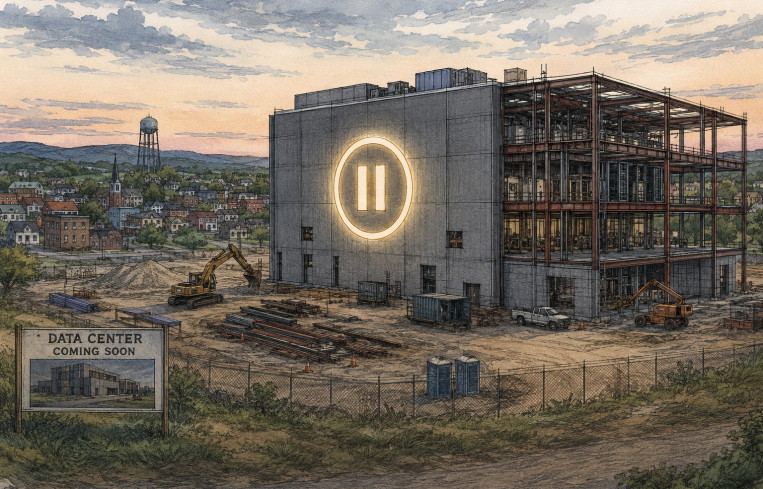
On July 14, New York Gov. Kathy Hochul signed the nation’s first statewide moratorium on the building of new hyperscale data centers, pausing all state environmental permits for up to one year.
The purpose, according to the governor’s announcement, is to take the time to establish “a nation-leading regulatory framework that protects ratepayers, the environment, the energy grid and communities across the state.”
But, at a time when data center construction has become something of a national gold rush, with states competing for the jobs and economic activity new data center activity brings, many are asking if the moratorium will cost New York dearly in terms of economic growth.
According to engineering and supply chain intelligence platform Accuris, the top five hyperscalers — Amazon, Microsoft, Google, Meta and Oracle — are “projected to spend over $600 billion on infrastructure in 2026, a 36 percent increase from 2025.”
And, for another illustration of just how quickly the industry is evolving, in mid-2025, Goldman Sachs projected that hyperscaler capital expenditure from 2025 through 2027 would reach $1.15 trillion, a massive increase compared to the $477 billion spent from 2022 through 2024.
But the investment bank drastically revised its own estimates barely a year later, and now projects that hyperscaler capex in 2027 alone could reach $1.1 trillion.
It makes sense, then, that some states are fiercely competing for this spending and the jobs it could bring, and that when a state like New York hits pause, states with more lax regulatory frameworks gain ground on bringing those dollars and jobs home.
Texas and Virginia lead the nation in both current data center capacity and the willingness to indulge in as much additional data center construction as possible.
According to market intelligence company Cleanview, which tracks large hyperscale data centers with identifiable power capacity, Virginia currently has 371 operating data centers with a combined capacity of 17,378 megawatts (MW), and 438 more projects currently planned to add 36,406 MW. It’s worth noting that the largest existing data center in the state has a capacity of 243 MW, while the largest planned facility will have 2,400 MW, and at least nine planned centers will eclipse the current 243 MW high. All told, 140 different developers have such facilities in the works throughout the state.
Texas currently has 129 facilities totaling 7,036 MW, with 241 more planned to add 98,633 MW from 95 different developers. The largest current facility has a 750 MW capacity; the largest planned has 7,650 MW.
New York, by comparison, is an underachieving younger sibling in the data center space. With nine facilities offering 205 MW, current plans call for 25 more for a total of 9,797 MW from 27 developers.
Predictably, the states indulging mass data center development are also enjoying the spoils.
Virginia’s Joint Legislative Audit and Review Commission (JLARC), which conducts policy analysis on behalf of the state’s legislature, found that Virginia’s data center industry “is estimated to contribute 74,000 jobs, $5.5 billion in labor income, and $9.1 billion in GDP to Virginia’s economy annually.”
But despite this, the news is not all positive for data center-friendly states.
While Virginia’s energy demands remained essentially flat from 2006 to 2020, JLARC estimates that “unconstrained demand for power in Virginia would double within the next 10 years, with the data center industry being the main driver.” It also noted that building enough infrastructure to satisfy this demand — or even half the demand — would be “very difficult to achieve,” and that the increased demand would “likely increase system costs for all customers, including non-data center customers.”
And while New York is the first to enact a moratorium statewide, other states are taking measures to prevent environmental and economic damage to residents. Similarly, localities throughout the country, including in Texas and Virginia, have been pushing back despite the clear economic advantages.
In January 2025, the Georgia Public Service Commission passed a rule allowing public utility Georgia Power to charge any new customer using more than 100 MW in a way that includes minimum billing requirements, and to “address risk associated with large-load users.” The commission is also currently investigating whether data centers are shifting fuel costs onto the utility’s other customers.
Even in famously business-friendly Texas, Gov. Greg Abbott issued a call in June 2026 for sweeping regulations on the state’s data centers, including ensuring that “Texans are not burdened with the costs of infrastructure driven by data center expansion.”
According to Juan Arias, national director of U.S. industrial analytics at CoStar, data center development nationwide has already had a strong upward effect on the prices we all pay for electricity.
“If you look at electricity prices per kilowatt hour in the United States, they were flat at around 14 or 15 cents per kilowatt hour for over a decade,” said Arias. “In the last four or five years, in line with data center construction, they’ve gone up at a 7 percent compound annual growth rate above inflation, and now they’re closer to 20 cents per kilowatt hour. So there has been an electricity price impact, and a lot of that is due to the capital cost of building out new electricity capacity for these data center projects.”
In light of all this, Lauren Bachtel, a partner at the law firm Linklaters and a leader of its environmental and permitting practice in the U.S., considers the New York moratorium unsurprising.
“It’s a trend we’ve been seeing across the United States as more localities impose new and broader requirements on data centers, though it is the first time we’re seeing it statewide,” said Bachtel. “It looked at one point like Maine’s legislature was going to pass something, but it was vetoed by the governor.”
For that matter, just weeks before Hochul issued her order, the New York State Legislature passed the Responsible Data Center Development Act, which would have imposed a one-year moratorium on data centers over 20 MW in addition to requiring a new electric rate class, setting energy efficiency goals, laying out benefits for host communities and a slew of other regulatory provisions.
Hochul went with her own broader and less restrictive version of the moratorium instead with, among other differences, restrictions on centers of only 50 MW or higher.
Nina Roket, co-managing partner at the law firm Olshan, said she believes that while regulations are necessary, Hochul’s version is still too drastic, and that developing the regulatory framework as development proceeds, as other states are doing, is a smarter way to ensure New York enjoys the economic benefits of data center development.
“The pause will have long-lasting effects, and really risks sending investment elsewhere,” said Roket. “Data center deals are years in the making, and, if anything is going to halt a deal, it’s uncertainty. When the data center operator does not have clarity on what operations might look like, financing and interest in site selection are going to go away, and these long-term deals will not be made here. These deals will potentially go to other states, and New York will lose out.”
Throughout New York’s business and legal communities, the thought that Hochul is placing economic growth at risk is pervasive.
“It’s going to put New York behind other jurisdictions that don’t have these moratoriums,” said Brent Gilfedder, a partner at the law firm King & Spalding. “If you’re looking to start construction in the next two to three years, why would you pursue a site in New York given the uncertainty about what’s going to happen? You’re going to go to other states.”
Part of the issue for data center developers, said Gilfedder, is the time it takes to gain access to power.
Proposed data center developments have to join a queue for access to power, a request to the regional grid operator that triggers a series of studies about the effects of that connection. That includes whether the power provided can sustain a 24/7 connection, and any possible effects delivering the requested power might have on the surrounding community.
According to the energy nonprofit RMI, there are currently “more than 2.2 terawatts of generation and storage projects waiting in interconnection queues — nearly double the installed capacity on the grid today.” (A terawatt is equal to 1 trillion watts.) The organization also noted that while the average time from interconnection request to commercial operation had been under two years in 2008, that had risen to almost five years by 2024.
Amazingly, according to RMI, “just 19 percent of projects that requested interconnection between 2000-2019 had reached commercial operations by the end of 2024.”
A statewide moratorium, therefore, could cause developers ready to launch a project to look elsewhere, since they are already facing ready-made delays due to the wait times for connection.
(Some data center developers abandon the queue altogether and construct their own power sources, while others begin operations self-powered until the queue approves their connection.)
Gilfedder also noted that some New York-bound projects might just elude the moratorium altogether by downshifting capacity, much the way many of the state’s multifamily developers avoid the wage requirements of the 485-x tax incentive by keeping projects to 99 units.
“You may potentially see some people pivot to smaller buildings with 30, 40, or 49 megawatts to avoid the moratorium,” said Gilfedder.
While some fear that the development of the regulatory framework could go beyond New York’s stated one-year limit, others are taking hope from the moratorium’s wording declaring it to last “up to” one year, meaning that it could potentially end sooner.
“My hope is that the moratorium is short-lived and that we can create a path forward for these data centers, because they’re happening all across America,” said Carlo Scissura, president and CEO of the New York Building Congress. “Data centers should be part of the community and should obviously be good neighbors, creating good jobs and economic development. But my fear is that they will go to other states, since those states are already moving forward with them. Those states will get the jobs, the tax base, and the economic development that comes with it.”
While the risks of the statewide delay are clear, some believe the moratorium could bring some unexpected benefits.
Jared Dubrowsky, environmental transaction leader for the insurance firm Howden U.S., noted that many data center operators mistakenly bypass the opportunity to secure specific environmental insurance, an often bespoke form of insurance that can cover costs for a spectrum of potential environmental impacts including pollution and noise.
“There is a misconception that a general liability policy would cover pollution,” said Dubrowsky. “That is not the case.”
As such, Dubrowsky believes the moratorium could help to educate more developers in this area.
“I think it’s going to drive more people to look for this coverage, because what’s happening is that you’re raising awareness in the community, and any time you raise awareness on environmental issues, you’re opening the door for lawsuits,” said Dubrowsky.
Another potential effect of New York’s moratorium is how it might spread. Given the deepening apprehension about the effect of data centers nationwide and similar moratoriums in communities throughout the country, some are waiting to see if Hochul becomes a trendsetter on this.
“We have a bunch of clients that want to expand data center growth in the U.S., and they want to know where to focus and where not to,” said Linklaters’ Bachtel, who works with both sponsors and investors in the data center space. “Right after this was issued, we put together an alert to send out to relevant clients, and the reaction was, ‘What does this mean now for X, Y, and Z states?’”
There is also another interesting wrinkle to the potential effect of any delays caused by the moratorium: the evolution of technology.
Dubrowsky invokes the possibility that over the next few years, the need for massive data centers, as with everything in technology, could decrease as the process of data storage and delivery becomes more efficient. This means that the longer a data center project is delayed, the closer to obsolete it could be by the time it’s put into action.
“The first IBM computer was the size of a building and had less memory than a floppy disk,” said Dubrowsky. “Our cellphones have more computer technology than the Apollo rockets had. It’s trending smaller and smaller. Some of these facilities will be antiquated before they’re finished. The technology is going to evolve so rapidly that you’ll be able to stick these things in a shipping container. I don’t want to say this is all for naught, but it’s going to reach a point where we rapidly decelerate.”
Time will tell how true this prophecy becomes, and what actual effect the moratorium has both within the state and on the national data center discourse as a whole. But, while addressing residents’ environmental and other concerns is paramount, Hochul’s action will be considered a failure by many if New York misses out on the explosion of spending and jobs to come in the data center industry.
“The priority is that wherever these data centers go, they have to create jobs for the local community,” said Scissura. “The governor has an opportunity to lead across the nation, to bring us all together and say that this is really big for construction jobs, for union jobs, and then for permit jobs. But what can we do to ensure there is progress being made for communities? I think we can all come together on that.”
Larry Getlen can be reached at lgetlen@commercialobserver.com.