

In Dallas-Fort Worth, the CRE Recovery Will Be Uneven
DFW remains one of the best-positioned U.S. markets for long-term growth
By Greg Cornfield May 12, 2026 2:20 pm
reprints
Dallas-Fort Worth’s commercial real estate recovery is poised to be Texas-sized.
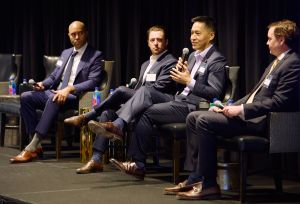
As DFW remains one of the best-positioned U.S. markets for long-term growth, some of commercial real estate’s biggest capital providers, developers and investors gathered in late April for Commercial Observer’s third annual Dallas Development and Investment Forum. There they discussed how the market has moved past the worst of the valuation reset with capital returning to the scene.
Panelists at the forum at the Santander Tower also said development is more difficult, but it’s not dead, and the Dallas-Fort Worth market shows consistent demand for housing, industrial, infrastructure and mixed-use development.
The first panel, “Capital Markets Update: Where Smart Capital Is Being Deployed,” featured Michael Hyun, chief investment officer at owner and investor Crow Holdings; Kris Lowe, vice chairman of debt and structured finance at CBRE; Adam Simon, managing director of real estate at KKR; and moderator R. Davis Powell, partner at law firm King & Spalding.
The panelists agreed that the market is no longer in free fall, but still early in recovery.
“There are lots of tailwinds right now in the commercial real estate market,” Powell said. “We’ve seen a bifurcated or K-shaped recovery, both within asset classes and across asset classes.”
Hyun described the industry as being in “the first or second innings” of a new cycle after several difficult years driven by inflation, higher interest rates and thin capital flows.
“It’s probably been the worst-performing sector for several years now, but I think you are starting to see that bottom,” Hyun said.
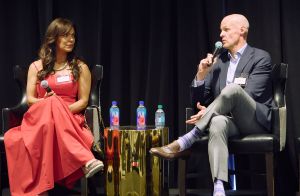
Simon said values had reset by roughly 20 to 40 percent depending on the sector, but “over the last 12 months, that valuation has clearly bottomed,” creating a better environment for lending and investment. Lowe pointed to broader liquidity as one of the clearest signs of improvement.
“It does feel like we have full participation once again, starting with the major money center banks, the regional banks,” Lowe said.
Major money center banks, regional banks, life companies, commercial mortgage-backed securities lenders and debt funds are all back in the market, he said, creating more competition and helping push transaction volume higher. Also, CBRE’s Dallas office is already seeing more broker opinion-of-value activity, and Lowe said 2026 closings are on pace to exceed 2025 if the current trend continues.
Hyun said “beds and sheds” remain durable — referring to residential and industrial — while the pullback in new construction could create a more balanced market three to five years from now. Rather than rhyming, Lowe went the alliteration route and said CBRE sees the most activity still in “living and logistics.”
Simon said KKR is still lending across asset classes when the real estate, sponsor and basis are right, citing recent Dallas-area loans tied to multifamily, industrial, office, hospitality and retail.

A second panel, “Distress and Opportunity: Strategies for Growing the Pipeline and Getting Deals Done,” featured Nadia Christian, partner at developer and investor Wolverine Interests, and Jon McAvoy, chief investment officer at PRP Real Assets. (Hunter Graul, partner and head of acquisitions at Platte Canyon Capital, was listed on the agenda but was unable to participate.)
McAvoy said the market may be moving beyond “distress” as the dominant theme, but is still offering opportunistic returns as assets built or delivered from 2022 to 2024 are repriced and recapitalized.
“The elephant in the room is equity,” he said of the return to previously out-of-favor sectors, including office. McAvoy said lenders are helping the market clear troubled deals through refinancings, debt funds, mezzanine capital and balance sheet lending.
Christian said Wolverine works with cities to solve problems around economics, design and community, and that municipal incentives can change how lenders and capital partners perceive risk. For example, her recent work in Arlington, a Dallas suburb, focuses on connecting underutilized sites to broader civic and university plans.
“Most of our impactful work has been with public-private partnerships,” she said.
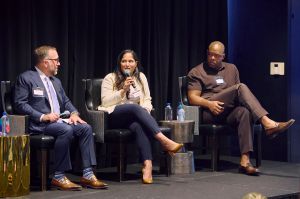
The final panel, “Finance and Investment Trends Defining 2026: Identifying the Leading Asset Classes and Navigating the New Capital Stack,” featured Andy Carmody, senior managing director of investments at single-family rental firm Tricon; Ted Norman, managing director of commercial real estate at First Citizens Bank; Edwin D. Tatum, CEO of TatumTek Modular Systems; Tisha Vaidya, co-founder and principal of Elizabeth Property Group; and moderator Tamela Thornton, executive director of ULI Dallas-Fort Worth.
Thornton framed the conversation around a market in which data centers remain the “darling” of DFW, while construction in other sectors has slowed and costs have risen.
“We’ve seen costs increasing by roughly about 45 percent from the pandemic, and we’re also starting to see some financing and policy uncertainty that are affecting feasibility,” Thornton said.
Norman said First Citizens is still focused on multifamily, particularly deals emerging from stressed capital stacks, recapitalizations and cash-in refinancings. He said the bank has tapped the brakes on speculative industrial, but still likes infill, shallow-bay industrial with mark-to-market rent upside.
Carmody said development remains difficult because equity can often earn similar returns in credit positions today: “Why would you put equity and new financing on a new development when you can lend to that development down the street and earn nearly the same return in a credit position?”
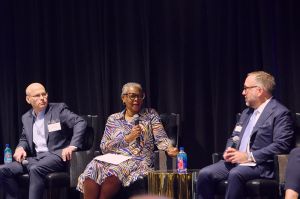
He also argued that Dallas and Texas remain among the best places in the country to build, acquire or work out real estate investments.
“If you can do it, you can do it in Dallas,” Carmody said. “You can do it in Texas.”
Vaidya said affordable housing operators are seeing equity partners focus more heavily on cash-on-cash returns rather than future value creation.
“More so now than ever, equity partners are really not willing to rely on that back-end value to prop up the IRR returns,” she said. “We’ve never really relied on cap rate compression, but even then, it’s just really not a believable story anymore.”
Tatum said modular construction is gaining traction as developers look for cost certainty, faster delivery and ways to make projects pencil despite higher construction costs. He said TatumTek has projects in Toronto, Dallas and Austin preparing to break ground, and developers are turning to modular when traditional construction cannot make the numbers work.
“They’ve been able to make the numbers work,” he said, “because of our ability to reduce cost as well as have cost certainty and deliver those projects with the velocity.”
Gregory Cornfield can be reached at gcornfield@commercialobserver.com.


