Debt Yields Rebound as Negative Leverage Persists Across CMBS
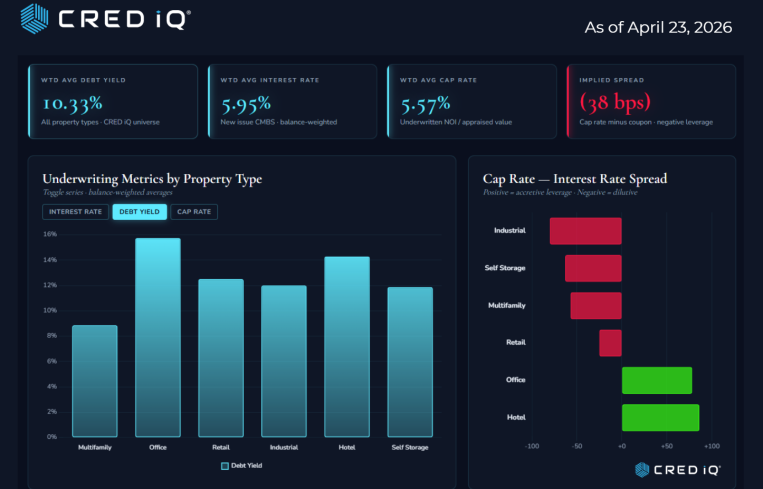
Debt yields on recently originated commercial mortgage-backed securities (CMBS) loans have firmed to a weighted average of 10.3 percent across property types, even as interest rates continue to exceed implied cap rates for multifamily, industrial, retail and self-storage assets — a condition known as negative leverage. CRED iQ’s proprietary analysis of approximately 3,700 loans totaling $94.7 billion in principal balance illustrates how lenders, borrowers and appraisers are repricing CRE credit in a higher-for-longer rate regime.
How do debt yields vary by CMBS property type?
Debt yield — underwritten net operating income (NOI) divided by loan balance — is the most critical cushion metric for CMBS bondholders because it normalizes for interest rate volatility. Office leads all property types at a balance-weighted 15.75 percent debt yield, reflecting lender insistence on substantial NOI coverage to absorb continued office leasing risk. Hotel follows at 14.3 percent, consistent with the sector’s traditional volatility premium. Retail (12.51 percent), industrial (12.01 percent), and self-storage (11.88 percent) cluster just below the teens, while multifamily prints at 8.87 percent — the lowest of the group, reflecting both agency-dominant execution and tighter proceeds discipline.
What are current CMBS interest rates by asset class?
Balance-weighted note rates range from 5.8 percent on office and 5.85 percent on multifamily to 7.33 percent on hotel loans. The 150 basis point (bp) gap between multifamily and hotel pricing reflects the market’s risk-based tiering: stabilized multifamily collateral, particularly within Freddie Mac K series and conduit execution, continues to benefit from the most favorable pricing. Retail, industrial, and self-storage loans price in a narrow 6.06 percent to 6.19 percent band, sitting between the multifamily floor and hotel ceiling.
Why does negative leverage matter?
Four of six property types show balance-weighted cap rates below their loan coupons: multifamily (minus-57 bps), retail (minus-25 bps), industrial (minus-80 bps) and self-storage (minus-63 bps). Only office (plus 78 bps) and hotel (plus 86 bps) offer positive leverage. Negative leverage means new acquisitions cannot be financed accretively without underwriting NOI growth or near-term refinancing relief. Industrial’s negative spread is particularly notable — strong demand fundamentals have kept cap rates at 5.35 percent, while loan coupons at 6.15 percent reflect Treasury-driven all-in costs.
What do cap rates reveal about CRE valuations?
Implied cap rates derived from underwritten NOI divided by appraised value average 5.57 percent across the dataset. Hotel leads at 8.19 percent, followed by office at 6.58 percent, retail at 5.81 percent, self-storage at 5.57 percent, industrial at 5.35 percent, and multifamily at 5.27 percent. The narrow 8-bp dispersion between multifamily and industrial suggests appraisers continue to treat institutional-quality rental residential and warehouse product as near substitutes from a valuation standpoint, even as financing costs diverge sharply by asset class.
CRED iQ’s loan-level analysis confirms debt yield discipline has been restored across CMBS conduit and agency underwriting in 2025. Negative leverage, however, remains the dominant market condition, signaling that most originations are being underwritten on forward NOI growth and eventual refinancing relief rather than accretive day-one economics. Until cap rates re-rate higher or the yield curve shifts meaningfully lower, property-level cash-on-cash returns at origination will continue to lag pre-2022 benchmarks for all but the most specialized asset types
.Mike Haas is the founder and CEO of CRED iQ