Too Big to Burn: L.A. Takes Harder Look at Megawarehouses After Cold Storage Fire
The Lineage blaze in Boyle Heights, and its $100 million cleanup, are fueling concerns over large, automated industrial facilities near homes and other sensitive sites
By Patrick Sisson August 11, 2026 1:15 pm
reprints
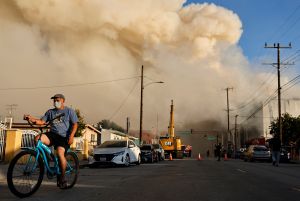
The smells still coming from the husk of the Lineage Cold Storage warehouse, which caught fire in the Boyle Heights neighborhood of Los Angeles on June 17, defy common description.
Nearly 4,000 odor complaints have been lodged with the South Coast Air Quality Management District (SCAQMD), with various descriptions of the putrid smell of rotting meat and other food. During a SCAQMD hearing in August, L.A. Mayor Karen Bass said “the putrid offensive odor coming from the tens of millions of pounds of rotting food in the warehouse is unbearable. … Now flies, rats and other pests have infested the community.”
In addition to picking up the funky scent, local leaders are also starting to express significant concern and unease around these projects, and their location adjacent to residential neighborhoods.
When Lineage submitted plans to rebuild the half-million-square-foot building in late July, it led to outcry from L.A. leaders. In that same SCAQMD statement, Mayor Bass, who issued an emergency executive order placing a hold on rebuilding until cleanup is complete, urged the SCAQMD to hold Lineage “accountable to the maximum extent of the law. That includes fines, effective mitigation, and a complete and thorough cleanup,” including “maximum penalties for the ongoing air quality violations, including maximum financial fines.”
Councilmember Ysabel Jurado has advocated for a suite of environmental justice ordinances in wake of the fire, including an ordinance that would prohibit locating new cold storage warehouses anywhere near school, daycares and other sensitive sites.
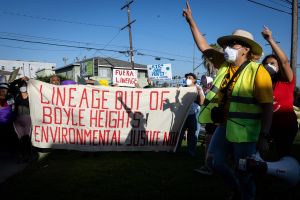
“I’ve said from the beginning that I have no intention of supporting the rebuilding of this facility while this public health crisis continues,” said Jurado in a statement.
The conflagration and highly contested cleanup of the Lineage cold storage facility in Los Angeles — a remediation process the company expects will cost up to $100 million — has underscored the new risk awareness around industrial real estate. An analysis by Zurich Insurance Group found that “a ‘too-tall, too dense’ approach to commercial warehouse storage is increasing the size and severity of fires and with it, the risk to lives and property.”
“When you introduce these bigger warehouses, the impacts grow,” said Susan Phillips, a professor of environmental analysis at Pitzer College who studies warehouses. “Fire should absolutely be considered as something that can have just tremendously negative impacts on surrounding communities and the environment.”
Community backlash has been heating up in recent months beyond just Lineage, or asset groups limited to cold storage. Data centers, of course, have become a flashpoint in local politics around the country and the coming midterm elections, and garnered exceptional community pushback. According to data obtained from climate newsletter Heatmap, at least 20 proposed data centers were cancelled after resident outcry in the first three months of 2026, a record amount of cancellations that impacted $41.7 billion in potential investment.
But accidents at other types of industrial buildings have brought more and more scrutiny to different property types. Between 2020 and 2024, more than 1,500 warehouse fires have started each year in the United States, per a February report from the National Fire Protection Association, resulting in an average of two deaths and 17 injuries. NFPA data shows the actual number of warehouse fires every year has declined since the ‘80s, but the fires that do occur tend to be bigger and cause more damage; losses have been averaging $200 million annually in recent years, and are trending upwards.
Features common with larger, modern warehouses — more diverse stores of goods, larger automated warehouse floors, a greater prevalence of lithium-ion batteries, even large banks of solar panels — can “keep local fire department officials up at night,” according to a NFPA brief.
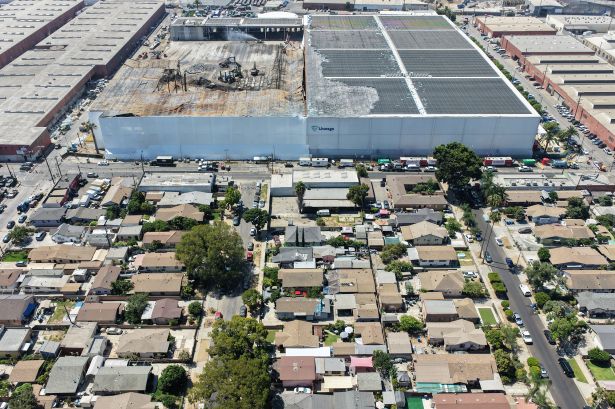
Lineage neglected an opportunity to respond to this story, instead directing Commercial Observer to its website and daily press statements detailing its cleanup progress (as of August 11, 90 percent of the food waste has been removed). A CBS investigation found there have been 63 fires at Lineage sites over the last decade, and a number of lawsuits have been filed in recent weeks.
When asked about the increasingly negative perception of some of these massive industrial buildings, and how potential pushback from locals and wariness from local government may impact the industry, NAIOP provided a statement.
“Across the industrial real estate industry, facilities are designed, built and operated under comprehensive federal, state and local safety standards,” Tim Jemal, CEO of NAIOP Southern California and the Supply Chain Federation, said in a statement. “We are committed to working collaboratively with city and county officials, regulatory agencies and public safety partners to continue strengthening community safety while keeping the food, medicine and essential goods Californians depend on moving every day — an industry that supports nearly 2 million jobs and generates approximately $23 billion in local tax revenue.”
Over the last five years, many new industrial sites — especially during the pandemic-era boom in warehouse construction — have become larger, more automated, and often closer to residential areas. The Lineage site on South Los Palos Street is just 100 feet from single-family homes. CBRE research found that the average warehouse size had increased 25 percent between 2012 and 2022.
“Basically, the bigger warehouses are now cannibalizing the smaller warehouses,” said Phillips. “They want everybody to migrate to bigger warehouses because they can be automated and be so much more cost effective.”
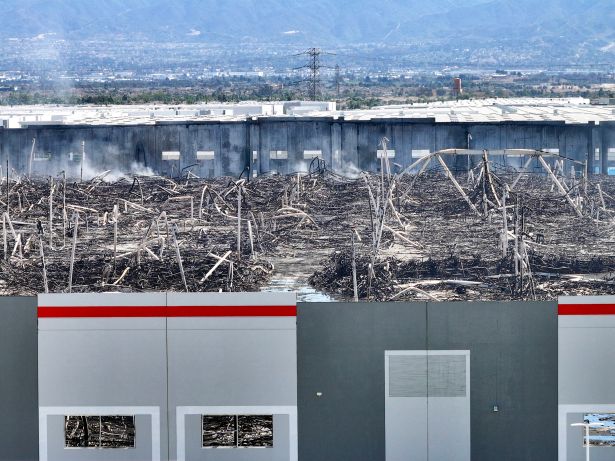
A number of high-profile incidents, both in Southern California and across the nation, have galvanized attention around warehouse safety. In April, a 1.8 million-square-foot Kimberly Clark warehouse in Southern California burned in what authorities suspect was arson. In June, the Medline warehouse in Tracy, Calif., burned through a 1 million-square-foot medical supply warehouse. In January 2025, California’s Moss Landing battery energy storage site went up in flames, and a May 2025 fire at a mattress warehouse in West Baltimore required 200 firefighters, disrupted train service, and required officials to move dozens of residents to temporary housing. The year before that, another Lineage cold storage site in Finley, Wash., in 2024 burned for two months, and in 2022, a fire at a Plainfield, Ind., Walmart warehouse cost $500 million.
In addition to the size of these new warehouses, additional dangers have arisen from the way these structures are operated. Big logistics warehouses — increasingly likely to be automated and include higher rack systems to increase efficiency and fewer workers — end up having a higher density of materials and fewer people on hand during emergencies.
Cold storage sites such as Lineage are built with excessively strong walls and dividers, in part to insulate food at very low temperatures and increase energy efficiency. But that means if a blaze does break out — ammonia coolant systems can also become flammable — it can be challenging for firefighters to reach and mitigate the fire. While it seems counterintuitive, cold storage has real fire risks, including significant amounts of combustible goods and insulation, and thick insulated walls that hinder the ability of firefighters to contain fires.
Worries about warehouses, and more strident pushback from locals after the recent string of fires, comes as the larger warehouse industry is recovering from a supply glut. Cold storage specifically has seen spec construction and development pipelines slow down in recent years, though a recent Newmark report argues the downturn is over, and that there’s an increasing flight to quality among tenants seeking automation, energy efficiency and high-throughput capabilities.

Plus, overall leasing of large warehouse facilities has come back in recent months, according to Cushman & Wakefield data. Companies signed 146 leases nationwide for warehouses over half-a-million square feet in 2025, 31 percent more than 2024. In addition, warehouse construction has bounced back, hitting 305 million square feet under construction as of the second quarter of this year, up 18 percent from 2025.
There’s no sign as of yet that these concerns around safety and the impact on neighboring communities has led to a raft of new regulations or development slowdowns. But sentiment is clearly shifting, and where that goes is uncertain at best.
“What we need is a broader conversation about warehouses being in proximity to homes in the first place, and then, what it actually means to get your head around fire risk,” said Phillips. “How do you measure that again in your cost benefit analysis?”