Commercial Real Estate Finance Is Entering the Crypto Age
The virtual approach to currency — with its stablecoins and tokenization — is becoming more acceptable in the real estate business
By Brian Pascus June 30, 2026 6:30 am
reprints
Change is coming for the national banking system — and, by extension, commercial real estate finance — and it’s arriving through the innovations taking place across the nebulous world of cryptocurrencies, tokenization and stablecoins.
On June 4, Goldman Sachs announced it had formed a partnership with Apex Group, a global fund administrator founded in Bermuda, and Archax, a London-based digital asset platform, that will utilize Goldman’s customized blockchain platform to create a tokenized commercial real estate fund using cryptocurrency assets.
“This collaboration is another step in our journey towards furthering on-chain markets for digital assets,” said Mathew McDermott, global head of digital assets at Goldman Sachs, in a statement that accompanied the firm’s announcement.
The marriage of Goldman Sachs with international cryptocurrency platforms to tokenize its real estate investment funds follows moves by J.P. Morgan Chase, Bank of America, Wells Fargo and Citibank to open a shared tokenized deposit network in 2027, giving customers and clients the ability to convert their traditional bank deposits into digital tokens on the blockchain network.
The initiative is private and no funding figure has been disclosed, but J.P. Morgan’s digital token, JPM coin, which represents the bank’s dollar deposits in the cryptosphere, averages roughly $3 billion transactions per day.
If this sounds like the biggest banks are hedging their bets on the future of cryptocurrencies and blockchain payments, well, that might be an accurate assessment.
“Smaller players always experiment around making money in finance that hasn’t already been tried,” said Robert Hockett, professor of law and financial regulation at Cornell Law School. “Once it looks like it’s got staying power and will continue to attract those with more money than they know what to do with, that’s when we see Goldman and the investment banks accept cryptocurrency.”
While millions of global users for the last 17 years have utilized cryptocurrencies like bitcoin and ethereum to facilitate peer-to-peer transactions on a decentralized, mathematically encrypted blockchain ledger — bypassing banks and traditional clearinghouses along the way — the growth of commercial real estate tokenization funds is a relatively new phenomenon.
Tokenization — turning traditional financial investments like stocks, bonds, funds and shares of commercial real estate assets into cryptocurrency tokens on the blockchain network — is expected to grow considerably in the coming years, which explains why Goldman and Wall Street’s other usual suspects appear to be preparing for their own tokenized funds and deposit base.
The Deloitte Center for Financial Services estimates that tokenized commercial real estate will increase from less than $300 billion in transactions in 2024 to $4 trillion by 2035.
“Tokenization really is a way of selling ownership of real estate in a digital format versus the way we’ve been doing it historically,” said Shlomi Ronen, managing principal and founder of Dekel Capital. “It’s either through investment in an entity where there’s deeds or [a passive real estate ownership structure], but eventually tokenization becomes a way for us to perfect ownership by essentially modernizing title.”
The main reason tokenization has gone mainstream, however, goes well beyond deeds and modernized titles. The technology is now affecting the world of commercial real estate finance, and the highest levels of U.S. banking, because of the growing acceptance, use and understanding of stablecoins across the financial spectrum.
Stablecoins — as opposed to bitcoin or some of their peer tokens — are the lifeblood of cryptocurrency financial transactions, and therefore tokenization.
Because the price of individual cryptocurrencies like bitcoin and ethereum fluctuate so wildly with demand, stablecoins were developed as a cash management tool to serve as collateral for cryptocurrency loans and transactions. They are digital coins pegged to a stable reference value of real-world assets, like dollars and euros, outside of the cryptocurrency universe.
“Stablecoins have been pitched as a payment mechanism, and the idea was that people would use these for payments,” said Hilary Allen, a law professor at American University Washington College of Law, who defined them as “the poker chips in the crypto casino.”
In another analogy, Matthew Bisanz, partner at Mayer Brown in Washington, D.C., compared stablecoins to gift cards, in that, like any gift card, you are able to make purchases and complete transactions because the card is exchanged for a defined real-world dollar value.
Per U.S. law, any issuer of stablecoins must hold $1 of liquid assets — usually U.S. Treasury securities — for every $1 of stablecoins they distribute onto the blockchain, but there is no limit to how many stablecoins can circulate and who can ultimately issue them, nor are stablecoins insured, as bank deposits are, by the FDIC.
Cornell’s Hockett argued that stablecoins are not anything new, despite their highfalutin reputation in tech circles. Money market shares essentially do the same thing, without the crypto universe confusion, as one share in an account is worth exactly $1, and, as accounts grow in value, shares are added to an investor’s holdings to ensure parity.
“The whole point of stablecoins is to use that crypto asset in the same way you’d use a dollar, but what value does this add?” asked Hockett. “We already have a dollar, the dollar is the ultimate stablecoin, and the dollar’s value is already guaranteed by the Federal Reserve.”
Putting aside the actual utility of stablecoins, which remains open for debate, the federal government is now big believers in them.
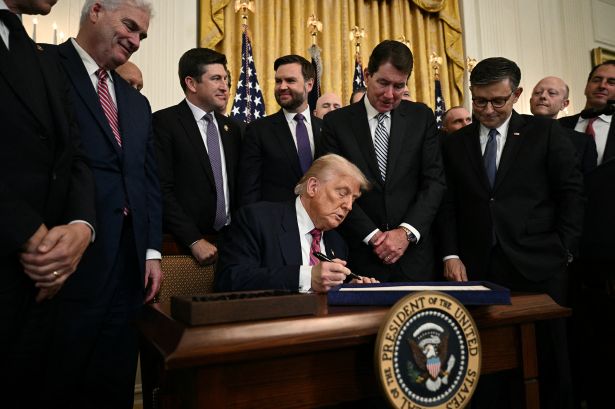
While the predilections of President Trump and his family toward cryptocurrencies are well known (according to Reuters, the Trump family has made $2.3 billion in crypto transactions), Congress has already passed one law, and is considering a second piece of legislation, that will integrate stablecoins into the nervous system of U.S. banking and finance, and impact the future of commercial real estate.
Mr. Crypto goes to Washington
In July 2025, Congress passed, and Trump signed, the Guiding and Establishing National Innovation for U.S. Stablecoins (GENIUS) Act, a bipartisan measure that created a new regulatory framework for dollar-backed payments in stablecoins — but one that left open enough questions and loopholes that the U.S. Senate is now debating the Digital Asset Market Clarity Act after the House of Representatives passed the legislation in July 2025 in a bipartisan 294-134 vote.
“The GENIUS Act was really focused primarily on stablecoins, whereas the Clarity Act is trying to lay out who has what responsibilities to regulate cryptocurrency,” said Lawrence White, professor of economics at New York University’s Stern School of Business.
“When you think of banks, you think of securities, and that’s the Securities and Exchange Commission’s (SEC) jurisdiction, and when you think of options and futures, that’s the Commodities and Futures Trade Commission’s (CFTC) responsibility, but there isn’t a crypto regulatory agency,” he added. “Crypto is an alternative currency, except it really doesn’t function as a currency. It’s a means of a payment that doesn’t rely on a central trusted party [like banks].”
While it’s unclear whether the SEC or CFTC will ultimately regulate cryptocurrencies, Molly White, an independent crypto researcher, argued that the Clarity Act would define most crypto assets as commodities and make the CFTC the primary regulator of the crypto industry rather than the SEC, an agency widely viewed as being the more hostile of the two regulators.
“The push to regulate crypto through GENIUS and Clarity is more of a deregulatory push,” she said. “These bills essentially carve out exemptions for crypto assets from long-standing financial regulations that have existed since the 1930s, and they don’t offer additional protection or transparency to investors.”
Warren Kornfeld, senior vice president of Moody’s Investors Service, said that the largest outstanding item surrounding stablecoins revolves around what sort of financial remuneration can be provided to a holder of a stablecoin.
While the GENIUS Act prohibits an issuer of stablecoins, such as Circle or Tether, from paying financial incentives like interest payments or yields on deposits, the legislation is unclear whether cryptocurrency exchanges and broker-dealers can pay financial compensation for holding stablecoins.
“So, for instance, Circle is an issuer, and, if you’re holding stablecoins at Coinbase, then Coinbase might provide rewards as it does for certain holders for stablecoins,” said Kornfeld, who noted that the GENIUS Act is silent on such an arrangement, thus creating deposit-like arrangements.
“Some of the language has been somewhat vague, and it will still be determined as to how the rules are drafted and how the courts will view different types of arrangements,” he emphasized.
Professor Allen argued that the fatal flaw in the two pieces of legislation lies in the Pandora’s box that the GENIUS Act opened for the entire financial system.
“It’s really a terrible law drafted by the industry and for the industry because it doesn’t recognize any fragilities of the stablecoin business model that make them susceptible to runs,” she said. “It opens the door to tech companies to accept deposits, killing the separation of banking and commerce, as Meta or Amazon could soon issue stablecoins.”
If this sounds controversial, and even a bit dangerous (cue the Global Financial Crisis redux fears in the back of everyone’s mind), then get ready for the banking industry’s view. Because no one has pushed back on these two pieces of legislation more than the banking lobby, including the most notable banker in the country, J.P. Morgan’s Jamie Dimon.
Not on my watch
Dimon is not a man to mince words.
During a May 29 interview at the Reagan National Economic Forum in Washington, J.P. Morgan Chase’s longtime CEO said that the banking industry “will not accept” the Clarity Act in its current form, and publicly attacked Coinbase CEO Brian Armstrong, who has been lobbying senators to pass the bill. Dimon said that Armstrong was “full of shit,” and vowed to unite the banking community against the legislation.
“The banks will not accept it that way,” Dimon said. “The ABA [American Bankers Association], the small banks, the credit unions. It’s not just the big guys.”

The heart of the issue lies in the loophole that allows broker-dealers like Coinbase to pay yield on stablecoin deposits. Moreover the legislation permits crypto firms to bypass existing anti-money laundering and Bank Secrecy Act rules, especially for unhosted digital wallets and decentralized finance (DeFi) developers, efficiently creating two sets of rules for crypto actors performing bank-link functions.
“Banks understand that there is a digital innovation in payment systems,” said Tomasz Piskorski, professor of real estate finance at Columbia Business School. “Stablecoin providers say, ‘Why keep money in the bank, when I can offer you 4 percent per year, and I’ll give you a coin to make payments in every store, and you can wire the money instantly?’”
“With Gen Z and millennials, this could over time become quite a viable alternative to banking,” he added.
The Bank Policy Institute (BPI), an industry advocacy group, has said as much themselves.
The BPI released a white paper in May 2026 that determined that introducing yield-bearing stablecoins will create “a nearly infinite sequence of transactions that play out over time,” influencing businesses and households to conduct some transactions with stablecoins, and fewer with deposits, leading to what one study anticipates to be a $2.7 trillion decline in lending and $3.7 trillion in destroyed deposits by 2030.
“Once the dust is settled and interest rates and balance sheets adjust, deposits will decline and so will bank lending,” wrote BPI analyst Bill Nelson. “Stablecoin issuers will grow and banks will shrink.”
Cornell’s Hockett, no stranger to banking history, called the existing loophole in the dueling crypto bills “significant,” and said, “the entities that buy and sell and administer these digital assets are going to be able to function as competitors to commercial banks when it comes to the transaction account businesses.”
One reason the banking industry is pushing back as hard as it can is due to the nasty memories of the last time innovations in yield-bearing accounts were introduced — that being in the late 1970s and early 1980s during the growth of money market mutual funds. Those came into existence as a reaction to regulation that limited the amount of interest commercial banks could pay on deposits.
“It’s clear banking suffered a substantial competitive loss with the rise of money market mutual funds, and I think they are seeing a similar phenomenon now,” said Lawrence White. “Jamie Dimon, J.P. Morgan and the major bank trade organizations must have some institutional memory and are seeing this rise of another set of institutions, and this new financial tool of stablecoins, as competitive with what they do.”
Not so stable
The question, of course, is what does this mean for financial markets, and therefore commercial real estate?
Hockett said that creating a potentially trillion-dollar stablecoin industry that can offer yield-like products and siphon deposits and take lending capability away from commercial banks is “dangerous as hell,” largely because the FDIC extended insurance coverage to money market mutual funds during the 2008 GFC, as regulators identified those accounts as a systemic threat.
Yield-bearing stablecoins “are a systematic threat to the entire payment system, and the entire commercial economy, because this is where people keep assets that allow them to buy and sell,” said Hockett. “Money market funds said, ‘You better insure us now or the entire economy goes down,’ and it’s happening again 20 years later with crypto, and that’s what Jamie Dimon is warning about.”
Molly White argued the country is setting itself up for “a financial catastrophe” with the current regulatory stance advanced by the GENIUS and Clarity acts, mainly due to the unprecedented amount of money crypto interests spent to support industry-friendly political candidates in the last election cycle.
Citizen.Org estimates crypto lobbies spent a record-breaking $245 million in the 2024 election.
“The crypto industry really bought a lot of the changes we’ve seen in the U.S. regulatory sphere … and the crypto industry is literally writing the rules and laws that are being debated in Congress right now,” she said. “The degree of integration we’re seeing between the crypto industry and the legislature is horrifying.”
Others take a more benign approach to the new legislation and its possible ramifications
“It’s negative, it will increase bank funding costs,” said Moody’s Kornfeld. “They’d have to raise non-deposit funding and either shrink their balance sheet or reduce the amount of lending, but it’s not an existential threat.”
Owen Lau, a senior analyst at fintech firm Clear Street, said he doesn’t buy the argument that more yield-bearing products like stablecoins will siphon deposits away from banks, mainly because money market mutual funds — which also pool money to purchase assets like U.S. Treasury bills and commercial paper — haven’t taken down commercial banking yet.
“If that argument is true, fundamentally, why has nothing happened for 40 years?” said Lau. “All these banks have gotten bigger and bigger as we now embrace money market mutual funds.”
On the contrary, NYU’s White argued that money market funds were an alternative place for depositors in savings and loan institutions to place their money, creating increased competition for S&Ls just when they started having trouble with their mortgage portfolios in the late 1980s.
“There was definitely a connection between the rise of money market funds in the late 1970s and the savings and loan debacle that followed in the late 1980s,” he said.
Dekel Capital’s Ronen said that evolution of cryptocurrency and banking reminds him when E-Trade emerged and threatened the traditional broker model of Merrill Lynch and others. But he also pointed out that stablecoin issuers are required to buy U.S. Treasurys, which would likely drive up the price of Treasurys and lower their yields.
“It could be accretive to commercial real estate investors and developers,” said Ronen. “There will be a massive demand driver for U.S. Treasurys, as they are the instruments of choice for cryptocurrency to use to back the currency [stablecoins] they’re printing.”
Columbia’s Piskorski was much more pessimistic, as he said that a sizable number of commercial banks are now at risk in a high interest rate environment, and that bank failures haven’t happened because depositors haven’t taken much money out these last four years.
“The competition from the stablecoins could force banks to pay higher rates on deposits, and that could reprice their business model,” he said. “As of now, the pressure on banks has been masked by the [effectively] 0 percent interest rate on deposits.”
White also turned to history, albeit more recent history, noting that the “crypto winter” of November 2022, which saw bitcoins lose 77 percent of their value and crypto firms like BlockFi and FTX collapse into bankruptcy, did not have much, if any, effect on the overall financial system. She said GENIUS and Clarity would “devastate” the firewalls that have been put in place for everyday Americans and compared the birth of stablecoins to mortgage-backed securities leading up to the 2008 financial crisis.
“That’s where we’re headed with a large-scale push to integrate crypto into the traditional finance system,” she said. “If things go bad in crypto, there’s less of a firewall than there once was, and that firewall is being eroded day by day.”
Others, like American University’s Allen, harkened back to an even darker time in modern finance, recalling the way easy regulatory policy and a speculation boom around nebulous securities products laid the groundwork for a financial apocalypse.
“What we’re doing if we pass these bills is we’re exempting crypto from banking laws and securities laws, thus allowing them to repeat all the mistakes our forefathers made leading up to the Great Depression,” she said.
“We had a huge boom in the stock market in the 1920s, as people bought and sold stocks and bonds that turned out to be worthless, with nothing behind them because of low barriers to entry,” Allen added. “And that sounds a lot like crypto.”
Brian Pascus can be reached at bpascus@commercialobserver.com.