

CMBS Distress Rate Could Reach 15% by Year End: CRED iQ
CRED iQ projects the overall distress rate for commercial mortgage-backed securities (CMBS) could reach 14.5 to 15 percent by December as persistent headwinds continue pressuring commercial real estate borrowers. This forecast assumes continued refinancing obstacles as loans mature into today’s higher rate environment, challenges persist in office and certain retail sectors, and near-term monetary policy relief remains limited.
The latest loan analytics data reveals a persistent upward trend in CRE distress that shows no signs of abating. The overall distress rate has climbed from 4.83 percent in July 2022 to 11.98 percent in January 2026 — a 148 percent increase over the 43-month period. This remarkable expansion reflects the compounding effects of monetary tightening, weakened property fundamentals, and a challenging refinancing environment that has left borrowers with increasingly limited options. This analysis includes all loans classified as CMBS conduit or single-asset, single-borrower (SASB).
The trajectory has been remarkably consistent despite periodic volatility. After peaking at 11.78 percent in August 2025, distress briefly moderated to 10.30 percent by April 2025 before resuming its ascent. This temporary relief proved fleeting as higher interest rates, refinancing challenges, and
property-specific headwinds reasserted pressure on borrowers. The subsequent reacceleration through year-end 2025 and into early 2026 suggests that underlying market conditions remain hostile to distressed borrowers seeking resolution.
Both delinquency and special servicing metrics contribute to the troubling picture. Delinquencies have surged from 2.93 percent to 9.4 percent, while specially serviced loans expanded from 4.47 percent to 11.1 percent. The parallel expansion across both categories indicates systemic stress rather than isolated portfolio management issues. This dual deterioration signals that problems are spreading beyond early-stage payment defaults into deeper workout situations requiring intensive special servicing intervention.
Special servicers are taking an increasingly aggressive posture toward distressed assets.
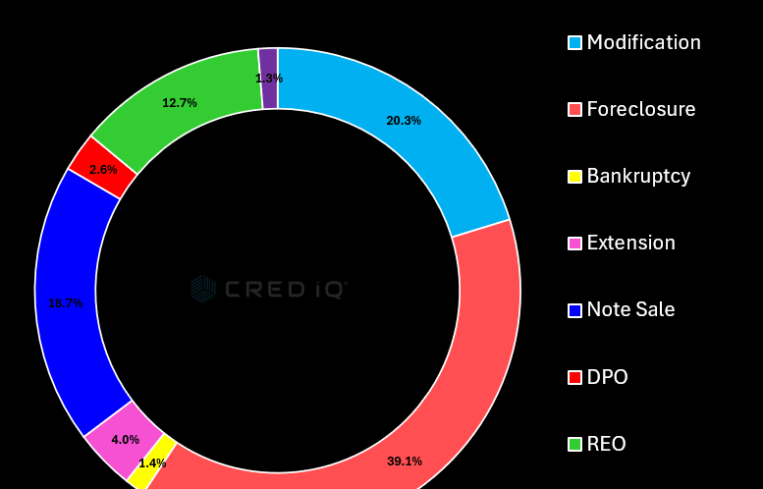
Among the $40.1 billion in specially serviced loans with defined workout strategies, foreclosure dominates at 39.1 percent ($15.7 billion), signaling that restructuring efforts have largely been exhausted. Note sales account for 18.7 percent ($7.5 billion), reflecting servicers’ preference for transferring risk to distressed debt investors rather than managing prolonged workouts.
Loan modifications represent just 20.3 percent ($8.1 billion) — suggesting limited appetite for collaborative restructuring solutions. REO properties comprise 12.7 percent ($5.1 billion), reflecting completed foreclosures where lenders have taken title. The prevalence of liquidation-focused strategies over collaborative solutions underscores servicers’ belief that many troubled assets cannot be salvaged under current market conditions.
Mike Haas is the founder and CEO of CRED iQ.


