The Real Talk About 4Q12
The overall vacancy rate for metro New York City closed out 2012 at 12.2 percent, equal to the third-quarter 2012 figure.
But first, the bad news. Read More

The overall vacancy rate for metro New York City closed out 2012 at 12.2 percent, equal to the third-quarter 2012 figure.
But first, the bad news. Read More

Ahhh—the hustle and bustle of the Grand Central submarket.
It has it all: a spectacular train station with its shops, bars, restaurants and food hall (oh, and actual trains, too), a fantastic location within walking distance of everything from Times Square to Central Park (and you can always take the subway if you’re lazy) and a thriving commercial office market consisting of almost 59 million square feet of inventory (though only 27 percent of that is considered Class A).
But all there isn’t absolutely perfect—something about those wonderful buildings getting a bit long in the tooth, maybe? After all, it’s not really the Mad Men days of yore, and the building stock (average age: 72 years) doesn’t necessarily work for all those companies looking for wide-open floorplates and glass from floor to ceiling. That’s the reason a number of government and private-sector movers and shakers have decided to, well, shake things up by looking to upzone a large swath of the area. Read More

Talk about a nice round number—50!
Well, maybe not so nice, as 50 is the total number of Midtown Manhattan buildings with at least 100,000 square feet of (mostly) contiguous availability. (I say “mostly” because, in some cases, there are two large chunks within a building that can be put together to equal more than 100,000 square feet.) Read More

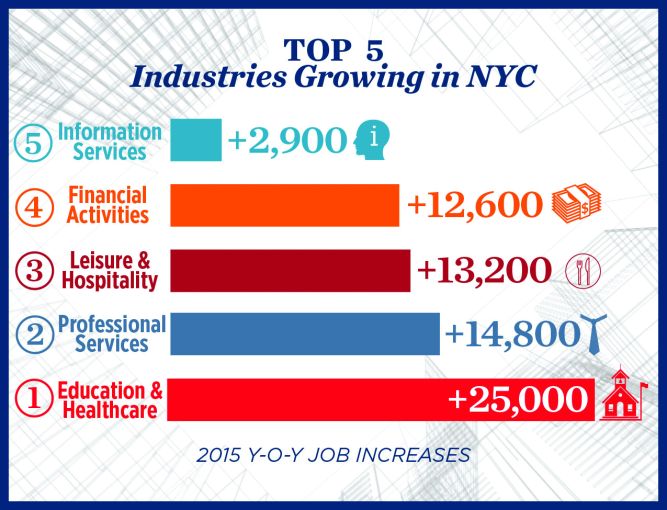
New York City has been whipped around over the past couple of months, and though the number of jobs has declined since August, the naked city is still near a record-high figure of 3,887,100 jobs as of the end of October.
Health services remains the largest industry by employment, with 601,600 positions, or 16 percent of the total jobs. That just beats out trade, transport and utilities with 15 percent (thank those retail workers for that), and government (certain to remain in the top three despite all of the fiscal cliff talk) with 14 percent. The biggest gainer in terms of absolute numbers has been leisure and hospitality which has added more than 100,000 positions in the past 10 years alone. Read More

Net absorption (net change in occupied space) wrapped up the first 10 months of 2012 at a little more than 1.6 million square feet.
It could be worse … but it could also be better.
This year, firms haven’t been expanding in or relocating to Manhattan at the same speed they did even in 2010 and 2011. And unless some growth explosion happens over November and December, this will be the worst year for absorption since the sharply negative 2009. Read More

After easing in both of the previous two months from its 2012 high of 10.4 million square feet in July, overall sublet availability reversed course to close October at just over 9.8 million square feet. Interestingly, this is almost exactly the monthly average, going back nearly 21 years, of just under 9.9 million square feet.
Though there has been talk of Sandy-displaced Downtown firms taking at least some of the “plug-and-play” sublet space available in Midtown, it likely will not make much of a dent in the figure. At this point, many tenants with multiple offices are finding a way to desk-share at another location or work from home. Read More

Will the Midtown light shine brighter (it has been rather dim lately) since it escaped much of the wrath of post-tropical storm Sandy?
The jury, of course, is still out, but let’s review the facts: flooding and power outage issues continue in the southern third of Manhattan, but I most definitely think this part of the borough will come back. Read More

With the election next week, we thought it was a great time to (very briefly) look at a 20-year time span (which will soon include a total of six presidential elections) in the context of the Manhattan commercial real estate market. Where did the market stand at the time of each election, and what occurred under the stewardship of each president? Real estate cause and effect appears, for the most part, much more local, and doesn’t have a close relationship with the person or party in the highest office. Nevertheless, elections are great reference points.
After the jump, each of our last five elections is listed, showing the overall vacancy rate and asking rent in Manhattan, ending with where we stand today, exactly one week before the next election.
Read More

The overall Downtown vacancy rate—as it stands today, right now, this very moment—is 10.3 percent. If one were to take that 10.3 percent (FYI: it topped 20 percent in the mid-1990s and 15 percent in the early 2000s), the judgment would likely be that Downtown is back and better than ever, given the more vibrant nature of its existence (more housing, retail, cultural venues, much-improved transportation, etc.).
But there is one humongous reality to face, and that would be some seriously large empty office space about to slide into the vacancy rate figure. This is not exactly a surprise, as much of it has been advertised for months now. By our calculation, there are 21 buildings with at least 100,000 square feet of current or future availability being marketed. Read More

44.6 percent—that’s the percentage of leasing transactions (by square footage) that were in the tech/advertising/media/information (TAMI) fields in Midtown South during the year to date.
The average size of those TAMI deals was rather small, at just over 26,000 square feet, and ranged from leases such as Havas, with 226,000 square feet, down to Speed Media, with just under 2,000 square feet. But we think TAMI has legs in Midtown South, due to the variety of firms taking space—it’s not just one particular segment of these creative fields. Read More

Given all the trauma going on globally, nationally and even locally, the third-quarter New York City metro-wide vacancy rate ended up not so bad.
The total figure (for all classes) closed September at 12.2 percent, down 20 basis points. That figure is based on a whopping 733.1 million square feet of inventory (with just over 89.3 million square feet of availability) across the Cassidy Turley local tracking area. Read More

The Midtown Class A average asking rent, defying a rather weak leasing market, jumped 2.4 percent in the third quarter to close at $76.75 per square foot and is now at its highest since attaining $80.70 per square foot in January 2009.
It has risen in each of the three quarters thus far in 2012 and is up 8.3 percent year-to-date. Furthermore, each of the five Midtown submarkets has seen a rise this year (some quite substantially). Read More

Before digging into the latest jobs numbers for New York City, let’s pause for a comment on the ongoing controversy regarding the unemployment rate in both the city and the state. Very briefly—the household survey, used to calculate the unemployment rate, is believed by a number of government officials and economists to be flawed.
This is primarily because it is a much smaller sample within a potentially inaccurate model, as opposed to the larger payroll survey derived from employers. It remains to be seen when this issue will be resolved, but for now, let’s talk more about the latest (and more reliable) payroll survey. Read More

The Plaza Class A vacancy rate closed August at 13 percent–the highest vacancy rate of the 14 Manhattan submarkets. It climbed 120 basis points last month alone, thanks to a new 492,000-square-foot chunk of space now available on a direct basis at the Kushner Companies- and Vornado Realty Trust-owned 666 Fifth Avenue. Read More

Despite recent challenges in our quaint local market of Manhattan, the average asking rent has generally continued on an upward trajectory since the recent recession. Part of this has to do with red-hot Midtown South and its rising prices, and part of it has to do with Midtown and space generally being leased at the lower end of the range while some of the higher-priced product languishes (i.e., a bit of a statistical anomaly).
Even Downtown will likely soon see a sharper increase when higher-priced space at World Trade Center is included in the formula within the next year. And compared to other markets around the country, Manhattan far outweighs the competition. Read More
Affordable Housing or Lack Thereof