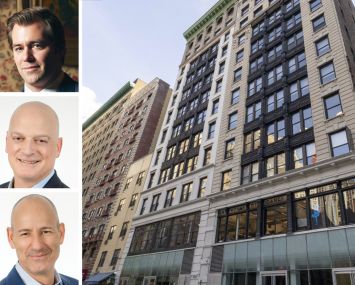
Lord & Taylor’s cachet helped Broadway north of Union Square to develop into a retail destination. Within its first three days, more than 10,000 people rode the store’s steam-powered elevators, then a novelty. Selling men’s and women’s clothing, carpeting and cloth, Lord & Taylor also pioneered new concepts, such as merchandising (the store had the first Christmas display windows). The company took over neighboring 893 Broadway in 1907, when Morrison & Son, another dry goods company, moved uptown, altering the ground-floor storefront on Broadway to match its adjoining building at 895-901 Broadway.
But the retailer had built a small kingdom destined to decay. In 1915, Lord & Taylor departed to its current location, at 38th and Fifth Avenue, following the inevitable flow of retail further uptown. After their departure, both 893 and 901 Broadway were used for manufacturing and fell into obscurity for the better part of the century.
With its mansard roof and intricately ornamental exterior, 901 Broadway was an obvious candidate for landmark status, which it received in 1977. But by 1987, it was the focus of a Times piece highlighting the lack of financial incentives for owners of landmarked buildings to continue their sometimes very expensive upkeep. “Almost by definition, a landmark incorporates craftsmanship and features that are exceedingly difficult to replicate. Consequently, the cost of historically accurate repair work can be staggering.” The owner at the time, Saul Gordon, was letting the building decline rather than hire highly skilled labor. The millions it would cost to restore “would be out of sync with the building’s limited economic potential as a 118-year-old loft building.”
But the tide turned for that area, unquestionably. By 1995, new owner Darius Sakhai was replacing the storefronts and restoring the building’s upper facade. At the time, the building was occupied only by a nightclub on the ground floor.
The developer of Coney Island fame, Joseph Sitt, acquired 901 Broadway in 2006 for $17.375 million through his Thor Equities. In a quiet and surprising transaction in the late summer of 2009, Mr. Sitt sold it to a Spanish businessman, a mysterious self-described “industrialist,” for nearly $25 million, according to The Real Deal. That put the sale at $1,715 per square foot, a staggeringly high price for investment sales in post-Lehman Manhattan. The new owner has not been named, but he paid all cash in a deal that may very well encapsulate a Great Recession trend: first-time foreign buyers picking up New York City buildings with no mortgage.
And 901 Broadway is enjoying renewed retail cachet, despite its dark period in the middle of the 20th century. The ground floor is now occupied by trendy women’s clothing retailer Miss Sixty, with the next three floors rented by a gallery. The fifth floor penthouse remains available. Retail asking rents in the Flatiron area, according to CB Richard Ellis’ latest report, average $276 per square foot annually.
gvoien@observer.com